
 Sommaya Singh
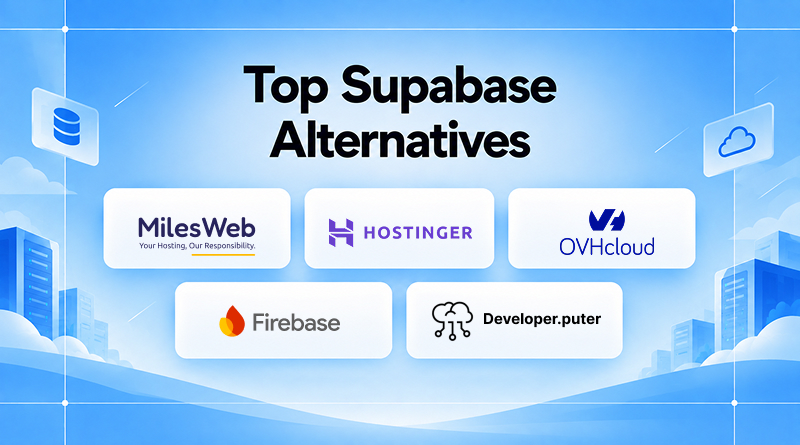
Supabase is an open-source backend platform built on PostgreSQL that gives you flexibility. But it’s not the right fit for every team. Some teams need flexible pricing, some need a specific database engine and some want to avoid lock-in with a single vendor.
Major trade-offs are price jumps, managing complex functionalities and tedious backend projects in minutes. Best Supabase alternatives for each category: BaaS (Backend-as-a-Service) platforms, self-hosted options, cloud providers, and light-weight databases. Scroll down and find the right option as per your requirement.
Table of Content
What is Supabase?
Supabase is an open-source Firebase alternative backend-as-a-service platform. It gives you all the backend services you need like databases, authentication, file storage, and real-time APIs without having to build or maintain your own infrastructure.
Unlike Firebase, which uses a NoSQL database, Supabase is built entirely on top of PostgreSQL, an enterprise-grade relational database.
Why Look for Supabase Alternatives?
Multi-Region and Advanced Scaling: Supabase’s managed platform lacks the specific multi-region database routing or high-availability configuration needed by enterprise global deployments.
Complex Authorization Limits: Supabase Auth relies heavily on Row Level Security (RLS) policies, which becomes difficult to maintain and scale when authorization logic expands into complex, fine-grained cross-service governance.
NoSQL or GraphQL Preferences: Supabase is strictly relational PostgreSQL. Projects required either a NoSQL document store or a native GraphQL-first architecture.
Self-Hosting and Data Sovereignty: Supabase is open source, however the multi-container stack can be operationally intensive to self-host on a private cloud infrastructure, pushing teams toward simpler self-hosted options such as Appwrite or PocketBase.
Best Supabase Alternatives





1. MilesWeb

MilesWeb is a practical Supabase alternative for teams demanding backend infrastructure without getting locked into a single managed platform. Supabase bundles PostgreSQL, storage, and edge functions into one opinionated stack. We allow developers to assemble a comparable setup on their terms, spinning up managed PostgreSQL or MySQL databases paired with VPS hosting infrastructure.
The key differentiator is cost predictability and support. Supabase’s free and Pro tiers scale unpredictably once the project scales. In contrast, MilesWeb’s hosting and database plans offer fixed billing with no surcharges, along with 24/7 expert-backed support.
Key Features
- Instant deployment
- Optimized with AMD EPYC processors
- 24/7 Supabase expert support
- Multiple Linux and Windows OS
2. Hostinger
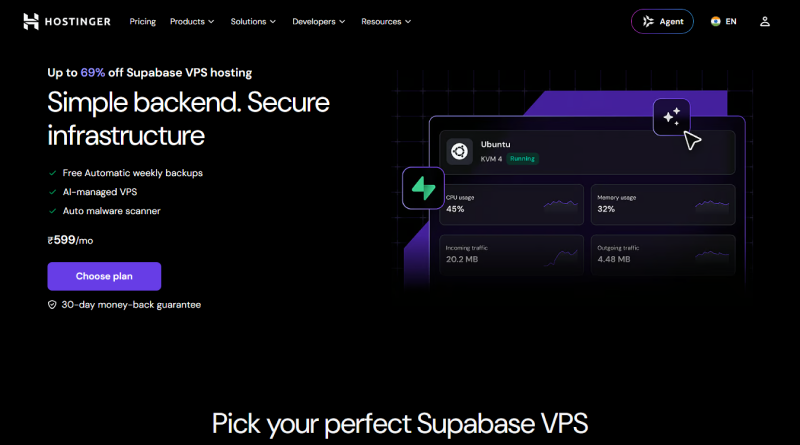
Hostinger’s real edge as a Supabase alternative is that it’s one of the cheapest ways to run Supabase yourself, not just something “Supabase-like.” Because Supabase is open-source, Hostinger’s KVM-based VPS plans (with one-click Docker support) let you self-host the entire Supabase stack, Postgres, GoTrue for auth, PostgREST, and Realtime Storage on infrastructure that costs a fraction of Supabase’s Pro tier.
Key Features
- Generous bandwidth
- Predictable pricing
- Dedicated resources
- Full root access
- Docker support
3. OVHcloud
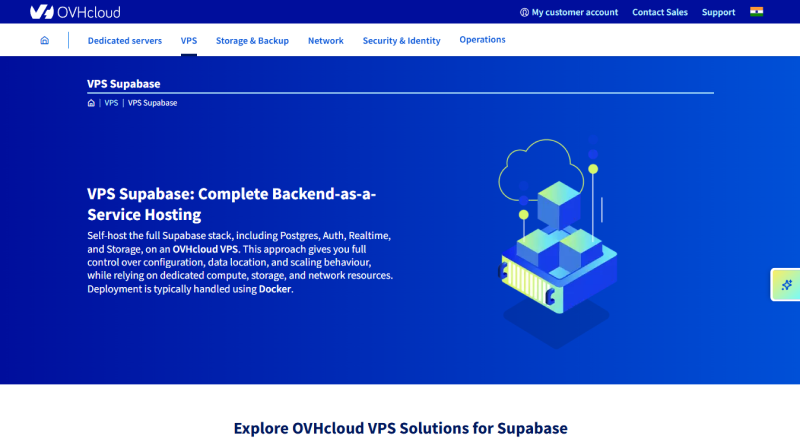
OVHcloud’s approach as a Supabase alternative is fundamentally different from that of Hostinger or MilesWeb. It aims at teams demanding enterprise-grade infrastructure and data sovereignty instead of cheap computing. The Supabase alternative offers managed database services (public cloud databases for PostgreSQL, MySQL, and more) alongside VPS. You can pair a managed Postgres instance with OVHcloud’s storage and a self-hosted containerized API layer where you get a Supabase-equivalent stack compliant with GDPR guidelines.
Key Features
- No API request limits
- Resource-constrained performance
- Full-stack deployment
- Real-time scaling
- Data sovereignty
4. Puter.js
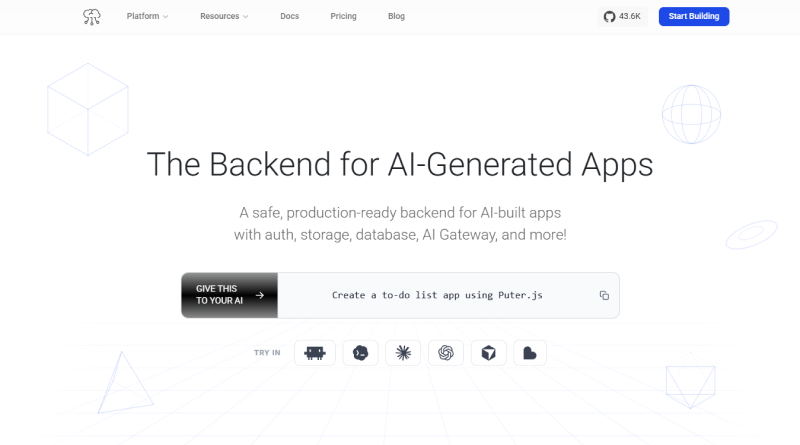
Puter.js eliminates the traditional backend management approach using a frontend-first architecture. Puter.js serves as a Supabase alternative, fundamentally shifting the management of application state and infrastructure. It uses a client-side JavaScript SDK that eliminates the backend by utilizing a unique “user pays” architecture where the user’s browsers securely interact with their cloud space. Furthermore, it integrates built-in AI gateways providing native, keyless frontend access to over 500 LLM models, making it an easier task than Supabase.
Key Features
- Serverless key-value database
- Cloud & object storage
- Static site hosting
- User-pays model
- Built-in AI integration
5. Firebase
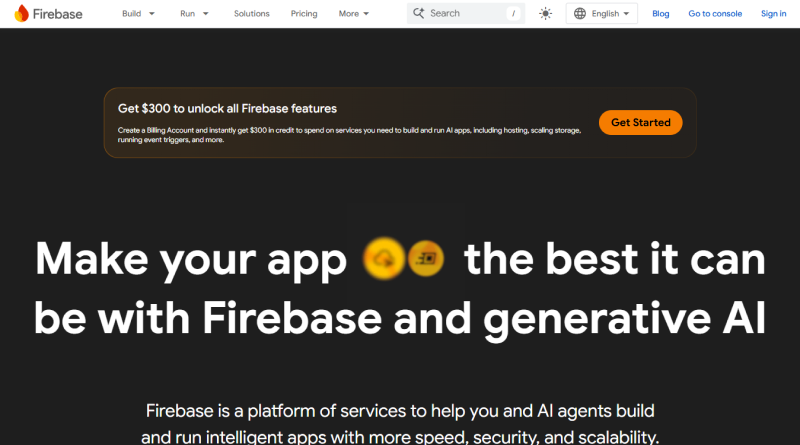
Firebase is a proprietary NoSQL BaaS. Supabase is an open-source relational database platform built on top of PostgreSQL. The platform, built on Google, offers developers pre-packaged backend services to develop web and mobile apps without the hassle of managing physical servers. Firebase is a Google offering and plays well with Google Cloud. It is a comprehensive suite of built-in tools far beyond database management that include native push notifications (FCM), Google Analytics, Crashlytics (crash reporting tool), and machine learning capabilities.
Key Features
- Realtime subscriptions
- Built-in vector search
- Edge functions
- Row-level security
- Open source & self-hosting
Supabase vs. Alternatives: Which One to Choose?
Choose MilesWeb if:
- You need your own VPS with custom configuration, not a managed BaaS.
- You want full root access to customize the database, auth, and storage layers individually.
- You want NVMe SSD-backed hosting with predictable, fixed pricing, not usage-based billing.
- Your team has the technical capacity to assemble and maintain its backend stack.
Choose Hostinger if:
- You need the lowest-cost way to self-host an actual Supabase stack through Docker/VPS.
- You are deploying a small-to-mid-scale app and don’t need enterprise SLAs.
- You prefer a simple, beginner-friendly VPS setup with one-click app installs.
- A predictable billing cycle is expected.
Choose OVHcloud if:
- You want managed database services with control over your infrastructure.
- Your project must be GDPR-compliant or have data residency in the EU.
- You’re not a hobbyist anymore, you need enterprise SLAs or dedicated hardware.
- For larger, production grade deployments you want Kubernetes or dedicated server options.
Choose Puter.js if:
- You build browser-based apps that require no backend server setup.
- You want integrated AI features (LLMs, image generation) without the hassle of running separate infrastructure.
- Your app is in the experimental/prototype stage, client-side, or lightweight.
- You want free, serverless-style backend functions you can call directly from JavaScript.
Conclusion
There’s no one-size-fits-all “best” choice for every use case, so the right Supabase alternative depends on finding the platform that best fits your project’s technical requirements, your team’s expertise, and your growth trajectory. It’s going to be beneficial for teams that need optimized resources, predictable pricing and compliance.” OVHcloud is well-suited for managed cloud offerings and enterprise-scale ambitions.
Whichever .net domain name provider you choose, one habit that matters is to check renewal pricing before you commit, not just the number at checkout. The real cost of domain ownership starts from the second year onward, despite first-year discounts across the industry. Take a few minutes to compare that figure and confirm what’s included versus what’s a paid add-on, and you’ll avoid the most common regret domain buyers run into a year later.
FAQs
1. What is the best Supabase alternative?
MilesWeb is the best overall Supabase alternative. It offers the same set of features for database management, authentication and cloud storage with full data sovereignty and predictable pricing when hosted on a high-performance MilesWeb VPS hosting plan.
2. What are the best Supabase competitors?
The best competitors in the industry are Google Firebase (for mobile-heavy ecosystems), Neon (for serverless PostgreSQL scalability), and PocketBase (for micro-projects). Appwrite and Nhost are the best enterprise-grade competitors that are on par with Supabase’s relational backend capabilities for developers who use MilesWeb’s scalable infrastructure.
3. Is there a self-hosted alternative to Supabase?
Yes, MilesWeb and Firebase are great open source and self-hosted alternatives where you do not have to worry at all about vendor lock-in. When using these alternatives on a Linux VPS server, you are given full root access to manage your backend environment without the resource overhead of typical cloud platforms.
4. Can I host Supabase on a VPS?
Yes, Supabase can be run on any VPS using the official open-source Docker distribution. For optimal performance, deploy a robust MilesWeb VPS with a minimum of 4GB RAM and execute the complete Supabase stack utilizing Docker Compose.