
 Sommaya Singh
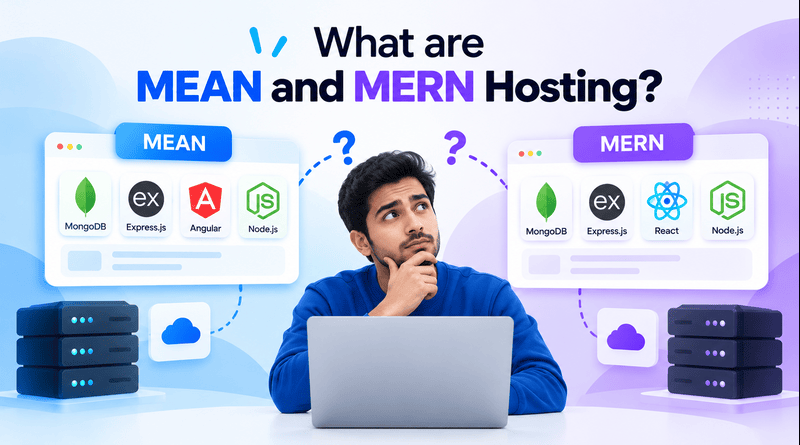
High technical endurance is a must for every web project’s technology stack. MEAN (MongoDB, Express.js, Angular and Node.js) and MERN (MongoDB, Express.js, React and Node.js) are technology stacks that are used to develop end-user applications. Ultimately, both tech stacks enable developers to create seamless and powerful applications that meet evolving business needs.
The article contains important information about MEAN and MERN, their components and hosting them on web servers.
Table of Content
What is MEAN Stack?
MEAN is a short form for MongoDB, Express.js, AngularJS, and Node.js. It is a JavaScript stack used for developing cloud-ready applications. It is becoming popular in the development of modern web applications.
Consider MEAN stack as a unified toolkit where every tool that communicates in the same language: JavaScript. Instead of juggling different technologies for your database, server, and user interface, everything works together seamlessly.
What is MERN Stack?
MERN stack is an innovative group of four JavaScript-based technologies (MongoDB, Express.js, React, and Node.js) employed for creating dynamic, full-stack web applications.
It lets developers work on user interfaces and database management to build full-stack applications.. All the tasks can be executed without switching to any other environment.
Read More: MERN Stack: A Complete Guide
MEAN vs. MERN: Full-Stack Comparison
What Does “MEAN/MERN Hosting” Actually Mean?
MEAN Hosting or MERN Hosting does not refer to dedicated hosting service. Instead, it refers to the potential infrastructure supporting all the moving parts these stacks need. At minimum, that means a Node.js runtime environment to run the Express.js backend, MongoDB database hosting, and the ability to serve frontend build output, whether that’s Angular or React.
Beyond the basics, proper support for environment variables, build processes, and often WebSocket connections become essential as the app scales. Some web hosting providers offer all these services in one package, while others require you to host the frontend, backend, and database separately to make connections. Both approaches have their merits, it all depends on the size of your app, your budget and how much infrastructure management you want to do vs. opting for a managed service.
Also Read: WordPress vs React
Key Hosting Requirements for MEAN/MERN Apps
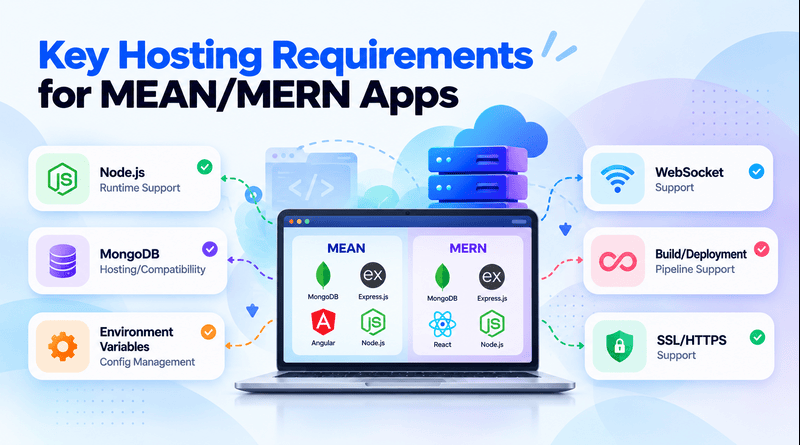
1. Node.js Runtime Support
Both MEAN and MERN stacks run the backend on Node.js; your hosting provider needs to support it natively, not just as an afterthought bolted onto a traditional LAMP-style setup. Look for providers specifying a Node.js version, install npm packages, and run the Express.js server as a continuous process rather than treating it as a static website.
Version compatibility is more important than it initially appears. Node.js has a rapid release cycle, but some web hosting environments are slow to update or restrict you to old, unsupported versions. If you are using the latest JavaScript features or have specific package requirements, be sure that the provider supports the Node.js version that your app actually requires.
2. MongoDB Hosting/Compatibility
You’ll need to decide between self-hosting MongoDB on your own server using a managed service like MongoDB Atlas. Self-hosting means you have complete control over configuration; it can be cost-effective, but it also means that you are responsible for backups, security patches, and fine-tuned performance.
Tools like Atlas are managed, which removes that operational burden, and they automatically handle scaling, backups and security updates. There is a monthly subscription fee. Some web hosting providers have integration with Atlas, or have their own managed MongoDB add-ons, so check if your web host supports easy connection with IP whitelisting.
3. Environment Variables / Config Management
MEAN and MERN apps use variable environments for sensitive configuration, database connection strings and API keys apart from your codebase. Your web host will need an easy way to set and manage these variables without hardcoding them into application files.
Look for providers offering isolated configuration for dev, staging and production environments not just storage of variables. This prevents accidental use of production credentials in a testing environment, and also makes it easier to manage secrets securely as your app and team grow.
4. WebSocket Support
If your app has real-time features like live chat, notifications, or collaborative editing, it’s probably using WebSocket connections instead of regular HTTP requests. Not all web hosting environments support persistent default WebSocket connections, and this is especially true for serverless platforms which are optimized for short-lived requests.
Before you commit to a host, you want to check that it supports WebSocket connections, and that there aren’t any aggressive timeout settings or load balancer configs that will break them. This is a common gap that only appears when a real-time feature fails in production, so it’s worth testing early, rather than for compatibility.
5. Build/Deployment Pipeline Support
A good MEAN/MERN hosting setup must support CI/CD workflows, automatically building and deploying the app whenever you push changes to the Git repository. It removes manual deployment steps and reduces the risk of human error during releases.
Look for native Git integration (GitHub, GitLab, and Bitbucket) and the ability to build commands separately for your frontend and backend. Providers that support staging environments alongside production deployments give you a safer way to test changes before they go live.
6. SSL/HTTPS Support
SSL/HTTPs is not an optional task for any production application but is required for security, user trust, and SEO, and modern browser features won’t work over plain HTTP at all. Your web hosting provider must offer free, auto-renewing SSL certificates rather than requiring manual certificate management.
This becomes especially essential for MEAN/MERN apps handling user authentication or sensitive data, since unencrypted connections expose credentials and session tokens to interception. Confirm SSL is enabled by default across both your frontend domain and any API endpoints your backend exposes.
Also Read: Node JS vs React JS
Common Mistakes to Avoid While Choosing MEAN/MERN Stack
Separate Platforms for front-end and back-end: If your React/Angular front-end and Node.js back-end are on different vendors that don’t play nicely together (CORS problems, region mismatches, extra latency), then you might have performance complexities.
Does not consider the free/low tier MongoDB connection limits: MongoDB Atlas free or entry-level tiers limit the number of concurrent connections. Apps that exceed this limit without upgrading will have their connections dropped or their production throttled.
Not Protecting Variable Security: Do not hard-code API keys, database credentials, or any other secrets directly in the codebase. Take advantage of proper environment variable management to avoid exposing sensitive data, especially if the repository is public or becomes public at some point.
MEAN vs. MERN Hosting: Which One to Pick?
The answer is to align your infrastructure with the application architecture and your team’s development workflow. Both configurations offer the wonderful speed, scalability, and efficiency of a single JavaScript ecosystem, but they cater to fundamentally different project blueprints.
Keep this expert rule of thumb in mind when making your final choice:
- Choose MEAN hosting: If you are deploying a large scale, highly structured enterprise application then you need strict MVC (Model View Controller) architecture imposed by Angular.
- Select MERN Hosting: To quickly prototype, scale tailored solutions, and provide smooth user experiences for dynamic Single-Page Applications (SPAs) or SaaS solutions developed using React.
Full-stack web design is evolving. Find out more about securing an optimized host to deploy successfully. Make sure that the web hosting provider that offers Node.js support, isolated resource allocation, and easy MongoDB integration will speed up the applications’ growth.
FAQs
1. What is the main difference between MEAN and MERN hosting?
The key difference is the framework used in the front end. MEAN uses Angular, which provides a very rigid, complete framework requiring TypeScript. As JavaScript is quite versatile and has a lot to do with fast changes to the user interface, MERN leverages React featuring versatile JavaScript-based libraries.
2. Is MERN outdated compared to MEAN?
MERN is the more popular and widely used option among modern web development startups and big tech-based companies. It is because of an extensive community of developers surrounding their main component, React. MEAN is still very relevant but primarily geared toward legacy enterprise platforms and corporate software.
3. Can I mix both stacks on a single hosting plan?
The backend (MongoDB, Express, Node.js) is precisely the same, so anything can be deployed simultaneously on a single server instance, hosting an Angular app (MEAN) and a React app (MERN) and serving data to each.
4. Which hosting option is better for beginners?
MERN hosting is generally easier for beginners to get started with. React has a simpler learning curve than Angular, and its large online community makes it easier to find tutorials, solutions, and support when you face development or deployment issues.