
 Sommaya Singh
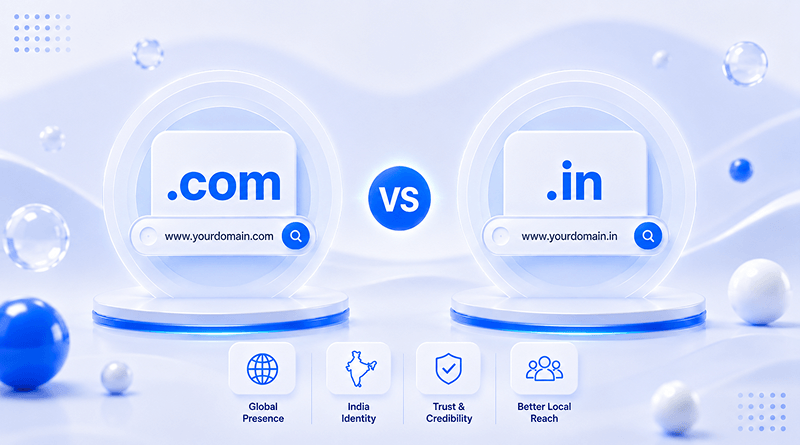
India’s digital push has compelled 62% of small and medium businesses to go online [Source: Economic Times]. Their first decision is often the same: Should their website end with .com or .in? Behind this simple choice lies a complex web of business implications. It affects branding, trust, and even how easily consumers find you on Google.
Both extensions offer distinct benefits that can support growth plans and objectives. This guide compares the .com and .in domains and gives an insight on choosing the right one for your business.
Table of Content
What is a .com domain?
The .com extension was originally launched for business websites. Over time, it has become a widely recognized domain extension globally. Today, millions of companies, organizations, and personal brands use .com domains because of their universal appeal and credibility.
Users easily trust and remember .com websites because of their familiarity. A .com domain name is a professional image that resonates worldwide for businesses aiming to have an international presence.
Because of its popularity, several coveted .com domain names are already taken, and it’s difficult to get the domain name you want.
Also Read: Types of TLDs Explained: gTLD vs ccTLD vs sTLD
What is an .in domain?
Just like .uk is used for the United Kingdom and .us is used for the United States, .in is the official country-code TLD (ccTLD) of India. This indicates the website is oriented for India, which is a logical choice for businesses, organizations, and individuals in the Indian market.
Indian businesses have numerous benefits of a .in domain name. It builds local trust and credibility with Indian consumers, often performs better in local search results, and is affordable or easier to register than several .com alternatives. It is especially desirable for short names registered using the .com extension. The local relevance has made it an increasingly popular choice among Indian startups and SMEs (small and medium enterprises).
.com vs .in for SEO: Which Performs Better?
Both .in and .com cater to specific website nuances and brand segments. Hence, neither domain is inherently superior. The choice depends strictly on the target audience. The .in domain focuses exclusively on Indian consumers and local search.
Since .in is a Country Code Top Level Domain (ccTLD), it provides an automatic geo-targeting signal to Google without manual geolocation setup inside Google Search Console (GSC) for the region.
A .com domain extension is suitable for international reach and universal recognition. It has global authority and attracts type-in traffic. If your goal is international trade or a worldwide audience, .com is the gold standard.
Google and other search engines confirm that TLD is not a standalone search engine ranking factor. So, it doesn’t outrank .com simply by existing. Domains with the .in extension signal the website’s geo-targeting to India, automatically giving local searches a natural edge. A .com domain extension achieves the same milestone on a global landscape. But for its geo-targeting setup, you have to do it manually on Google Search Console. So, the .com domain wins in international search visibility, while .in is suitable for cementing the local presence.
Also Read: .org vs .com: Complete Comparison Guide for Beginners
Does Google Prefer .in or .com?
How do ccTLDs work?
A ccTLD is explicitly reserved for the specific country or geographic territory (e.g., “.in” for India, “.uk” for the UK, and “.ca” for Canada).
When Google crawls a ccTLD, it uses the strong automatic geo-targeting signal. Google assumes websites using “.in” are explicitly built for users located in India or native content.
- Geo-targeting benefits of .in
- Global ranking potential of .com
- Expert insight
- Google does not directly favor either extension.
- Relevance, content quality, backlinks, and user experience are more important.
| Feature | 🇮🇳 .in | 🌐 .com |
|---|---|---|
| Primary audience | Indian customers | Global customers |
| SEO reach | Performs well for India-focused searches | Suitable for worldwide visibility |
| Local trust | ★★★★★ | ★★★★☆ |
| Global recognition | ★★★☆☆ | ★★★★★ |
| Geo-targeting | Built-in India targeting | Requires hreflang or Search Console targeting |
| Availability | Higher chance of getting preferred name | Often highly competitive |
| Registration cost | Usually lower | Usually higher |
| Best suited for | Indian startups, local businesses, regional brands | International brands, SaaS, global eCommerce |
💡 Expert Insight: Google doesn’t directly prefer .in or .com. Rankings depend on content quality, search intent, backlinks, technical SEO, and user experience rather than the domain extension.
Geo-Targeting Benefits of .in
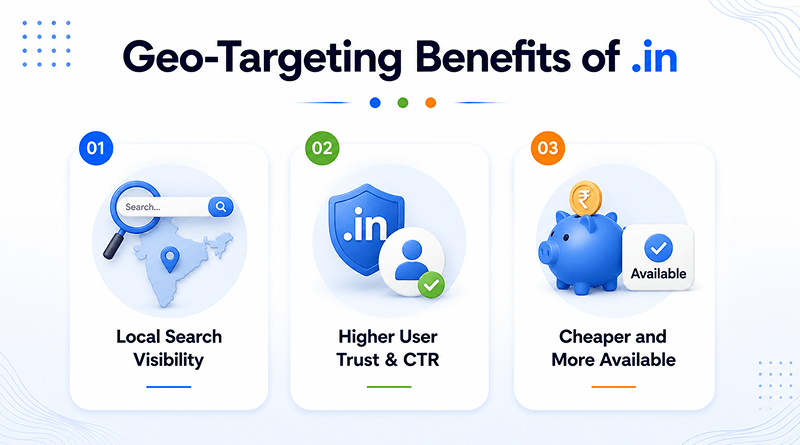
The .in domain can reap the following benefits for businesses while targeting Indian consumers.
- Local Search Visibility: With local searches such as ‘best web hosting in Mumbai,’ Google gives more relevance to the local results business. There are more possibilities of Google showing the .in domains in the search results.
- Higher User Trust & CTR: The .in domain names fosters geographical familiarity of Indian local businesses. This familiarity leads to higher CTR in search results than the generic global domain.
- Cheaper and More Available: Finding short, brandable, and keyword-rich domain names is much easier and more affordable with the .in extension than with the crowded .com extension.
Global Ranking Potential of .com
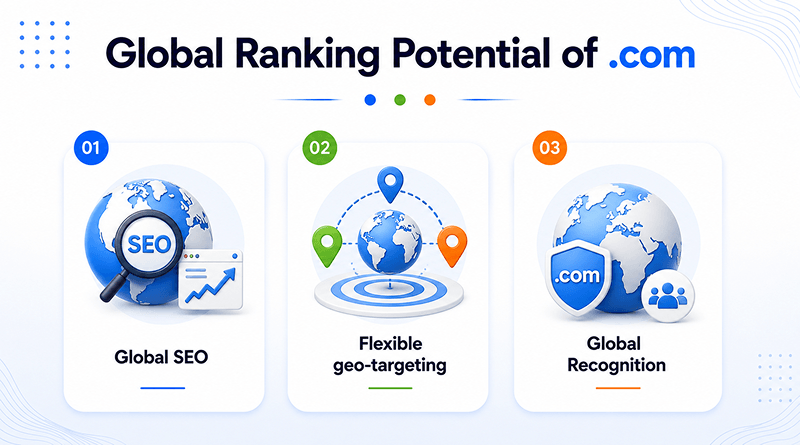
A .com domain is a gTLD (generic top-level domain), which Google treats entirely equally across demographics.
- Global SEO: With an .com domain, ranking global, just by means of SEO optimized content and quality is a reality.
- Flexible geo-targeting: If you wish to add other countries later, a .com URL would have subdirectories (like example.com/in/ or example.com/uk/) and multiple hreflang tags would be used to target more than one country.
- Global Recognition: .com is the oldest and most well-known domain extension worldwide and thus has an organic feeling of authority and trust of the global audiences.
Expert Insight
Both .com and domains serve distinct target demographics. Google doesn’t just outrank .in the US/UK or any Western countries. Likewise, a .com domain may struggle to rank in the Indian subcontinent.
Relevance, content quality, backlinks, and user experience matter more than domain characters. Choose an extension that connects with the target audience.
Branding & Trust
From “Magnificent 7” companies of the US (Apple, Microsoft, Alphabet, Amazon, NVIDIA, Meta, and Tesla) to the top Indian MNCs/FMCG business brands have adopted the .com domain extension, which has maintained their global authority and prestige over the years. The .com extension has been present since the early days of the internet. Businesses looking for established, trustworthy, and consumer-oriented domain names have built legitimacy using .com.
Local Trust of .in
The .in domain extension highlights a business’s Indian identity to better serve local customers. It is built specifically for the Indian markets. Such a local trust factor matters most for businesses targeting tier-2/tier-3 cities, regional services, or government and public-sector audiences, where a “Made for India”
Identity can outperform global brands.
Also Read: Best TLD Options: How to Choose the Right Domain Extension
.com vs. .in: Domain Availability
Choosing a .com or .in domain depends on the audience. A .com represents global credibility and is ideal for international businesses but faces heavy availability constraints. Whereas the .in domain dominates the local Indian search results, offering abundant short, available names, at a lower cost.
Check your domain at: MilesWeb Domain Name Checker
Core Availability
Because the .com extension represents the gold standard of the internet, most dictionary words and generic names are already taken. As a result, securing a premium .com domain usually requires adding extra words or purchasing from the secondary market.
This surging demand makes acquiring a preferred .com Top-Level Domain (TLD) increasingly difficult.In contrast, the .in extension provides an excellent alternative, making it much easier to secure a short, brandable, and premium keyword domain. However, because the .in TLD strongly signals local alignment, its appeal is generally perceived as limited to the native Indian market,
Real examples
.com
- www.amazon.com
- www.nvidia.com
- www.google.com
- www.zomato.com
- www.tcs.com
in
- www.milesweb.in
- www.cleartax.in
- www.indigo.in
- www.pharmeasy.in
- www.testbook.in
Pricing Comparison
| Domain Type | Registration Cost | Renewal Cost |
| .com | ₹299 | ₹1499 |
| .in | ₹399 | ₹799 |
How to choose between a .com and .in domain?
Choose .in if:
International branding is a significant advantage for foreign companies trying to enter the Indian market, because the .in domain extension gives them an instant market presence and helps in gaining credibility in the region.
ccTLDs are important signals for Google when it comes to geo-targeting, so website pages are more likely to rank in a search when local users are looking for a local service. Moreover, a local domain name implies local operations, which aligns with local consumers’ intent and foreign friction.
Local SEO favors content with localized web addresses to attract high-intent geographic traffic. Having a localized digital storefront helps boost CTR, reduce bounce rates, and make Indian consumers aware that logistics, customer support, and pricing processes cater to the regional needs.
Choose .com if:
.com is a premier domain extension for businesses establishing a global online presence in different countries. As the most recognized top-level domain worldwide, it strips away geographical limitations and establishes instant credibility with the global audience.
The prominent TLD eliminates geographical limitations and establishes instant credibility for a global audience. Operating on the neutral extension prevents search engines from considering your website as a stereotype. Hence, it becomes an ideal foundation. for scalable international branding.
A .com infrastructure makes it easier to serve multiple languages and regions with content on subfolders or subdomains for businesses that are targeting multiple markets and a global presence.
SEO Quick Tip
🇮🇳 .IN or 🌐 .COM — which one fits your audience?
If most of your customers are in India, a .in domain sends a strong local-relevance signal to search engines. If you’re targeting customers worldwide, .com remains the safer bet — it’s the extension people trust and recognize everywhere.
.IN
Best for India-first businesses and regional intent
.COM
Best for global or mixed audiences
💡 Domain extension helps, but it’s a minor ranking factor — content, backlinks, and site speed still matter most.
Also Read: Free Domain Name Provider: Top Platforms Compared
Why You Should Buy Both .com and .in Domains?
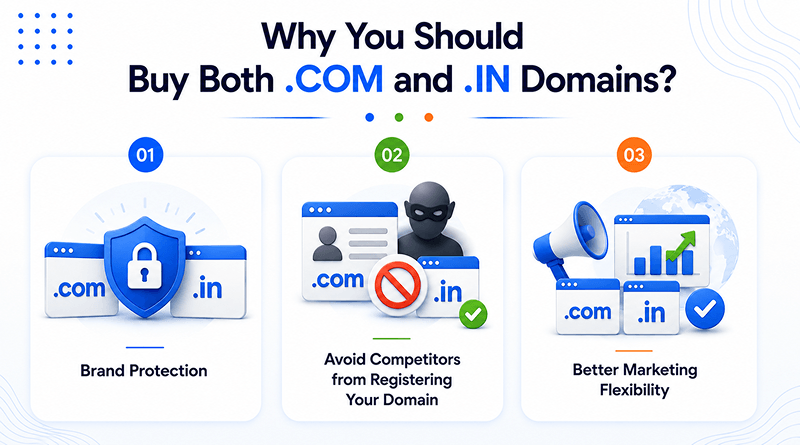
1. Brand Protection
Your domain name is the name of your business. If you register only the .com domain or only the .in domain, then you risk someone else, a competitor, a squatter, or even an unrelated business registering the other extension. After that, your brand is out of your hands when it comes to representation across various platforms.
Having both domains means you also have the competitive advantage. This measure ensures malicious bots cannot tarnish your hard-earned reputation or intercept your web traffic.
2. Avoid Competitors from Registering Your Domain
This is one of the most overlooked domain strategies. If a competitor purchases the version of
your domain that you don’t have, they could use a different domain or host to redirect traffic. They can also start another business with that name. That approach closely risks creating brand confusion for your target audience.
You can eliminate this risk and firmly maintain brand authority by purchasing both extensions. It cannot dilute your market presence.
3. Better Marketing Flexibility
Having multiple domain extensions provides you with additional space in which to work. Your marketing and SEO strategy. For example:
You can have region-wise campaigns, like in the domain for campaigns for the Indian audience and a .com domain for campaigns for the international audience or NRIs.
One domain may be used for a certain product line, landing page, or microsite, and the
The other one is the primary website.
It boosts your search engine presence in the worldwide (.com) search engine listings and
local (.in) search engine listings, particularly when you have to focus on local buyers in India.
Also Read: Best Domain Name Generators
Best Practice: How to Use Both Domains Effectively?
Buying one domain is not enough; its use cases matter as much for SEO and user experience.
1. Use One as Your Primary Domain
You can pick .com or .in as an authoritative domain. They both serve all marketing materials, business cards, social media, and official communication. .com helps you get global recognition, while companies focused solely on the Indian market can opt in for targeting native consumers.
2. Redirect the Secondary Domain
Setting up a 301 redirect from a secondary domain to a primary domain is a critical SEO optimization measure for the following reasons:
- It consolidates the search engine ranking signals to a single domain instead of splitting them.
- Avoiding duplicate content penalties from search engines.
- This ensures users typing either domain reach the correct URL, creating a seamless experience.
.com vs. .in: Pros and Cons
.com Advantages
1. Global Recognition
Currently, 48% of global websites utilize the .com TLD, and consumers consider it the
de facto extension for web addresses. It is significantly easier to remember for
the target audience.
2. Better for International Expansion
A .com domain carries universal recognition. It offsets the global limitations and adheres
to international data compliance. It signals the borderless operations and accessibility to visitors.
3. Higher Credibility Worldwide
The .com TLD is a universal standard for global recognition and trust. It creates the baseline for online credibility and builds intrinsic trust and legitimacy for professional businesses worldwide.
.com Disadvantages:
1. Low Availability
Because .com is the most popular extension (TLD) on the web, billions of domains have already been claimed. Finding short, brandable, or specific keyword phrases available at a standard registration price is exceptionally difficult.
2. Expensive Premium Costs
Because of high demand, acquiring a .com can be costly. You are frequently forced to pay inflated renewal fees compared to alternative TLDs.
.in Advantages
1. Strong Local Identity
The .in domain mirrors indigenous brand value, where native consumers connect with the local identity
of businesses. Currently, the .in TLD holds 0.61% market share with 5.2 million domains registered. [National Internet Exchange of India]. It has become the fastest-growing online domain extension in the region.
2. Affordability
The .in domain extension is value-driven and is reasonably priced. MilesWeb offers .in at ₹399 for the 1st year, with a renewal cost at ₹799. It is the budget-friendly choice to build an online business targeting Indian consumers.
3. Better Domain Name Availability
In contrast to the .com domain name, the .in suffix is highly available. Higher availability signals localized roots and improves the local discoverability. You can try our domain name checker tool to discover unclaimed domain names that could be your next brand identity.
.in Disadvantages
1. Less Global Recognition
The .in domain can’t facilitate borderless operations. Unlike .com, .in extensions don’t have universal recognition, which limits brand exposure to several countries.
The Closing Line
In the final analysis, the debate of .com vs. in. is not just about declaring a winner. But choosing one that is right for your business goals.
If you are building a global brand you need instant credibility and a plan to attract consumers, partners, or foreign investors. .com remains a safer, universally recognized choice. It is the extension people type out of habit, and familiarity carries weight.
Whereas businesses rooted in India serve native consumers irrespective of their statehood or business size. Tier-2 or Tier-3 cities such as Nashik, Bulandshahr, Kochi, and Jaipur demand local relevance. In domain signals, local relevance that ranks well for India-specific searches tends to be affordable and available compared to crowded .com names.
FAQs
1. Is .in better than .com for SEO in India?
Yes, .in gives you a slight automated advantage for local SEO because Google uses it as a strong geo-targeting signal for users within India. However, a .com can rank just as well if you consistently publish high-quality content and build strong local backlinks.
2. What is the difference between .in and .com domain?
The primary difference is that .in is a Country Code Top-Level Domain (ccTLD) specifically meant for India, while .com is a Generic Top-Level Domain (gTLD) used worldwide. .com carries global authority and trust, whereas .in immediately tells visitors and search engines that your business caters to the Indian market.
3. Can I rank globally with a .in domain?
You can rank globally with a .in domain, but it requires significantly more SEO effort and high-authority international backlinks to convince search engines. Because Google inherently geo-targets ccTLDs to their native country, a .com is always the preferred choice for targeting a global audience seamlessly.
4. Which domain extension is best for startups?
The best extension depends on your business target; choose .com if your startup aims to scale globally or raise international venture capital. If your business model focuses entirely on solving problems for the Indian market first, a .in domain is more affordable, highly relevant, and easier to acquire.
5. Should I buy both .com and .in?
Yes, buying both .com and .in is a smart brand protection strategy that prevents competitors or fraudsters from stealing your traffic. You can launch your main website on your primary choice and simply set up a 301 redirect from the secondary domain to your main link.
6. Does Google treat .com and .in differently?
Google treats them differently regarding geography; it automatically targets .in to searchers in India, while treating .com as a neutral, global canvas. Beyond this geographic targeting preference, Google applies the exact same ranking algorithms, quality guidelines, and crawling systems to both extensions.