

 Rajesh Jadhav
DNS is the best in terms of speed, security, and uptime for seamless web-related tasks. All requests sent from browsers worldwide begin by first performing a DNS lookup. When someone enters a website’s domain into their browser, DNS converts this domain into the corresponding numerical IP address as the request is being processed. It determines the speed at which the website can be loaded, the level of security of the user’s web browsing session, and the reliability of the connection being established.
According to the 2024 Internet Trends Report, delays in DNS resolution are responsible for approximately 20% of the perceived website load time for first-time visitors. It further emphasizes that selecting a best DNS service provider is a major decision, both technologically and for the business. DNS management has become a critical element for online visibility as internet use rises among companies and individuals.
Summary (TL;DR)
According to the APNIC 2023-2024 research report, over 35% of global users mostly depend on third-party public DNS providers. This adoption rate continues to rise with growing awareness about DNS security advances.
This article offers an in-depth insight into the best DNS hosting providers and compares the offerings of leading public DNS providers.
Table Of Content
What Are DNS Providers and Why Do They Matter?
DNS providers offer a reliable infrastructure for converting domain names into IP addresses. All this process takes place behind the scenes, yet it influences every single online activity. Leading DNS providers play a role in simplifying domain resolution.
Public DNS providers are preferred for their open access DNS resolution without restrictions. With their services, speed, security, and uptime are central to the delivery. This is the reason why most users switch from ISP-driven DNS to public DNS providers.
Why Choosing the Best DNS Providers Matters?
Quicker DNS resolution has a noteworthy impact on SEO parameters. Even Google’s Core Web Vitals considers user experience and loading speed as the key components. Your service provider should guide you on what is DNS and how its working principles are crucial in improving initial connection timing.
According to Verizon Data Breach Investigations Report 2024, DNS-driven attacks account for over 30% of phishing-based attacks. DNS has become a common target for cyberattacks. Leading DNS providers with threat intelligence functionality help mitigate such risk.
What Are the Different Types of DNS Providers?
DNS service providers generally come in three categories.
Internet Service Provider (ISP)
The first type is DNS services provided by your ISP. They are assigned automatically when you connect to the internet. Typically, they’re slower than other types of DNS services due to their reliance on a large number of users accessing them, and they usually lack advanced security features.
Public DNS
The second type of DNS service is public DNS. These are generally free to use and include DNS services such as those offered by Cloudflare, Google, and Quad9. Public DNS services are popular for their speed, privacy, and global footprint.
Managed DNS
The third category of DNS service is the managed DNS services. These are provided primarily through best web hosting providers or large enterprises. The DNS management service associated with a managed DNS service provider is often included as part of the web hosting service they provide.
Best DNS Providers for 2026 (Quick Comparison)
| Provider | Best For | Key Feature |
|---|---|---|
 |
Comprehensive performance | Managed DNS with hosting |
 |
Stable Speed | Fastest global DNS |
 |
Higher Reliability | High uptime worldwide |
 |
Strong Security | Blocks malicious domains |
 |
Multiple Filtering | Phishing & content control |
 |
Privacy Measures | No logs, no tracking |
How Does MilesWeb Help Manage DNS and Hosting Efficiently?

When you purchase hosting from MilesWeb, their professional team takes care of all DNS administration, thus simplifying the task of manually configuring your Domain Name System (DNS) records.
By managing the DNS from their location, MilesWeb ensures proper propagation of the DNS records, as well as providing a reliable and secure means of managing these records.
One advantage of this system is the reduction in errors that result from improperly configured DNS records; this is often the cause of downtime for many websites. Websites using managed DNS accounts have significantly less exposure to DNS-related issues than those using self-managed accounts.
Ideal Use Case
MilesWeb’s managed DNS service is ideal for businesses that want experts to handle their DNS management needs. It is also suitable for website owners who wish to have their DNS management by the best in the industry.
Top Public DNS Providers & Why They Becoming So Popular?
Public DNS servers allow users to connect to a DNS server. They typically provide better performance than an ISP DNS server. These best DNS servers have larger networks in multiple data centers worldwide, providing a redundant infrastructure for users.
Many free public DNS servers offer basic protection against malware and phishing URLs, making them attractive options for users. According to the DNSPerf research study from 2024 and 2025, Cloudflare DNS and Google Public DNS are the leading DNS service providers globally.
1. Cloudflare
Cloudflare has established itself as the world’s fastest DNS provider. It uses the 1.1.1.1 IP address, and it has no records of identifying data.
According to the 2024 Cloudflare privacy policy update, query logs are anonymized within 24 hrs of creation. This makes them among the most privacy-conscious DNS providers in the industry.
Based on the results of the 2024 DNSPerf Global DNS speed test, Cloudflare has been rated as the top DNS provider worldwide based on average query response times in all regions. Cloudflare is one of the first DNS providers to offer support for DNS over HTTPS and DNS over TLS. This prevents interception or manipulation of DNS queries.
Ideal Use Case
Cloudflare is best suited for users who need fast DNS resolution and have good privacy policies in place. Ideal candidates are high-volume websites, developers, and businesses that emphasize faster page loading times and global audience reach.
2. Quad9
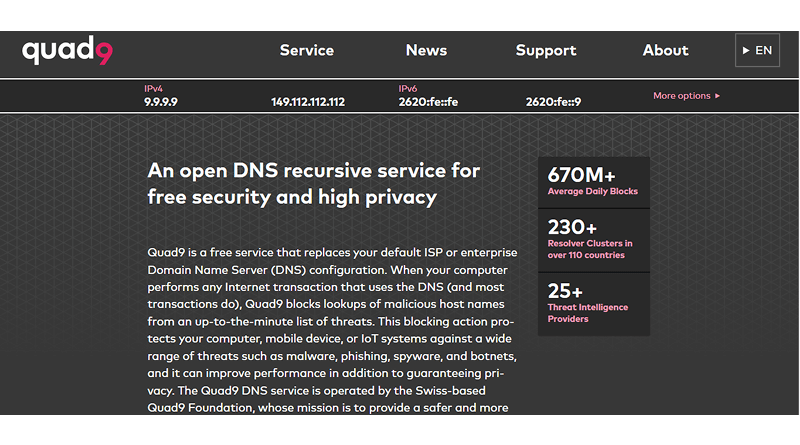
The Quad9 DNS service is provided by the Quad9 Foundation, sponsored by IBM Security and Packet Clearinghouse, which has a primary focus on blocking known malicious domains. This service provider blocks access to domains known to have been involved in malware, phishing, and botnet attacks by using real-time threat intelligence feeds.
The Quad9 Transparency Report for 2023 states that the Quad9 DNS service blocks over 100 million malicious domain requests every day.
Their DNS service does not retain individual IP addresses, therefore complying with privacy laws such as the GDPR. Many users select Quad9 as one of their trusted DNS service providers, as this provider offers comprehensive security rather than merely relying on raw speed.
Ideal Use Case
The Quad9 DNS host is best for customers who desire reliability over performance. Quad9 will automatically block malicious or phishing domains for its customers. Quad9 is most attractive for environments where network security through threat prevention is a priority.
3. Google Public DNS
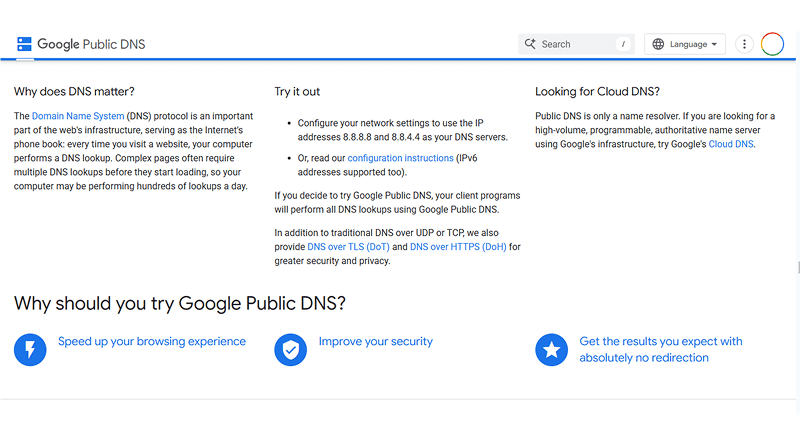
Google’s DNS services operate on two designated IP addresses, 8.8.8.8 and 8.8.4.4. They have one of the highest shared resources around the globe.
Google, in its October 2024 Infrastructure Update report, stated that it serves trillions of queries per day with near-zero downtime. DNSPerf listed Google as one of the premier public DNS sources in North America and Asia.
Google’s logging of diagnostic data is relatively limited and anonymous for DNS requests. Therefore, the provider has an equal balance between performance and operational transparency.
Ideal Use Case
The Google Public DNS service is for customers who prefer reliable performance and uptime across geographic regions. Developers, agencies, and global customers will find this solution to be the perfect fit for providing reliable hostname resolution. Additionally, the Google Public DNS service will be the best DNS resource for customers who compare the performance of their networks using a reliable method.
4. OpenDNS
Cisco has developed OpenDNS as a public DNS service, offering both free and premium plans with web filtering and security features to help protect against phishing attacks. Through its phishing protection and website filtering capabilities, OpenDNS is suitable for use at home, in the classroom, and for small company operations.
According to the Cisco 2024 Cybersecurity Threat Report, endpoint protection implementation with DNS layer security (such as what is available from OpenDNS) decreases the number of malicious domains by almost 40%.
Users can integrate OpenDNS public DNS service directly with Cisco’s own threat intelligence service for real-time DNS protection against sites that host malware and other web-based threats to the end user’s computer. For users looking for a DNS service provider with filtering controls but without a complicated installation process, the OpenDNS public DNS service is one of the most reliable options available.
Ideal Use Case
Home users, classrooms, and small business owners are looking for DNS filtering capabilities (website filtering) combined with basic security controls (phishing protection). Users who prefer website filtering protection while creating an access policy and managing it. Any Cisco user who benefits from Cisco’s threat intelligence as a source of information on potentially harmful websites.
5. DNS Watch
DNS Watch is a publicly available domain name system service provided by a company called he.net located in Germany. They have a strong commitment to privacy.
They do not store any user log files and do not apply any form of content filtering. Their policy, revised in 2024, clearly states that no personally identifiable information is ever collected or stored.
In terms of its performance, DNS Watch provides stable services in both Europe and Asia. While it may not always be one of the fastest DNS services available, it is a very reasonable solution for individuals who value their privacy.
Ideal Use Case
Those who would benefit most from DNS Watch’s services are users concerned about their privacy who wish to use a no-log DNS solution. It is ideally suited for people or businesses that operate with strict data protection laws regarding the collection of information. It is frequently used in jurisdictions with a focus on privacy law.
Free DNS Providers vs Paid DNS Services: Which Is Better?
Individuals and small businesses can use free DNS services. These have good performance and security features. According to findings from a Global Cyber Alliance study (2023–2024), switching from an ISP DNS to a public DNS service can reduce the risk of visiting a malicious site by approximately 25% or more.
Paid providers of DNS services offer additional features such as advanced traffic management tools, uptime service level agreement, and data analytics.
Most people find that they can satisfy all their current performance and security requirements with a free DNS provider. Google, Quad9, and Cloudflare are the leading free DNS providers offering a reliable performance rate.
What are the Common DNS Problems and How to Fix Them?
– DNS Server Not Responding
- It occurs due to an overloaded DNS server.
- Use the Cloudflare public DNS server (1.1.1.1) or Google public DNS (8.8.8.8).
- Regenerate the router and clear out the device’s DNS cache.
- MilesWeb’s managed DNS delivers seamless DNS availability and connectivity.
– DNS Propagation Delays
- Stands after a DNS update or change of the host that takes 24-48 hours.
- Reducing the TTL (Time To Live) before making a DNS change helps to streamline DNS propagation.
- Use tools like whatsmydns.net for propagation status monitoring.
- MilesWeb’s staff executes propagation for you.
– DNS Cache Poisoning
- Occurs when some malicious information is cached in your DNS resolver’s cache.
- Employ a DNS provider that provides DNSSEC (Domain Name System Security Extensions) support.
- Flush the local DNS cache periodically to eliminate previously replaced and/or compromised records.
- Additionally, MilesWeb hosting offers security to mitigate cache attacks.
How Do DNS Providers Affect Website Performance?
The speed of DNS resolution impacts the time it takes for a web browser to connect to a server. It results in faster DNS operations, reducing the time it takes to get the first byte.
The Google Web Performance Research Group signaled in a technical document published in 2023 that DNS lookup time is responsible for as much as 15% of the initial page load delays associated with uncached visits.
The fastest DNS providers optimize the routing of DNS requests and caching of DNS response information globally. It provides the same level of performance regardless of end-user location. By switching to a more reliable DNS provider, users will have increased stability while browsing the web, especially during periods of high traffic.
How Do DNS Providers Help Protect Your Privacy?
A certain class of DNS providers is committed to ensuring that its servers never store any user IP addresses or DNS queries, thereby providing an added layer of security from tracking and profiling.
The EFF reviewed three leading public DNS services for their compliance with the new privacy standards. It found that there was a significant improvement in privacy when using DNS providers with encrypted DNS protocols.
How Do DNS Providers Help With Security Filtering?
Certain DNS service providers will restrict access to any well-known malicious endpoint when a DNS query is performed on their server. As a result, devices will not be able to reach these harmful endpoints.
According to the CISA’s 2024 advisory, DNS-layer protections have been able to reduce phishing attempts by 80%.
Therefore, OpenDNS’s public DNS server and Quad9’s DNS service excel at applying DNS-layer protections because they cover substantial feedback of threat intelligence into their filtering processes.
Concluding Insights
DNS providers have significantly more influence over your internet speed, privacy, and security than you might otherwise know. Public DNS providers offer a more reliable alternative to the default DNS service from your Internet Service Provider (ISP). Free DNS providers are now providing enterprise-level service and security to their users.
The best DNS provider must include speed, privacy, and reliable uptime. When selecting an appropriate DNS provider, both personal and professional users gain a better internet experience.
You can choose the Cloudflare DNS provider for speed, the Quad9 DNS service for security, or MilesWeb for convenience by utilizing their managed DNS services. For both consumers and businesses, reliable DNS providers have become a core element that solidifies their online presence.
FAQs
1. Are free DNS providers safer to use?
Most of the time, free TLD providers are fairly safe, provided that they have been around long enough and belong to a well-established company. For example, Cloudflare, Google, and Quad9 have maintained very high security practices. This is evident from both their independent audits and their published transparency reports.
2. Which DNS providers focus on privacy protection?
Examples of such providers include Cloudflare, Quad9, and DNS Watch; according to their published policies, these three providers limit the amount of personal information they store regarding the websites you visit and also utilize encrypted protocols to transmit the data they do allow to be stored about you. TLD providers that promote privacy will do the best job at protecting your personal information.
3. Can changing DNS providers improve browsing performance?
The answer is yes. DNSPerf conducted a study of the world’s top TLD providers in 2024-2025 using benchmarking. Their study showed that most TLD providers are capable of finding and returning information from TLDs (such as .com,.net, or .org) much faster than any TLD operated by an ISP.
4. Can DNS providers block malicious or unsafe websites?
Yes, several TLD providers offer access to various databases that identify harmful web content. According to studies by Cisco and IBM, both Quad9 and OpenDNS are the best DNS providers when blocking access to known phishing sites and malware sources.