Sommaya Singh

Personal data is the fuel of a successful digital marketing campaign. However, cyberattacks and data breaches are significant warning signs that can severely undermine customer trust and damage brand reputation. Therefore, the Government of India and the Ministry of Electronics and Information Technology (MeitY) rolled out and operationalized the Digital Personal Data Protection Act, 2023.
The respective amendment changed the data retrieval process for marketers across industry niches. As a digital marketer, you must read this overview about the act that maintains the data sovereignty of your campaigns and choose a reliable web hosting service to ensure data safety.
Table of Content
What is the DPDP Act?
The DPDP Act outlines the data processes carried out by Indian marketers. Native brands and marketers are compliant with protecting the personal data of consumers and their rights under this act.
Core Principles
- Consent and Transparency: Data should be processed based on free, clear, and specific consent.
- Purpose Limitation: Data is used for the specific objective for which it was collected.
- Data Minimization: Only the purpose-driven data must be fetched from the target audience.
- Accuracy: Organizations must execute reasonable steps to keep personal data updated.
- Storage Limitation: Data must not be stored for a prolonged period.
- Security Safeguards: Organizations must implement preventive measures against data breaches.
- Accountability: Data fiduciaries are legally accountable for compliance with the Act.
Also Read: What is Performance Marketing?
Why Do Digital Marketers Need to Care?
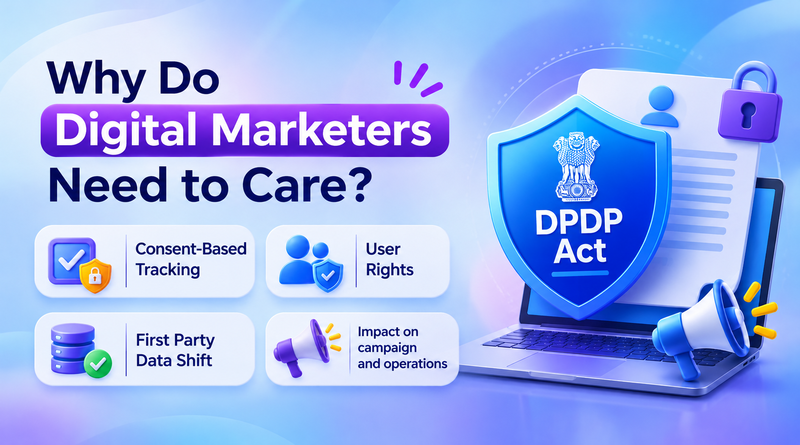
- Consent-Based Tracking: Marketers can’t force users to sign up for newsletters, nor can they use one consent as a blanket for promotional remarketing.
- User Rights: Users have the right to access, correct, delete and revoke consent at any time. If a consumer withdraws their consent, marketers must stop processing the data and eliminate it from active workflows.
- First Party Data Shift: The tightening rules on cross-border data transfers, ad-tech tracking and behavioral monitoring all point to the shift to first party data strategies.
- Non-compliance, data breach or failure to put in place reasonable security safeguards can face monetary penalties up to ₹250 crore.
- Impact on campaign and operations: We had to audit lead generation forms, WhatsApp opt-ins, email lists and analytics or retargeting tools to be fully compliant.
Also Read: Effective Ways to Improve Digital Adoption in Your Small Business
How the DPDP Act Changes Everyday Marketing Work?
1. Lead Forms and Data Collection
What changes: You must provide prior notifications to users stating the purpose of data collection. Pre-ticked boxes like “by submitting, you agree to everything” are obsolete.
What to do
- Keep only required form fields like name, phone, and email.
- Plan how to give notice to existing leads whose data was collected before the Act.
2. Cookies, Pixels, and Tracking Scripts
What changes: The Act doesn’t mention cookies by name, but identifiers that can be tied to a person are personal data, so trackers like ad pixels and session recorders must be treated as consent-based. Loading them automatically on page load is risky.
What to do
- Audit all tags, pixels and scripts on the site and note what each one collects.
- Implement a consent banner that only loads non-essential trackers after the visitor has consented and allows them to easily decline and withdraw as accepted.
- Remove unused tags and keep a list of which vendors receive data.
3. Email, SMS and WhatsApp marketing
What changes: Marketing messages will need channel-specific consent and people need to be able to opt out if they find it irrelevant. A good example would be WhatsApp and their opt-in policies implementation and TRAI’s SMS regulations.
What to do
- Instead of one broad consent, get the specific opt-ins for email, SMS and WhatsApp.
- Turn on the unsubscribes option to give users the option to block spam messages.
- Churn old contact lists and stop messaging them who show dissent.
4. Retargeting and Audience Building
What changes: Uploading customer lists to ad platforms, building lookalike audiences, and following people across websites involve processing personal data, so basic consent is required. Processing minor children’s data needs authorized parental consent.
What to do:
- Identify contacts on the list who agreed to the data usage.
- Exclude audiences you can’t verify, especially anything likely to include minors.
- Sign data processing agreements with ad platforms and agencies, because you stay responsible for what vendors do with the data.
5. Analytics and Measurement
What changes: Tracking must have a lawful basis for individuals and data must be deleted when they no longer serve the purpose. Full dashboards of user-level data with no limits on retention become a liability.
What to do
- Prefer anonymous reporting where possible.
- Set a retention period in your analytics and CRM tools, and delete it, or keep it private.
- If someone asks, make sure the data retrieval process is smooth across tools as data principals have the right to request access, correction and erasure.
Also Read: Significant Digital Marketing Trends to Promote Your Business
DPDP Compliance Checklist for Marketing Teams
- Audit all CRMs, WhatsApp business tools, email marketing platforms, shared drive spreadsheets with customer info, ad platforms.
- See where personal data (name, email, phone) flows from sign-up forms and webinar registrations to your automated nurture campaigns or external agencies.
- Ensure that marketing consent is not pre-ticked or bundled in the general terms of service. Consent must be freely given, specific, informed and unambiguous.
- Your data collection needs clear sign-up forms, what you do with it, and how users can remove it.
- No purchased, rented or scraped cold lead lists without auditable explicit consent.
- Use double opt-in lists on your marketing platforms like HubSpot or Zoho Campaigns.
Also Read: SEO Trends Explained
Myth vs. Reality: Marketing Under DPDP
Myth: Consent alone makes us compliant.
Reality: Consent is not a marketer’s right to use personal data. Rather, they must provide multilingual notices and a simple means of withdrawal of consent.
Myth: DPDP is the same as GDPR.
Reality: The DPDP Act raises penalties for data breaches and bans the profiling of children below the age of 18 for marketing purposes.
Myth: We can keep all of our old marketing data.
Reality: Legacy databases are highly vulnerable. If you do not provide proof of how and when you obtained explicit consent for an old lead list, you must issue a new compliant notice to either revalidate or purge the data.
Conclusion
For marketers, the DPDP Act may seem like yet another regulatory decision, but in simple terms, it upholds the voice of dissent from consumers. The majority of the key updates are effective on platforms like lead forms, tracking scripts, email campaigns, WhatsApp, retarget lists, and analytics dashboards. The basic requirements will come into effect from mid-May 2027, and the penalty can be up to ₹250 crore; hence, it is better to take the time than wait until the deadline.
It doesn’t have to be done all at the same time. Ensure you identify where your leads and customer data are coming from, cut out data that is not relevant, and update your forms and consent banners. Then, clear out old lists, review your vendor and agency contracts, and determine who will manage consent records and deletion requests. Brands that nail these aspects are likely to build trust with people, as they’re more likely to give their information to a brand that is upfront about what they do with it.
FAQs
1. How does the DPDP Act change the way digital marketers collect user consent?
Consent must now be explicit, specific, informed, unconditional, and completely revocable by the user. Marketers can no longer use pre-ticked checkboxes or hidden clauses, and must provide clear, multilingual notices explaining exactly what data is being collected and why.
2. What is the impact of the “Purpose Limitation” rule on existing marketing databases?
Marketers can only use collected customer data for the exact, specific reason the user originally agreed to. If you collect an email address for a newsletter, you cannot use it for behavioral ad targeting or pass it to third parties without securing a separate, fresh consent.
3. Can marketing agencies still run targeted ad campaigns under this law?
Yes, but tracking strategies must pivot heavily toward first-party data and privacy-preserving aggregation tools. Unrestricted third-party profiling and gathering excessive user data “just because a form allows it” are strictly prohibited under data minimization rules.
4. What are the financial penalties if a marketing campaign violates the DPDP Act?
The Data Protection Board of India can impose severe financial penalties based on the nature of the privacy breach. Non-compliance or failing to implement proper security safeguards can cost a business up to ₹250 crore per violation.