
 Jyoti Prasad
Over the last 20 years, Python has been used to create millions of websites, automate processes, and power nearly all artificial intelligence and data projects.
Does this mean Python is all that you need? Unfortunately, despite having all the tools, even the most popular programming languages like Python have limitations.
The speed, security, and scalability required for a modern-day application are the driving factors. This is another reason why developers believe that Python is holding back their rapidly escalating projects. Consequently, developers are turning to alternatives to Python, often seen as strong Python competitors, that offer them quicker, smarter, and more adaptable solutions.
So are you too stuck in this situation?
With the advancement of technology in all facets of life, development teams are now evaluating which languages will best address the needs of today’s developers. Some are searching for programming languages like Python, often exploring languages similar to Python but with a more stringent typing structure; others are looking for languages with a smaller footprint in memory usage; and again, there are users finding programming languages that provide a better means of concurrency and a mobile-first framework.
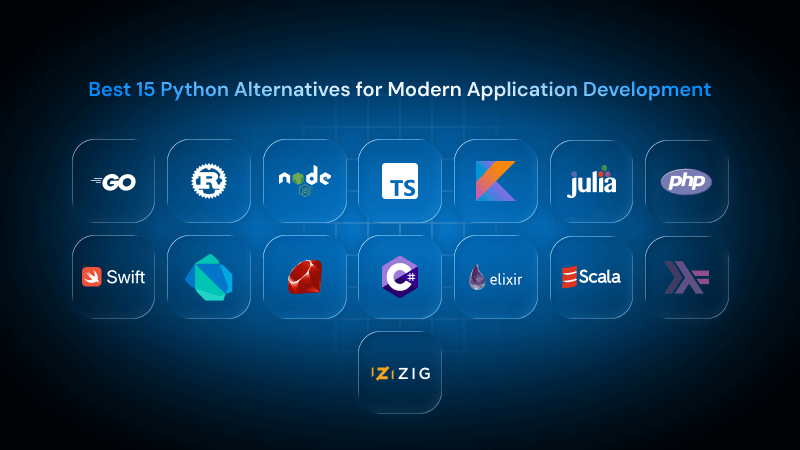
In any case, whatever the rationale for switching languages, it is usually narrowed down to only a few viable alternatives. So without further delay, let’s take a look at some of the most popular programming languages (top alternatives to Python and other leading alternatives for Python) and see if they can meet the current development needs.
Summary (TL;DR)
Python is a versatile and widely-used high-level language, but it isn’t always the best fit for every project due to performance, concurrency, and ecosystem limitations.
The blog highlights top alternative languages like Go, Rust, Node.js, TypeScript, Kotlin, Julia, C#, and others that offer advantages such as faster execution, better concurrency handling, scalability, mobile-oriented tooling, or optimized scientific computing.
The right choice depends on your project’s specific needs—speed, memory safety, scalability, or cross-platform support—and switching early can help avoid development bottlenecks later.
Table Of Content
What is Python?
Python is one of the most widely used high-level programming languages. Its simplicity and ease of integration with other programming languages make it one of the prime user-friendly interfaces. This is a vital point, providing many Python libraries.
There are numerous ways in which developers use Python, including web development and UI automation, AI development, data science development, and enterprise application development. With the growth of the market for these services, developers and businesses have begun to look for a dependable Python hosting solution that offers the ability to easily deploy applications with speed and ease of scalability.
Useful Read: Best Python IDEs: Top Tools for Every Developer
Why Developers Need Python Alternatives?
Python is excellent for general-purpose coding but may slow down high-performance systems. Heavy traffic platforms need languages that manage thousands of requests per second. Real-time applications like gaming and streaming require faster execution. Complex mobile systems also demand languages optimized for iOS and Android devices.
Tooling preferences also play a major role. Some languages provide bigger ecosystems for web, mobile, and cloud development. Other languages offer better memory safety or simpler deployment pipelines. Developers choose alternatives based on project goals, team skills, and long-term maintenance needs.
The majority of programming languages available today, including languages similar to Python, provide a level of simple coding that is comparable to that of Python, yet many can provide greater execution speed than what is offered by Python.
When Looking at Alternatives to Python for Development
When considering other programming languages like Python, including Python similar languages, to use for building an application, you should consider several different factors that affect its overall performance over the long term.
- how fast the execution of the program is (execution time), particularly for mission-critical applications;
- how well the language supports concurrency;
- how the language supports parallelism;
- how scalable it will be as the application gains more users or data;
- how steep or simple is the learning curve; and
- how many people can easily write code in the language
In the following sections, a few of today’s most popular Python like programming languages and widely considered among the best Python alternatives will be discussed, including their differences in these aspects.
Quick Comparison Summary: Top Python Alternatives
| Best Python Alternative | Requirement | Why It Fits Best |
| Go, Rust | High-performance backend services | Compiled execution, fast performance, efficient concurrency |
| Go, Scala, Elixir | Large-scale distributed systems | Strong concurrency models and scalability support |
| Node.js, Elixir | Real-time and event-driven applications | Non-blocking I/O and lightweight process handling |
| Node.js, PHP, Ruby | Web application development | Mature ecosystems and rapid development workflows |
| Kotlin, Swift, Dart | Mobile application development | Native and cross-platform mobile-first frameworks |
| Dart (Flutter) | Cross-platform UI development | Single codebase with consistent UI and fast iteration |
| Julia | Data science and scientific computing | High-speed numerical computing and parallel execution |
| C#, Scala | Enterprise-grade applications | Strong typing, JVM/.NET ecosystems, long-term stability |
| Rust, Zig | System-level and low-level programming | Memory safety and fine-grained control over resources |
| Haskell, Rust | Correctness-critical systems | Strong compile-time checks and predictable behavior |
Top Alternatives to Python: Based on Primary Programming Languages
The languages listed below are our handpicked Python alternative options to Python. The shortcomings of Python include limited execution speed, limitations in the concurrent execution of code, and the time related to errors that occur when running code due to the GIL. These languages offer fast execution speeds, safer memory management, and the ability to do parallel work, and are compatible with current cloud-based and distributed computing models.
1. Go (Golang)
Overview of why Go is one of the best Python alternatives.
Go has high-performance execution speeds, with built-in, easy-to-understand concurrency and threading models. Additionally, it was designed by Google with the purpose of building fast, reliable software. Because Go is “compiled,” it allows for direct execution without the delay of a runtime environment. Go provides the ability to run thousands of different tasks at the same time with business rules with goroutines! The language has a very clean, easy-to-read, and informative syntax.
Go can be used effectively for:
- Microservices and APIs, where speed and low latency are critical factors.
- Cloud-native applications that require fast scaling.
- CLI (Command Line Interface) tools that need to be fast (triggering events on any system) and can be dependable.
- Development tools internal to an organization where consistent quality and stability are required.
2. Rust
Overview of why Rust is noted as a top alternative to Python:
Rust is well-known as a fast and safe language; its speed comes from the fact that it has a built-in memory protection system known as “Fearless Concurrency.” During compilation, it carefully checks that multiple tasks do not access the same memory at once. Because of this, it can manage memory safely without needing a garbage collector. Rust has many characteristics that make it similar to C/C++, but unlike C/C++, it does not have the same level of memory corruption issues, which can occur at the high level. This makes Rust the most suitable language for designing & implementing secure and reliable systems.
Rust can be used effectively for:
- OS-level components: “/Component-based Architecture” that require a high level of reliability and integrity, typically for embedded devices.
- No way to slow down processing time in performance-sensitive applications (e.g., backend services).
- For software where you can’t afford to lose data due to potential memory errors (i.e., high-security applications).
- For data processing pipelines, with processed data over time that should be of consistent quality.
3. Node.js
Overview of why Node.js (the JavaScript platform) is noted as alternative to Python
Node.js has a remarkable ability to handle multiple concurrent connections and a non-blocking I/O model (an event-driven architecture), which is very useful for real-time applications. This strength allows for the frontend and backend of an application to be developed using the same programming language (JavaScript). In addition to that, it gives developers access to a large and growing collection of reusable packages through the npm package ecosystem.
Node.js can be used effectively for:
- Developing real-time applications such as messaging and streaming dashboards or notification systems.
- Creating reverse proxy or proxy servers to facilitate high I/O operations.
- Building applications where both the frontend and backend use the same logic in JavaScript.
- Developing lightweight APIs that are quick to develop and/or update.
Specialized Python Alternatives: Based on Project Requirements
Certain programming languages excel within narrow niches of development. When the objectives of the project call for high speed, extreme accuracy, or an extensive array of innovative tools, these specialized programming languages provide a tremendous amount of specialized value as alternative for Python. The language of your project dictates which programming language you should use and under what conditions.
4. TypeScript
Overview:
TypeScript expands upon JavaScript to provide developers with the option to use static typing. As type-checking occurs before runtime, bugs in large/complex applications can be caught before the code is executed. With this type of checking available, TypeScript provides an enhanced level of maintainability, increases the ability to use high-quality tools, and retains the flexibility offered by the JavaScript programming language. All these specs offer a structured approach to developing software.
Why/When should you use it?
- TypeScript is an ideal choice for large-scale web applications, both on the front-end and on the back-end, as well as for enterprise-level dashboards, internal tools, and customer-facing portals.
- TypeScript enables developers to create and maintain more readable and predictable code than they would be able to create/maintain using JavaScript alone.
- If your project requires stable long-term maintenance, TypeScript is a strong choice for developing application code.
5. Kotlin
Overview:
Kotlin is a modern, pragmatic, expressive language developed to work with the Java Virtual Machine (JVM) and be completely compatible with Java. Kotlin’s syntax is incredibly concise and eliminates many common errors found in Java development. Kotlin supports both object-oriented and functional programming paradigms. Kotlin focuses on developing code that is safe, easy to read, and fast to develop.
Why/When should you use it?
- Google’s primary source for developing Android apps is Google’s official Android SDK, which uses Java.
- Google App Engine gives developers a solid option for developing Java-based web applications via the Ktor or Spring frameworks (Kotlin).
- Kotlin can also be beneficial to businesses developing systems that run on the Java ecosystem.
- Kotlin allows development teams to produce cleaner code and still utilize Java libraries.
6. Julia (Programming Language)
Overview:
Scientific computing and numerical analysis are the primary purposes of Julia. Julia runs much faster than Python, it is a high-level programming language similar to Python and often described as a language like Python for scientific computing. If a development team needs to perform many complex mathematical calculations, Julia has an advantage because it can run these operations in parallel using multi-core processing capabilities.
Why/When should you use it?
- Technologies require many computations to run properly, and Julia offers a fast, accurate way of building models for machine learning projects.
- Additionally, Julia’s greatest strength is the ability to run statistical analyses and create scientific simulations.
- When operating using Python, that operation may run too slowly or take too long; in many cases, it’s difficult to find the proper level of code in Python for heavy data processing. Julia can replace Python in this instance.
- Julia is a good choice for developers requiring speed and accuracy in completing their calculations.
Python Alternative for Developers: Flexible Programming (Web, Mobile, and Cross-Platform)
There is high flexibility offered by these languages to create anything from a web app to a mobile page, from a desktop application to a cross-platform tool. If your project requires both a rich user experience and support for multiple platforms, you should consider replacing Python with one of these languages.
7. PHP
What makes PHP unique Python alternative:
PHP is highly used as a server-side programming language, and because of the introduction of current web agency standards like Symfony and Laravel, PHP has matured as a programming language. Moreover, because it is easy to take advantage of the multitude of web servers that accept PHP and also provide PHP with a wide range of tools and resources, it continues to be a popular platform, with many developers using it as a subject for new technology.
Where PHP excels:
- Websites that have a large amount of content and need access to powerful content management tools.
- APIs that have a fast cycle time for development and can be hosted easily.
- MySQL-based systems and how to create workflows based on a MySQL database.
- Replacing Python in the standard web stack.
8. Swift
Apple’s new programming language (a programming language like Python), known as “Swift,” is a modern development environment used to create fast, secure applications. Compared to other programming languages, Swift is an exceptionally safe programming language.
It provides a powerful set of safety checks and a simple programming syntax for developers. Swift applications can also produce high-performance binaries for use in the final application. Therefore, the overall development process is faster and safer than other development tools from Apple.
Where Swift excels:
- Developing iOS, iPadOS, macOS, watchOS, and tvOS apps that require fast execution and smooth user experiences.
- Developing applications that require high levels of security and reliability due to the strong typing system and built-in safety checks of Swift.
- Developing native apps (mobile or desktop) with efficient memory management and flexible performance optimization capability.
- Developing projects with quick compile times and features of a modern programming language, compared to older Apple development tools.
- Developing solutions that require seamless integration with Apple’s framework and ecosystem.
9. Dart (via Flutter)
What makes Dart unique Python alternative:
Dart is paired with the Flutter framework. Hence, it provides a seamless workflow between the UI development, making it easier for both developer and designer. The simple syntax of Dart enables developers to produce more in less time. Similarly, it also provides rapid prototyping and testing of an app’s UI in real-time during development through hot reloading.
Where Dart excels:
- Cross-platform options using Flutter. This means you can develop mobile, web, and desktop applications from one shared codebase.
- User Interface (UI) driven applications with the ability to have consistent design and fluid animations regardless of what platform they’re built on.
- Rapid development of UI-driven applications due to hot reload and rapid feedback cycles when testing UI.
- An environment in which developers and designers can work closely together with a single integrated workflow.
- Code that is maintainable and productive due to Dart’s clean syntax and excellent tooling support.
10. Ruby
What makes Ruby unique Python alternative:
Developing web applications with Ruby is the simplest and most efficient approach for developers. The syntactic structure of Ruby is very simple and straightforward, allowing developers to quickly and easily create web applications using the Ruby programming language.
Additionally, the Ruby on Rails framework, which enables developers to build web applications more quickly and easily using Ruby, uses a principle known as “convention over configuration.” This means there are fewer configurations that developers need to manually create for their Ruby applications.
Where Ruby excels:
- Web application with a short time frame.
- Prototyping internal tools and portals.
- Startup or development teams who need rapid iterations on prototypes.
Alternatives to Python: System-Level And Safety Focused
Reliability, performance, and systems-level control are the foundations of these programming languages. You can run these languages as an alternative to Python when additional memory safety measures are required, as well as lower-level efficiency and/or high integrity.
11. C#
C# is a modern, versatile programming language from Microsoft and is an object-oriented, functional programming (OOP) language. The combination of these two paradigms allows for a highly expressive and flexible development style.
With the support of the .NET framework, which has extensive libraries and tools and is cross-platform compatible, C# is frequently used to develop enterprise-grade applications, APIs, backend services, etc. C# has a very strictly typed and managed type and memory system, leading to fewer run-time issues, making it an excellent option for large, long-term projects.
Where C# shines as alternative to Python:
- C# is a preferred choice for strong typing to reduce runtime errors compared to that of Python.
- .NET allows for cross-platform capabilities, so you can run C# on all major platforms.
- C# has better performance when dealing with large-scale, long-running workloads.
- C# comes with a rich set of development tools and libraries to support structured and maintainable development.
12. Elixir
Elixir was built to be a concurrent, fault-tolerant, distributed system. Built on top of the Erlang Virtual Machine, Elixir is well suited for real-time communication environments, such as messaging systems, telecommunication systems, and streaming data pipelines.
Elixir has lightweight processes, which allow for a large number of concurrent processes to operate with minimal overhead. Thus, it’s an excellent choice for event-oriented architectures. Additionally, due to its unique approach to error handling and failure recovery, Elixir offers high reliability and availability during high traffic loads.
Where Elixir shines as alternative to Python:
- Elixir is a small, lightweight language built for concurrency & distributed systems:
- Elixir’s focus on concurrency and large-scale systems is ideal for building real-time data processing and event-driven, communication-intensive applications.
- Elixir is capable of handling tens of thousands of processes concurrently with top-notch efficiency.
- Elixir is a great choice when you must ensure uptime and scalability.
Advanced Python Alternatives: Specialized System Design
The use of advanced Python alternatives is applicable when the focus is on system-level performance, fault correctness, and control, rather than on the speed of rapid development. Advanced alternatives are not intended to completely remove the use of Python but are meant to solve specific, highly engineered challenges.
13. Scala
Scala’s biggest strength as a programming language is its ability to strongly type, write expressively, and scale easily through its combination of object-oriented and functional programming. It also runs on the Java Virtual Machine (JVM), is very distributed, and is great for building highly scalable, distributed systems.
What is Scala good at?
- Building large-scale distributed systems with microservices.
- Big data platforms and stream processing systems.
- Any application that requires enterprise-level functional programming stability.
- Interesting systems that interoperate perfectly with Java libraries.
14. Haskell
Haskell is unique as a programming language because of its strict functionalities. It is solely based on functional programming with a focus on correctness, immutability, and mathematical precision. Haskell’s strict type system is also quite unique in a good way, as it compiles very few system errors. With these attributes combined, this programming language is great for systems that require a very high level of reliability.
What is Haskell good at?
- Precise-critical and safety-critical systems
- Any financial and scientific or academic application
- Any application that is logic-heavy and complex with predictable behavior
- Any project that requires long-term maintainability and correctness
15. Zig (Advanced/Optional)
Zig is a low-level programming language that focuses on performance and simple, explicit control over memory. Zig is the more appropriate option for high-performance and deterministic environments because, unlike Python, it allows developers complete control over system resources.
What is Zig good at?
- System-level programming is usually done in C/C++.
- Performance-critical applications where minimal runtime overhead is needed
- Hardware-near applications and embedded systems
- Projects that need memory usage to be predictable and under control, plus more granular control over it.
Closing Perspective
Developers continue to use and appreciate Python for its reliability and flexibility; however, it is not the ideal programming for each and every project. Alternatives that we have discussed in the above blog meet varying needs, such as maintaining performance, security, and fault tolerance or including features like asynchronous processing, security or safety, user interfaces, scalability, and cross-platform support.
Your choice of language really depends on your “behind-the-scenes” needs, like speed and security, especially when evaluating a long-term Python replacement strategy. Picking the right one early saves you from the headache of fixing messy code later, helping you cross the finish line much faster.
FAQs
1. Why should I switch to a Python replacement language?
Consider switching to a Python alternative language in cases when there are high-speed, better concurrency, or reliability requirements. In such cases, Python should be replaced with better alternatives such as Go, Rust, TypeScript, or Kotlin. The result of selecting a Python replacement language is better-performing applications with lower technical hurdles.
2. Which Python alternative has a faster execution speed?
Execution speed is a major downside of Python when compared to other programming languages. Go and Rust are considered more execution-speed efficient and performant than Python, as they are compiled and designed with high-performance optimized architecture. One of the benefits of Go is that it can achieve C speed with high levels of memory safety, featuring low latency and fast memory. On the other hand, Rust delivers better speed and concurrency when compared to Python.
3. What Python alternative work for automation tasks?
Node.js and Go are really great programming languages when it comes to automation tasks. Go easily creates lightweight and fast CLI applications that are able to run on any OS with a few dependencies. Node.js offers stream processing, real-time event handling, and other I/O-intensive tasks that make it good for automation tasks. Both Go and Node.js have great ecosystems and package support as well, making automation even easier.
4. Do other programming languages have the same gentle learning curve as Python?
There are various Python similar languages, making them strong Python alternatives for beginners, especially for programming newcomers. An example of this is TypeScript, which is a great substitute for anyone who is familiar with the basic concepts of JavaScript. Kotlin and Go are also great languages for newcomers to the Java Virtual Machine (JVM). These are easy to learn, structured, and predictable, making them top alternatives to Python for new coders. Such languages are significantly more structured and have greater processing power than Python, positioning them among the best alternatives to Python for learning to code while allowing newcomers to develop applications more seamlessly.