
 Jyoti Prasad
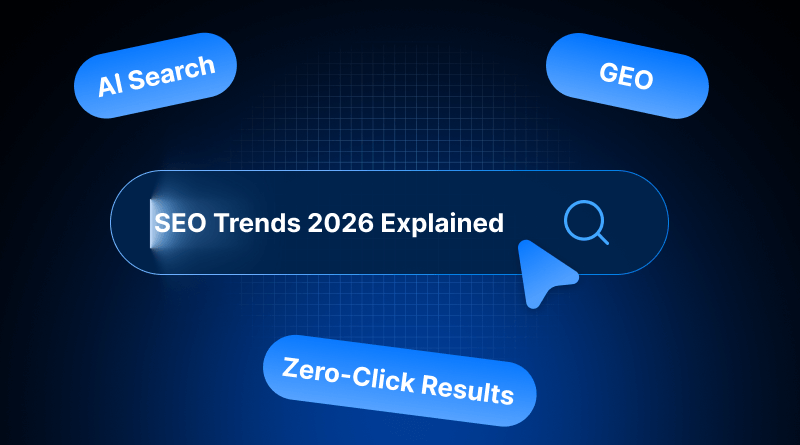
Are you worried about a sudden drop in website traffic despite your top search engine rankings? AI overviews are probably the cause. The user’s search behavior has migrated from traditional search engines to AI platforms like Perplexity, Copilot, and ChatGPT. The SEO measures are not only relevant for traditional search patterns but also for AI citations, which builds trust among visitors.
In this blog, we’ve rounded up the best SEO trends for 2026, from generative engine optimization to E-E-A-T to structured, citation-ready content. How to tweak these strategies for search experience? Scroll down to learn. It helps to build an AI-driven search experience for visitors.
AI systems are now able to read, interpret, and summarize the web content before the user even clicks on any link. As a result, being ranked number one is no longer the only objective. In fact, displaying your content inside AI will be just as important. Thus, when your content is properly written, it’s highlighted in SERPs, thereby increasing your visibility (especially when supported by a reliable web hosting foundation).
Today’s SEO involves understanding people’s real intent, building trust with them, and creating effective user experiences. So, if you are merely creating content for search engines, you need to pause and rethink. Now is the perfect time to catch up with all SEO trends of 2026 and train search engines to trust, cite, and rank your content with confidence.
Table Of Content
The Biggest Shifts Redefining Search in 2026
You must know “Content is being interpreted, not just indexed.” All the old-school ways have now been upgraded, and if your content is not up to par, you are losing business gems. Let’s check what’s changing in search engines and ranking patterns.
1. AI-Driven Search Experiences
In the current wave, “Answers come first, links come later.” AI has become the driving force behind search. AI Overviews replace traditional first-page results and present quick access to answers, summaries, and other key information without requiring users to click through to individual webpages. Users can now get answers to their queries within seconds. Ultimately, you don’t have to navigate through multiple links.
If you want to rank on search engines like Google, your content should be structured and ready for citation. You can also host it on performance-optimized platforms such as WordPress hosting or cloud hosting. It needs to be organized, have good headings, and be straightforward in answering questions and solving problems. The easier your content is to read, the more trustworthy it appears.
What do you get? A better chance of good placement in search results generated by AI.
2. Search Everywhere Optimization
Search will keep evolving, and so must SEO. The concept of search no longer refers to a single platform. Instead, search engine optimization relates to various platforms, such as Google, Bing, YouTube, and all types of social media sites that retrieve data from multiple platforms. Also, voice-controlled devices like Amazon Echo & Google Assistant and artificial intelligence apps that recommend or summarize available online resources function similarly. A user could search for a brand using a video and a post on social media before arriving at a company’s website.
What does this mean? Multiple touchpoints in customer discovery add layers of complexity to your brand’s findability. A single path could start from a user’s social profile, continue to a search engine like Bing, and conclude with an overview of the results presented by an AI application. Therefore, visibility across all different formats and platforms is just as essential as traditional website ranking methods. Many companies are missing opportunities when their products exist only on one channel or service provider.
Implementing Search Everywhere Optimization suggests that a company can present every piece of content consistently and accurately across all platforms, whether hosted on shared hosting, VPS hosting, or other advanced infrastructure. The key is that the message, value, and expertise presented by the company should remain the same, regardless of the platform shared through. This helps create confidence from the search engine algorithms that your content is valid and reliable.
3. Zero-Click Search and AEO
With the current development, countless searches are answered. Users typically obtain answers directly from AI Overviews, awarded featured snippets found on the search engine results pages (SERPs), knowledge panels (found via Google), or voice responses (as Google Assistant). The trend in “zero-click searches” means web owners are no longer able to gauge their site’s success solely by tracking their website traffic.
In simple terms, search results are now interactive and users are more likely to trust secure websites protected by SSL certificates. So website owners can now optimize their sites to show up as sources inside AI search answers. This helps you get more visibility by being the reference point that the search engine actually cites. This citation as an authoritative source or a trusted reference point builds up awareness.
To provide users clarity, the answers must be in more than one format. This helps search engines to accurately extract information from websites. By implementing an FAQ, adding structured data markup, and providing clear and to-the-point explanations, you can help facilitate Google in extracting the correct information for the answer.
Key SEO Trends 2026 to Watch
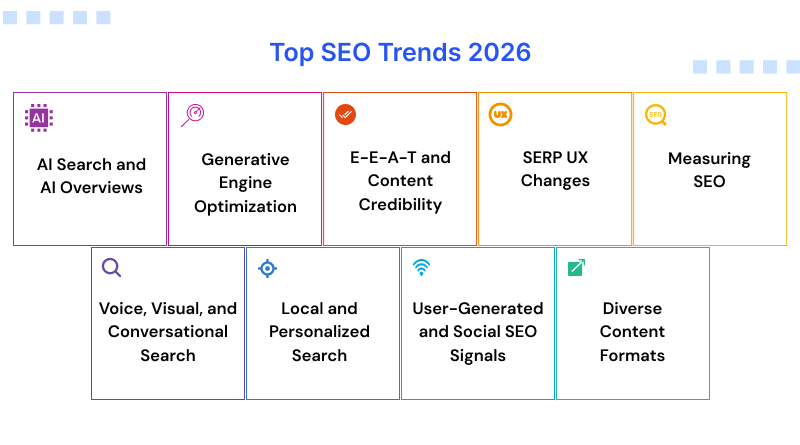
Trend #1: AI Search and AI Overviews
The types of AI Search and AI Overview services shape content discovery. AI systems randomly select online resources, while AI Overviews include only resources that are considered relevant and trustworthy based on the following criteria: accuracy of content, clarity of instructions, timeliness of the pick, and topical information. Content that clearly explains a topic and provides sufficient detail will likely be used by an AI system and referenced within its database.
With the current way, less clutter means more impact. The depth of content is more critical than before. By furnishing enough data in a well-organized structure, the reader will understand the subject more effectively. Content that lacks any depth or is imprecise in addressing user intent will not be included in the AI Overview database. This procedure works because AI systems prefer content that is created with confidence and portrays genuine knowledge, in contrast to superficial content.
The structuring of content allows for easy extraction by AI. By using clearly defined headings, short responses/bullet-point lists, and an overall logical flow, the user will know how to use and understand the content clearly. In other words, if a content creator can provide clear instructions easily understood by a reader, an AI will also easily access and summarize the information. McKinsey reports, visitors are having a diversified search behaviour across platform.
Trend #2: Integrating AI tools
Artificial intelligence is now embedded into marketing workflows. As per a survey of SEO Clarity, 86% of SEO experts are using the best AI tools in their day-to-day work. 83% of companies with 200+ headcounts see significant improvement in their SEO performance via AI use. The gain in efficiency is not insignificant: thanks to the AI support, SEO experts save an average of 12.5 hours a week. Here we put money into strategic work. Repetitive work just happens automatically.
This is a process that ensures AI is not replacing experts but scaling the potential. The human component, strategic thinking, creativity, and context-based decisions, remains imperative. The hybrid operation of humans and AI agents will co-exist peacefully in the future.
Trend #3: Generative Engine Optimization (GEO)
To summarize the way we optimize our content we have seen a large transition from Search Engine Optimization (SEO) to Generative Engine Optimization (GEO). Where traditional SEO is concerned with how a web page will rank on a search engine (Google), GEO is concerned with whether or not a page’s content will be selected by an AI solution to produce a response to a user’s question.
In order to optimize your content for AI-generated answers, it must be clearly written and organized. The information must explain complex topics in an easy-to-understand format and in a logical progression. Additionally, it has to be able to effectively and quickly solve the user’s problem, which means that condensed, organized, and concise information is much more useful than long passages of text without focused direction.
When you are writing content to be reused by AI solutions, you need to provide a wealth of detailed information so that the AI can find it easily. You should include: clear definitions of key terms, step-by-step explanations or examples for each term; examples of each term in relationship to other terms; and brief summaries of the topic being addressed in the content. By providing clear, concise information, AI engines will be more confident that the information is accurate and reliable so they will be more likely to use it when developing their own content.
Trend #4: E-E-A-T and Content Credibility
This year, E-E-A-T has become more important than just verifying keyword placement. Clear sources add credibility, and keyword density no longer serves as the primary metric for evaluating content. Search engines and AI platforms prefer content produced by writers with experience or involvement in the subject matter. To put it simply, you should have an inherent understanding and verified ownership through a registered domain name.
Author transparency has come to a point where clear author profiles, along with identifiable credentials and relevant real-world experiences, build a writer’s reputation. When a writer provides authentic perspectives based on hands-on experience, referenced case studies, or original observation, their content adds value.
In other words, when an author presents current, timely information through the use of factual claims, he/she can be trusted as a reliable source. Due to the ability of AI systems to verify and produce safe, factual, and accurate content for their users, trust is fast becoming a dominant ranking factor for search engines.
Trend #5: SERP UX Changes
Readers, we all understand that search behavior has clearly shifted. Information cards, expandable answers, and interactive search results now dominate search result pages (SERPs)—allowing users to explore different aspects of their search directly on the SERP. So, now users don’t have to scroll and click through multiple links to find what they want.
Before the current SEO trends, a search engine would display a list of blue links (relevant search results), which provided no direct answer. Visitors have to click and verify themselves from the mentioned links to find the applicable answer. SERPs are now focusing on providing users with the best experience by offering multiple methods of accessing content. When content is optimized for SERPs, it will be displayed and recommended frequently.
It’s important to create optimized content for visual hierarchy; writers can include appropriate headings, logical sections, and appropriate spacing between paragraphs. Thus, both users and AI can read and quickly comprehend content. By providing scannable and smooth navigation of a webpage through good design, users will find it easier to read and evaluate content, and it can be recommended for further review or consumption in SERPs.
Trend #6: Measuring SEO
It’s not just about keyword rankings when it comes to measuring SEO. Although it is still a valuable measure of success, it’s only part of the story. A large number of users will be accessing the information they seek via AI Overviews, so there will be instances where a site can rank well and still not have any visitors.
In addition to being visible on search engines, gaining visibility within AI Overviews is now one of the most important signs of success. Within AI systems, if someone references or cites your content, that helps establish your authority, and it builds long-term trust. With the rise of brand mentions and citations in SERPs, social media, and AI-generated answers, it’s clear that these are reliable indicators of the relationship between your content and the consumer.
With the rise of social media, the need for brand engagement is not just about raw web traffic numbers. To understand the true value of your search efforts, you must measure how people interact with your brand.
Trend #7: Voice, Visual, and Conversational Search
Users have adopted a more human-style way of searching online; there is a greater emphasis on using natural language for search queries. With the introduction of virtual assistants and chatbots powered by AI, users now use longer questions when searching for information. As a result, there is more conversational dialogue between users and systems.
Visual search continues to increase in popularity and use. It simply means finding information with images and video content is now straightforward, and users get exactly what they want. To take advantage of this trend, it is important to optimize images with appropriate quality, use alt text, and create good-quality titles and descriptions for any video posted online.
When creating content, you must ensure that it is presented in a way that encourages conversation. Users typically expect an answer to their question from the person or system they are communicating with. Therefore, using clear headers or sections of text within content and providing direct and concise answers allows search engines to quickly pick the gist of the content’s intent.
Trend #8: Local and Personalized Search
SEO trends have also shown high personalization of search results. What does this mean? Search now happens everywhere: your behavior, location, preferences, and previous activities dictate what you see in search results. So, although two individuals may be searching for the same keyword, their results will vary significantly based on their respective intents and contextual factors.
There will be much more emphasis on local relevance signals. Businesses located nearby and region-specific content will be prioritized over other factors. Therefore, it is now necessary to optimize for local markets, regardless of how broadly your company’s footprint may reach.
New listings, verified information regarding businesses, and authentic reviews are significant factors for establishing visibility. Fresh business listings, accurate information about business operations, and actual customer reviews can help a business build a strong degree of confidence with consumers who see those listings.
Trend #9: User-Generated and Social SEO Signals
Search engines now focus razor-sharp on the voices of actual people within the context of online interactions. This happens with both companies and related topics for improved site discoverability through social media activity. That includes sharing posts about brands, embedding videos, engaging in dialogue related to those products or services via social channels, etc.
User-generated reviews and comments are solid signals of trust between the company and its customer. Users can connect through their experiences with each other and communicate what they think is valuable about your business.
Online discussion boards such as Reddit or specialized blogs and video channels are increasingly appearing on search results pages (SERP). These forums are filled with real people sharing their views about how they feel about products or services. A well-developed social network fosters trust among consumers, creating an opportunity for businesses to use community-generated content for indexing and optimizing content on the web.
Trend #10: Diverse Content Formats
Search is no longer one-size-fits-all, so just blogging about publishing it is not a complete step.
Search engines (Google) and artificial intelligence (AI) systems rank different formats of content that meet the user’s needs based on image, video, etc. Today, users consume content in different ways, depending on how and where they conduct their searches (e.g., videos, infographics, etc.).
Videos and other visual content are engaging and highly visible within AI overview/visual search content types. Step-by-step guides/checklists and interactive tools are also great for delivering practical, quick value to the user.
Creating content for multiple search channels is essential; therefore, one topic can be made into several types of formats (blog, video, infographic, short-form post, etc.). For visual SEO, visual SEO best practices, such as image clarity/detail/description, as well as the use of uniform design formats, allow the user to easily find the content on modern search platforms.
Practical SEO Strategies for 2026
Modern SERO trends require an approach that meets both human needs and AI understanding.
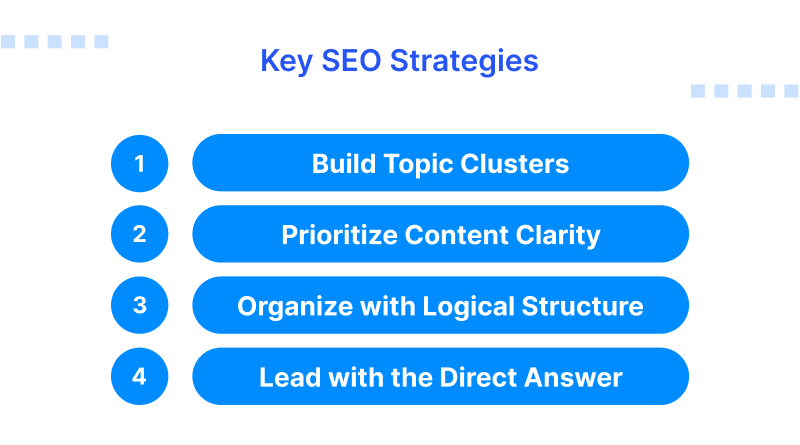
1. Build Topic Clusters
The initial step is to form topic clusters, rather than publishing posts in isolation. In other words, instead of having a web page focus on only one keyword, develop multiple related content pieces that cover a topic. This facilitates content depth, authority, and relevance and serves to naturally navigate users through further related information.
2. Prioritize Content Clarity
Clarity in content is the foundation for how modern SEO is performed. Depth beats surface-level content; thus, for both human readers and AI systems to read, understand, and utilize your content accurately, it should contain clear, simple language without any overly complex wording or jargon. In addition, clearly explained content increases your chance of getting featured in AI summaries.
3. Organize with Logical Structure
A section of your content should be focused on a single idea and define that idea clearly. This logical structure allows search engines to ascertain the context of the heading. Further, it helps AI systems to extract necessary information accurately and quickly.
4. Lead with the Direct Answer
The final key strategy is to begin with the direct answer to the question, then expand. Starting with a brief but clear answer to the question and then going into greater detail by including examples/cases/steps to explain what you mean works well with featured snippets, AI overview responses, and voice search responses.
What SEO Performance Tools Should You Use?
1. Search Console for AI Visibility Signals
Google Search Console (and other similar platforms) provides insight and data on how your content will appear in AI-generated answers or summaries. Tracking the pages that are cited, referenced, or highlighted in AI-generated content analyzes your presence and authority within the AI landscape.
2. Analytics for Engagement Quality
As we have learned, traditional pageviews do not provide a complete picture of SEO performance. Modern analytics platforms verify more granular measurements on engagement (how far users scrolled through your content, how long they spent on a particular piece, how many times they clicked on an interactive element, and how many times they returned to a piece of content). A high level of user interaction with your content indicates relevancy to both users and AI.
3. SERP Tracking Tools with AI Overview Monitoring
SERP tracking tools today allow you to monitor AI answers, featured snippets, and knowledge panels. Tracking an AI answer determines how many times the AI used or referenced your content, even if no one clicked it. Tracking AI usage helps you to optimize for “Presence SEO,” rather than simply generating “Traffic SEO.”
4. Visual Search and Video Performance Tools
With the growth of visual and video search, you must have tools to monitor your image and video performance. By monitoring your image/video search visibility, Click Through Rate (CTR), and AI Recommendations, you will have clear stats on whether your multimedia content is reaching the right people.
Last Line: The Future of SEO Trends 2026
SEO metrics have three major priorities to bring more visibility through AI citations.
1. Optimize content to adhere to AI algorithms.
2. Build real EEAT, not keyword optimization.
3. Track the number of AI citations.
You don’t need to overhaul everything simultaneously. Kick-start your optimization journey by auditing the top three pages for precision, AI-friendliness, and accuracy. You can figure these things out by reading the introductory line of the content. Please correct any grammar errors that may be present.
Brands leverage AI-driven search results or customer support to sustain themselves in the competitive business landscape in 2026 or beyond. To capitalize on this, pick two or more trends and augment your optimization journey.
FAQs
How is AI changing SEO in 2026?
AI has developed search engines into smart answer engines. Rather than simply providing a long list of URLs, search engines now construct and offer a summary of a piece of content, with quick and accurate answers to users. Therefore, the content created today for the online world should be concise, structured, and credible to qualify as a featured result.
Is traditional SEO still relevant in 2026?
Yes! Despite the changing landscape of traditional SEO (new ideas, methods, processes, programming languages, etc.), it remains an essential tool that digital marketers rely on. So to get a better position and match current SEO trends, you simply need to upgrade your traditional practice.
How can websites optimize for AI Overviews and zero-click searches?
A website must do the following:
1. Answer the question asked in the search engine.
2. Implement a clear and organized (structured) list of headings.
3. Use credible and/or authoritative data in the content.
4. Keep the number of words in a search engine query to a minimum.
By providing all of this information in a concise manner, it becomes easier for AI-based applications to locate appropriate and relevant content when generating overviews.
What metrics should be used to measure SEO success in 2026?
Rather than solely monitoring placement and rank, tracking metrics such as AI visibility, quality of engagement, brand mentions, and total presence across all search engine platforms can be helpful. This metric analyzes how your content is being perceived, utilized, shared, quoted, referenced, etc., within both AI-based applications and users.