
 Gaurav Bodhare
Modern digital architecture often feels like a collection of compromises. Most teams settle for virtual instances, where their speed depends on how much memory the co-hosted user is using. But when your application handles high-frequency financial data or thousands of simultaneous e-commerce checkouts, settling isn’t an option. Owning the hardware through a bare metal server provider is the only way to ensure your software has undivided attention from the CPU and memory.
This isn’t about simply renting a machine; it’s about removing the invisible friction of virtualization. Bare metal hosting providers deliver a single-tenant environment where every clock cycle is dedicated to your code. For Indian enterprises scaling in a mobile-first economy, choosing the best bare metal providers in India is a strategic move to secure ultra-low latency and absolute data sovereignty.
Summary (TL;DR)
Bare metal server hosting provides dedicated physical servers with no virtualization, ensuring maximum performance, security, and full hardware control. It’s ideal for high-traffic websites, enterprise workloads, AI/ML, and data-intensive applications.
The page highlights top providers based on performance, scalability, customization, and pricing, helping businesses choose the right solution for mission-critical hosting.
Table Of Content
How Does Bare Metal Server Hosting Work?
At its core, bare metal hosting is a direct connection with the physical machine. In standard cloud environments, a hypervisor occupies the space between your app and the hardware, consuming a percentage of performance to manage multiple users. A high-performance bare metal server removes the hypervisor layer to grant your applications direct access to the underlying hardware. Your operating system interfaces directly to the processor, which results in predictable throughput and the kind of I/O speeds that virtual machines simply cannot replicate. This architectural purity is why performance-critical industries—like AI learning, gaming, and big data—refuse to share resources. You can pick your kernel, change BIOS settings, and build NVMe storage setups for fast data access.
What Are the Benefits of Bare Metal Servers for Indian Businesses?
When you share a server, your performance depends on what everyone else is doing. If a “noisy neighbor” on a virtual machine suddenly consumes the CPU, your website feels the lag. A bare metal hosting provider ends this competition by handing you the physical machine. It’s about controlling the hardware so your apps don’t have to compete for resources.
Securing a spot with a top bare metal server provider offers a level of technical control that standard cloud setups just can’t touch:
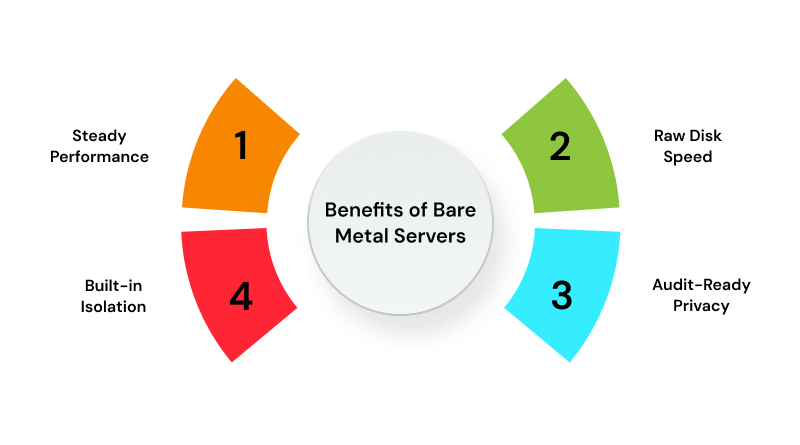
- Steady Performance: Your response times stay consistent because no one else is stealing your processing power. Even during a massive traffic spike, your hardware focuses only on your users, making speed a guarantee rather than a hope.
- Raw Disk Speed: High-traffic databases need to move data fast. Since there is no virtualization layer slowing things down, you get direct access to the NVMe or SSD storage. This means you avoid those hidden “IOPS taxes” and restricted speeds common in shared environments.
- Audit-Ready Privacy: If you handle sensitive info, you need to know exactly where that data lives. Physical machines make compliance easy because your files aren’t distributed across a virtual cluster. You can point to the specific disk and say exactly where the data is kept.
- Built-in Isolation: Physical separation is the ultimate security. Because you aren’t sharing the box with anyone else, you aren’t vulnerable to the typical leaks or cross-site attacks that happen when different companies live on the same hardware.
Top Bare Metal Server Hosting Providers in India
1. MilesWeb

MilesWeb establishes feature-driven authority by delivering enterprise-grade dedicated hardware that eliminates complex infrastructure hurdles. Instead of following the industry trend of over-complicating dedicated infrastructure, MilesWeb prioritizes high-velocity hardware that functions without the typical management burden. They provide a stable foundation designed to absorb massive traffic surges while keeping performance metrics stable. For those seeking the top bare metal providers in India, their infrastructure offers the specific localization needed to dominate the regional market through superior connectivity.
The most significant value lies in their refusal to treat essential data protection as an optional premium. While other providers often charge extra for basic security layers, MilesWeb integrates daily automated backups and free professional email accounts into the core of their bare metal plans. This approach ensures your business maintains a professional image and a resilient data strategy without needing to manage a complex list of add-on costs.
Strategic Advantages
- Strategic data centers
- Automated daily backups
- Free business email accounts
- Latest Intel Xeon and AMD EPYC processors
- 24/7/365 access to technical specialists
2. OVHcloud
OVHcloud is a global titan known for its industrial approach to server manufacturing and network capacity. While most providers simply rent out space in someone else’s data center, OVHcloud takes a different route by designing and building their own hardware from the ground up. Owning their infrastructure means they operate independently of third-party vendors, delivering a transparent cloud experience without unexpected fees. For companies that need to anchor their digital operations on a global scale while keeping a localized footprint, their infrastructure provides a massive private backbone that moves data without the friction of public internet congestion.
The defining edge of their platform is the vRack technology, a private network layer that lets you bridge multiple servers across different continents as if they were located in the same rack. It’s a powerful tool for architects who need to create secure, high-speed clusters for distributed applications or mission-critical databases. By removing the virtualization layer and the risk of shared resources, OVHcloud ensures that your dedicated resources are exclusively yours—giving you total authority over your hardware’s performance and energy footprint.
Strategic Advantages
- Global vRack interconnect
- Unmetered bandwidth
- Water-cooling technology
- Industrial-grade DDoS protection
- Automation-ready infrastructure
3. Vultr
Vultr has successfully challenged the idea that dedicated hardware has to be slow to deploy or rigid to manage. You get the raw power of a physical machine with the same automation as a cloud instance. This lets you launch high-performance bare metal servers instantly, just like a virtual machine. It is built for developers who need to test or scale data-heavy apps immediately without waiting for manual server setup.
The real shift in the Vultr experience is their move toward financial transparency through hourly billing. Most hosts trap you in monthly bills, ignoring the need for accelerated machine learning or quick traffic bursts. With a hardware stack that often includes cutting-edge GPU options and ultra-fast storage, they provide the agility needed to pivot your technical strategy in real time.
Strategic Advantages
- 32+ global data centers
- Lightning-fast NVMe storage
- Standard 10 Gbps networking
- Hourly billing for financial control
- Complete root access with ISO support
Related Read: Dedicated Server vs. Bare Metal Server: Key Differences
4. Equinix Metal
While most providers focus solely on the server itself, Equinix Metal shifts the spotlight to how that hardware interacts with the rest of the digital world. By positioning your physical infrastructure inside the most densely connected data centers on the planet, they eliminate the traditional lag that occurs when different networks try to communicate. It is a specialized environment designed for enterprises that need their bare metal hosting provider positioned physically adjacent to major cloud on-ramps and internet exchange points, ensuring that your data travels the shortest possible distance.
The true strength of this setup lies in Equinix Fabric, a software-defined interconnection that lets you link your dedicated hardware to other public clouds or service providers in minutes. This setup allows for sophisticated hybrid architectures where your most sensitive databases stay on isolated physical machines while you still leverage the scalability of the public cloud for less critical frontend tasks. It’s an infrastructure-first approach that treats connectivity as a core component of performance rather than an afterthought.
Strategic Advantages
- Instant ecosystem access
- Terraform and Ansible compatible
- High-proximity datacenters
- Enterprise-grade security solutions
- Edge computing and real-time analytics
5. AWS (Amazon Web Services)
For teams already invested in the Amazon ecosystem, transitioning from their existing tools just to get better performance is a difficult trade. AWS bare metal instances solve this by providing the raw power of dedicated hardware without forcing you to abandon the security and management layers you’ve already built. It is a setup designed for applications that refuse to run on virtualized hardware—like custom hypervisors or aging legacy stacks—while ensuring these systems stay connected to the rest of your custom hosting environment.
The primary benefit of this architecture is the total lack of operational friction. You manage your physical machines using the same console, security groups, and IAM policies as your virtual instances, so there is no new learning curve. By using a bare metal cloud provider that integrates with services like S3 and the Nitro System, you can offload background management tasks to dedicated hardware. This ensures your main processor stays entirely focused on your application’s performance, giving you a dedicated environment that feels as flexible as a standard cloud instance.
Strategic Advantages
- Nitro system management
- Unified management
- Scalable Amazon EBS storage
- Global compliance standards
- Deep ecosystem integration
6. CtrlS
As a Tier-4 provider in Asia, CtrlS uses integrated redundancy that goes beyond standard benchmarks. They support organizations like banks and healthcare providers, where even a few seconds of downtime is not an option. Being a bare metal server provider means they offer more than just hardware; they provide a protected environment that stays online through power cuts, cooling failures, or security threats.
What makes their massive scale sustainable is a commitment to “green” engineering that actually works. By running their solar farms and implementing high-efficiency cooling, they offer a hosting environment that is as environmentally conscious as it is technically resilient. For enterprises that need to prove absolute data safety and 100% uptime to their stakeholders, CtrlS provides the most hardened physical foundation available in the regional market.
Strategic Advantages
- Network Redundancy
- Military-Grade Isolation
- Eco-First Infrastructure
- Advanced disaster recovery
- AI-optimized cooling systems
Related Read: Dedicated Server Vs Shared Server: Know The Difference
Comparing the Best Bare Metal Server Hosting Providers in India
| Provider | Ideal Use Case | Standout Advantage | Technical Edge |
|---|---|---|---|
 |
Enterprise-Scale Apps | Priority Hardware Support | Dedicated L3 Networking & ISO-Certified Tier-4 Ready Facilities |
 |
Global Distributed Apps | Private vRack Interconnectivity | Global Water-Cooling Tech for Sustained CPU Performance |
 |
DevOps & Rapid Testing | Instant Hourly Deployment | NVMe-Backed High-IOPS Dedicated Storage |
 |
Hybrid & Edge Computing | Direct Network Interconnection | Physical Presence in 240+ Global Interconnection Hubs |
 |
Cloud-Native Enterprises | Full Ecosystem Integration | Hardware-Accelerated Virtualization via the Nitro System |
 |
Mission-Critical Systems | Rated-4 Physical Redundancy | Dual Active Power Feeds & Advanced Cooling Reliability |
How to Choose from the Right Bare Metal Server Providers?
Choosing from affordable bare metal service providers involves looking past marketing jargon to audit the actual network backbone. A weak network infrastructure impacts your performance if your provider skips direct peering with major internet networks.
- Redundancy Checks: Look for Tier-3 or Tier-4 facilities that guarantee power and cooling continuity, ensuring your hardware never faces a physical shutdown.
- Hardware Transparency: A reliable bare metal cloud provider lists specific CPU models and RAM types. Ensure you are getting ECC (Error Correction Code) memory to prevent data corruption.
- Human Expertise: Root access gives you control, but your support team must swap hardware or reset ports within minutes.
Concluding Insights
Choosing your hardware foundation is the defining technical move for any growing brand. Moving to a dedicated environment isn’t just about speed; it’s about reclaiming the autonomy needed to compete in a crowded digital market. MilesWeb stands out by pairing raw physical power with the kind of daily protections and professional tools that actually matter for scaling businesses.
Investing in this level of infrastructure means your website or app is ready to deliver a top-tier experience without encountering invisible performance ceilings. Direct access to hardware provides the baseline you need to expand your apps without exceeding virtual limits.
FAQs
1. What are the key differences between bare metal and virtual servers?
Virtual servers force you to share a machine with others through a middleman layer that can slow things down when your “neighbors” get too busy. A bare metal hosting provider delivers the entire physical server so your apps interface directly with the CPU and memory without any interference. While virtual machines are good for quick resizing, bare metal is the only way to get the full capacity of the hardware’s power and total isolation for your data.
2. How do I choose the right bare metal server configuration?
Start by identifying your hardware limits. For high-traffic databases or real-time analytics, use NVMe storage and high-frequency CPUs. If you are doing machine learning or video rendering, a high-performance bare metal server with dedicated GPUs is required. A 1:4 ratio—4 GB of RAM per CPU core—is a good baseline for most workloads.
3. Which infrastructure safeguards are essential when evaluating a bare metal provider?
Verify the host provides Secure Boot and TPM for the boot process alongside hardware isolation. You need a bare metal cloud provider with built-in DDoS protection for your firewalls and intrusion systems. Physical security matters too; the data center should have multi-zone access controls and 24/7 surveillance to protect the hardware where your data lives.
4. What kind of technical support can I expect from bare metal hosting providers?
Support in the bare metal world is usually split between infrastructure management and software assistance. You should expect your provider to handle all physical hardware maintenance—like replacing a failed drive or fixing a power supply—within a strict SLA timeframe. However, since you have full root access, you are typically responsible for the OS and applications. If you prefer a hands-off approach, look for a top bare metal server provider that offers managed services, where their team also handles security patching and kernel updates for you.