Sommaya Singh

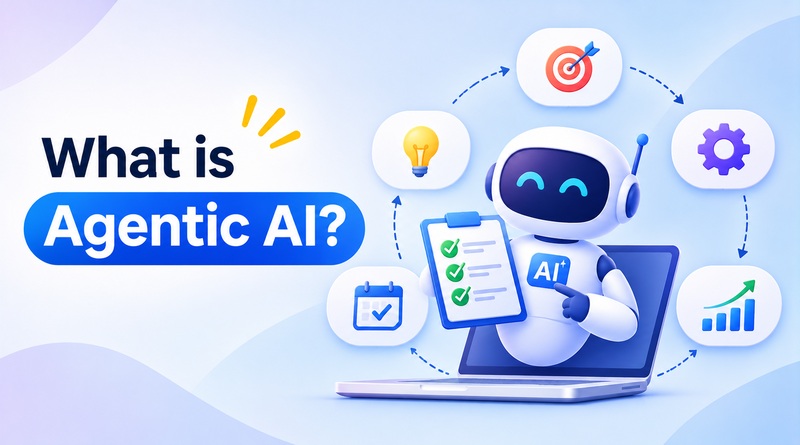
Agentic AI is a more advanced form of artificial intelligence which makes decisions autonomously and requires minimal supervision from humans. Traditional AI analyzes data . Agentic AI however will analyze data and set goals and plans and execute tasks automatically . The technology is changing a variety of industries by automating complicated processes and streamlining workflows.
AI agents go beyond static automation by independent reasoning, new data adoption, and collaboration across dynamic software workflows. The blog overviews the agentic AI and its characteristics.
Table of Content
Understand Agentic AI
Agentic AI means an automation workflow that makes decisions based upon past patterns and current assessments. It tracks progress towards and decides on the next steps, asking humans or other AI systems for assistance.
Unlike conventional AI, the term mostly used for nongenerative AI services, agentic AI isn’t limited to input/output models through human queries and supervision. Instead, the automation technology is sufficient for the system to take sophisticated steps toward its objectives, checking in with humans only when needed.
Also Read: Generative AI Vs. Agentic AI Vs. AI Agents
How Does Agentic AI Work?
- Setting a goal and parameters: Human insight sets the project’s outlook and limitations.
- Tasks and steps: LLM properly processes the retrieved information from the user and executes tasks. It satisfies the desired outcomes under the constraints of the given conditions.
- Autonomous decisions: After the objectives are established, the agentic AI system determines how to achieve its objectives and acts autonomously or with human interaction when appropriate.
- Feedback and revision: The AI agent takes data from parallel tasks and adjusts the workflow when needed. It eliminates the steps for workflow optimization to add in new steps for further data gathering. AI agentic is popular because of its best decision-making ability and real-time data adaptability.
- Systemic improvement: As the agent approaches the objective, it uses logged results and actions to feed into the systemic feedback loop (also called the data flywheel). The loop enhances the agent’s capabilities, with the goal of improving its accuracy and efficiency over time.
Also Read: Vibe Coding vs Agentic Coding
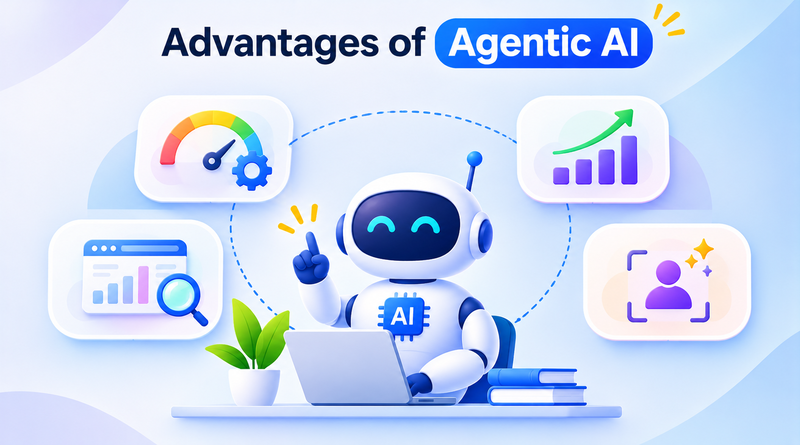
Advantages of Agentic AI
1. Improved Efficiency and Flexibility
Agentic AI is a learning and adaptable process throughout the business. Complex multi-step tasks and decision-making can be expedited by the use of autonomous AI agents. Independence will save time and reduce operating costs and the risks of human error. It can reason at a fundamental level and self-correct which is a valuable resource for the entire workflow automation, leading to a better overall performance.
2. Higher Productivity and Concentration
Agentic AI Automates boring, repetitive jobs and streamlines complex workflows to enable scalable digital work. It frees human teams from administrative tasks to focus on strategic, creative and high-value work. Artificial intelligence is able to do things faster and more accurately. It can also make decisions in real time and learn continuously.
3. Informed, Real-Time Decision-Making
Autonomous agents process cast data streams from different real-time sources, faster than any human team could. By detecting subtle patterns, synthesizing information across systems, and forecasting outcomes, we provide actionable insights. The capability of business decisions being data-backed and timely provides a significant competitive edge in evolving markets.
4. Deep Personalization at Scale
Agentic AI has great power to replicate human-like decision-making power. They mimic human intuition, comprehend the consumer’s context, and recall past conversations to produce personalized output. It helps in targeted marketing, consumer service, and providing personalized financial advice. It can provide a hyper-personalized experience, which translates into higher user satisfaction and long-term loyalty.
Also Read: OpenClaw Alternatives
Examples of Agentic AI
- Agentic artificial intelligence can be used by businesses to operate supply chains more efficiently, optimize inventory levels, forecast demand and plan logistics.
- Agentic AI is used in healthcare sectors to communicate with patients, track their needs, apply treatment regimens and provide personalized assistance.
- The ability of agentic AI to automatically generate debugging code, handle the development lifecycle, and design system architecture can lead to effective growth of software development.
- Software operations use agentic AI for the autonomous operation of networks and other IT infrastructure or services.
- Cybersecurity benefits from an agentic AI to help monitor network traffic, detect issues, and respond to threats in real time.
- Researchers use agentic AI to design and run experiments, analyze data, formulate new hypotheses, and speed up innovation pace by operating faster than humans.
- Finance and trade can scale with the ability of agentic AI to potentially analyze market trends and carry trade orders decisively based on the real-time data.
Also Read: n8n vs LangGraph
How Is Agentic AI Different from Traditional AI?
Traditional AI and agentic AI have distinct workflows. Conventional models use logic-based systems to process data and generate generic output. Fraud detection is the best example of traditional AI. In this case, the AI system flags anomalies and consumer records, purchase categories, and demographics.
This is an input (transaction data)/output (determination of fraud status) situation. Despite the workflow decisions involved, the AI is ultimately performing a predefined task for which it has been specifically trained.
Agentic AI is designed to be more autonomous, focusing on a goal, then deciding on the best way to get there. An agentic AI system has the independence to seek out the information it needs to determine how to achieve its objectives or even to connect with other available tools.
Agentic AI unveils sensitive information that provides more context and produces better results. Therefore, if a previous fraud detection model noticed an anomaly in purchase price and category that leads to a flag, an agentic AI system would be able to communicate with other systems to gather further details about the customer’s situation.
Also Read: Claude Alternatives
Conclusion
Agentic AI defines a system that doesn’t just answer questions but pursues goals. They outline steps, use tools, and carry out tasks with limited human input. AI agents are helpful for research, customer support, scheduling, and software development, where a task has several steps with a clear outcome.
These AI agents are still software that relies on models, which can produce errors. So the results depend on how well they are set up, what access they are given, and how closely people check the output.
To experiment with agentic AI, begin with a small-scale project. Pick one specific job, limit what the agent can do, involve a human for better choices, and keep track of how well it’s doing against set goals. Before you scale, review security, data privacy and cost and check rules that apply to the data the agent will handle.
FAQs
1. What are common use cases for Agentic AI?
- Customer Service: End-to-end ticket resolution and proactive customer support.
- IT & Software Development: Autonomous IT service management (ITSM), self-healing systems, and coding/debugging.
- Sales & Marketing: Multi-step campaign execution, content drafting, and lead research.
- Supply Chain & Finance: Dynamic demand prediction, automated restocking, and financial data analysis.
2. Does Agentic AI require human supervision?
Yes, typically through a human-in-the-loop framework. While the agent handles routine multi-step execution autonomously, human approval gates are usually enforced for high-stakes actions like spending money, approving payments, sending mass emails, or deleting data.
3. What is the difference between an AI Agent, a Single Agent, and Agentic AI?
- AI Agent: A fundamental software program that autonomously performs tasks and uses tools.
- Single Agent: A pattern where one individual AI agent operates independently to fulfill a purpose.
- Agentic AI: A broader system where multiple specialized AI agents collaborate, delegate tasks, and are managed by an orchestration mechanism to solve larger business goals.
4.What are the core components of an Agentic system?
- The Brain (LLM): Handles language understanding, decision-making, and logic.
- Memory: Retains short-term context and long-term history to avoid repeating mistakes.
- Tools / APIs: Allows the agent to search the web, run code, or interact with software applications.
- Orchestration / Planner: Coordinates single or multiple agents working together on complex projects.
- Evaluation / Safeguards: Built-in reflection or human-in-the-loop approval gates for critical actions.