
 Gaurav Bodhare
Every growing business eventually faces an infrastructure decision worth getting right: own the hardware running its applications, or lease it entirely from a specialized provider. That single decision rests on two terms, colocation and hosting, that are used interchangeably far too often despite standing on entirely different sides of an ownership line. Colocation keeps hardware ownership firmly with the customer, while hosting transfers that ownership to the provider for the duration of the contract.
Overlooking that difference costs businesses time, budget, and occasionally a costly contract renewal. Many teams outgrow shared cloud hosting and assume the next step is simply acquiring a bigger server, without realizing that colocation server and dedicated server hosting represent fundamentally different approaches to ownership and control.
Colocation asks a business to invest in its equipment and manage it from a distance, while dedicated hosting places that responsibility entirely on a provider in exchange for a predictable monthly fee. This guide walks through what each model actually means, how colocation operates on a daily basis, who a colocation provider really is, and where the real differences show up once the two models are compared directly.
Table Of Content
What Is Colocation Hosting?
Colocation, in plain terms, means paying for space inside someone else’s advanced facility instead of building one yourself. Companies running specialized or demanding workloads often choose this option because standard hosting plans cannot handle such loads. It becomes the natural choice for a business that wants facility grade infrastructure without taking on the cost and effort of running one. The provider supplies power, cooling, physical security and network connectivity, while the business owns and manages its own servers. This arrangement keeps hardware control in the company’s hands, without the burden of maintaining the building around it.
What Is A Colocation Provider?
A colocation provider is a distinct entity from a data center in the broader sense. A data center often operates its hosting or cloud services in addition to colocation. A colocation provider’s role, by comparison, stays limited to the facility itself: rack space, power, cooling, and connectivity. It secures rack space, delivers redundant power and cooling, maintains network uplinks, and controls physical access to the building. Everything beyond the walls, the rack, and the electricity stays in the customer’s hands.
This distinction is relevant for a small business evaluating vendors, since a facility that colocates equipment isn’t automatically equipped to manage software, backups, or security patching. Understanding what colocation in a data center actually covers helps set expectations early, so a business isn’t surprised later when a provider clarifies that server-level troubleshooting falls outside the contract.
What Is Dedicated Server Hosting?
Renting a dedicated server means the provider owns the physical machine entirely, configures it, and keeps it running, while the customer pays for exclusive use of that hardware. The customer gets exclusive use of that server without sharing resources with anyone else on it. Support and monitoring usually come as part of the package rather than something billed separately, which is the main thing that sets this model apart from colocation. Companies that want dedicated performance without owning or managing the physical hardware tend to choose this route well before colocation ever enters the conversation.
Related Read : Top Bare Metal Server Hosting Providers
How Colocation Works?
Colocation follows a fairly consistent sequence across providers, moving from a business’s own hardware decisions into a provider’s facility and back into the business’s hands for day-to-day management. Each step carries a distinct owner, whether that’s the business, the provider, or both working together. The steps below outline that process.
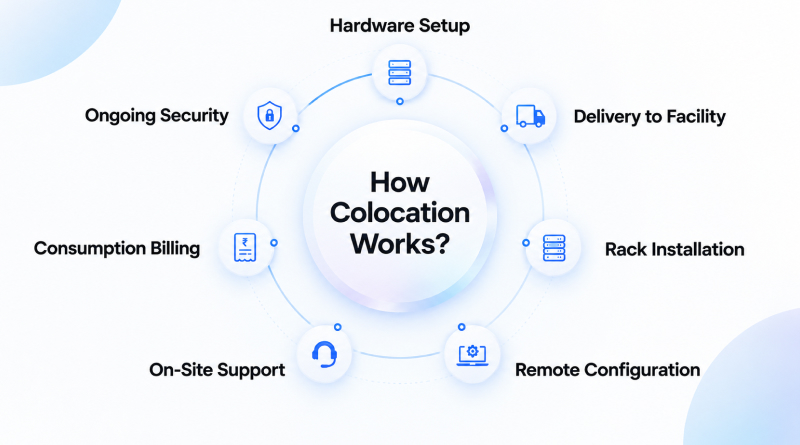
Stage 01
Hardware Setup
Before anything moves anywhere, the business configures its server around the actual workload it needs to run, rather than picking from a fixed tier.
Stage 02
Delivery to Facility
The configured machine then makes its way to the data center, ready for installation on arrival.
Stage 03
Rack Installation
Technicians on site mount the unit and connect it to power and network lines.
Stage 04
Remote Configuration
Control passes back to the customer at this point, who logs in remotely to load software, set up applications, and push updates as needed.
Stage 05
On-Site Support
Whatever can’t be handled remotely goes through the provider’s remote-hands team instead.
Stage 06
Consumption Billing
Power costs track actual usage, while bandwidth shows up as its own separate charge.
Stage 07
Ongoing Security
Facility access stays controlled around the clock, and SSL takes over once the server goes live, protecting whatever it serves out to the public.
Colocation vs Dedicated Server Hosting: What’s the Real Difference?
Colocation hands hardware ownership to the customer, along with everything that comes with keeping a physical machine running well. A dedicated server flips that arrangement. The provider owns the machine, rents it out as a finished package, and usually includes setup, monitoring, and support as part of the deal. Cost structures diverge accordingly. Colocation demands upfront capital for hardware but usually lowers ongoing costs over time, since a business isn’t paying a provider’s margin on equipment it already owns.
Dedicated hosting removes that capital outlay entirely and replaces it with an entirely predictable subscription fee, closer in nature to a cloud VPS plan but scaled up to an entire physical machine. Control follows the same divide. Colocation lets a business choose every component down to the drive and processor, while dedicated hosting limits choices to whatever configurations a provider has decided to offer.
Factor
Colocation
Dedicated Server Hosting
Hardware ownership
Customer owns the server
Provider owns the server
Upfront cost
High (hardware purchase)
Low (subscription-based)
Maintenance responsibility
Customer manages hardware and software
Provider often manages hardware, sometimes software
Control
Full control over specifications
Limited to the provider’s available configurations
Best suited for
Businesses with in-house IT expertise
Businesses wanting infrastructure without hardware ownership
The right choice depends on how much control a business wants over its physical infrastructure, weighed against how much internal expertise it has to manage that control. Predictable, well-understood workloads rarely need colocation’s added responsibility, which is why fast-growing companies with that kind of load usually settle on dedicated hosting for the simplicity it offers. Specialized or performance-sensitive applications change that equation, since colocation’s flexibility tends to justify the extra work involved once workloads get that demanding.
Colocation vs Managed Hosting Services
Managed hosting and colocation solve different problems, even though people often group them together. Managed hosting shifts monitoring, patching, and security updates onto the provider’s side of the arrangement. Hardware ownership has no effect on that arrangement at all. Colocation, by contrast, stays inherently self-managed by definition. Renting rack space doesn’t include software oversight unless a provider layers that service on top.
A store running WooCommerce hosting, for instance, might need constant plugin updates and uptime monitoring, which points toward managed hosting rather than colocation. A business running custom applications with an in-house engineering team, on the other hand, might prefer the raw control colocation offers and have no interest in a provider touching its software stack at all. MilesWeb bridges that gap through remote-hand support, giving colocation customers a practical middle ground between full self-management and a fully managed contract.
How Should You Choose a Colocation Service Provider?
Selecting a colocation provider depends on a short list of factors that genuinely shape day-to-day reliability.
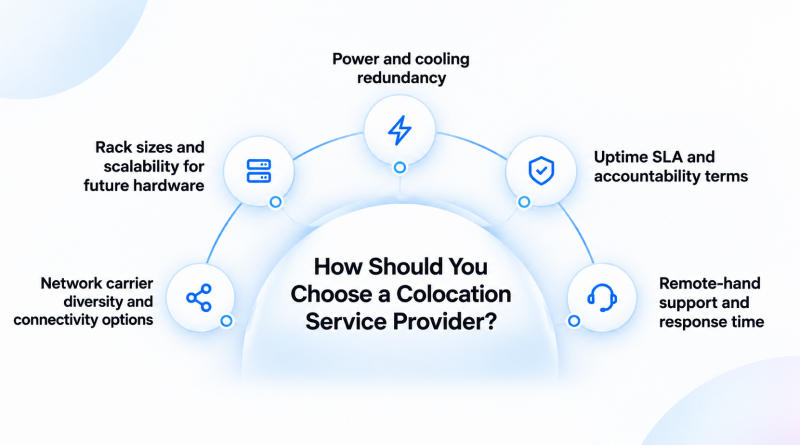
01
Rack sizes and scalability for future hardware
Rack size and scalability are crucial in determining whether the facility can accommodate future hardware needs, thus avoiding the need for a costly migration in the near future.
02
Power and cooling redundancy
Power and network redundancy determine how the facility performs during outages or maintenance windows, and this single factor often separates a dependable colocation hosting provider from one that only looks reliable on paper.
03
Remote-hand support and response time
Support responsiveness matters here too, especially when a business can’t send someone to the facility itself and has to rely on the provider’s remote-hand team to fix it.
04
Network carrier diversity and connectivity options
Connectivity options, including carrier diversity, influence latency and resilience across a business’s broader cloud hosting stack too.
MilesWeb’s colocation server hosting prioritizes these factors, providing businesses with a facility-grade environment without the need to build one from the ground up. A short evaluation call with the provider’s technical team, before signing anything, usually shows more about actual reliability than a features page ever will.
Colocation Hosting in India
Colocation hosting in India has grown alongside the country’s expanding data center footprint, particularly in cities like Mumbai and Pune. Businesses colocating here benefit from proximity to major internet exchange points, along with growing attention to data protection compliance under India’s DPDP Act. Lower latency for domestic users, combined with the ability to keep sensitive data within national borders, has pushed a growing number of Indian businesses toward colocation rather than hosting equipment overseas.
MilesWeb operates colocation infrastructure directly within these regions, giving Indian businesses a facility that understands local regulatory expectations without requiring them to negotiate compliance on their own. For companies considering global providers versus local ones, familiarity with local regulations often becomes the deciding factor.
Closing Insights
Colocation and dedicated server hosting address different priorities rather than competing on the same axis. Colocation rewards businesses that already have hardware expertise and want maximum control over their infrastructure, while dedicated hosting suits businesses that want facility-grade performance without owning or maintaining physical equipment. Neither model is inherently superior; each fits a genuinely different starting point, and the right pick usually reveals itself once a business is honest about how much hands-on management it can realistically sustain.
Technical capacity is as crucial as budget in this context, as colocation only proves beneficial when someone is prepared to manage the racked equipment. As data center infrastructure continues to evolve, both models are moving toward flexible, hybrid setups, allowing businesses more room to align their infrastructure to actual growth.
Frequently Asked Questions
1. What is colocation hosting, in one sentence?
Colocation hosting means renting rack space, power, and connectivity inside a data center to house server hardware that the business itself owns.
2. What is a colocation provider?
A colocation provider supplies the facility, the power, the cooling, and the network connection. Everything beyond that, including the server hardware and its software, stays with the customer.
3. How does colocation actually work day-to-day?
Once racked and connected, the customer maintains control over the server. Software installs, updates, and application configuration all happen remotely. Physical access, when something actually needs it, goes through the provider.
4. Is colocation pricier than dedicated hosting?
Upfront costs run higher with colocation, since the business is buying its hardware outright. Over time, though, that investment tends to bring ongoing expenses down below what a dedicated server’s recurring subscription would cost.