

 Jyoti Prasad
Picture this:
Hours of thorough research charted all your options. You have everything set up in your EA on MetaTrader VPS. The market moves as you expected.
But then…
- Your internet connection disconnects/drops for 30 seconds.
- Your laptop goes into sleep mode.
- Worse yet, you lose power entirely.
When your system reconnects, the trade you planned to make is gone (the price moved so the opportunity vanished). That little delay (milliseconds) changed a profitable trade to a lost one.
Welcome to Forex Trading 2026 — where speed and uptime matter.
The activity in today’s market is incredibly fast. Trades are executed within milliseconds, and automated trading occurs 24/7 worldwide. In this environment, relying on an average consumer-grade internet connection or a personal computer is no longer acceptable. An ounce of disruption can have a significant impact on trade execution, leading to slippage or preventing automated trades from being triggered at the appropriate time.
This is where a Forex hosting VPS gives you, the trader, a competitive edge.
Table Of Content
What is a Forex VPS?
Essential Read: How to Become a Forex Broker
A Forex VPS is a virtual private server designed for the purpose of running trading tools like MetaTrader 4 and MetaTrader 5 without interruption.
With a Forex VPS, your trading platform operates on a remote server located in a secure facility. Designed for uninterrupted performance, it runs 24/7 with dependable power, faster internet connectivity, and a specialized infrastructure that reduces the communication delay between your trading platform and the broker’s server (latency).
In other words, with a Forex VPS, your trading system keeps working even if you turn off your computer.
This is particularly important for traders using automated trading systems or Expert Advisors because you can maintain a constant connection to the foreign exchange market, ensuring trades will be executed immediately when market conditions allow.
Home Office Trading Setup: Common Mistake
In the beginning, many new traders run their trading platforms on their laptops or desktops. Although this may seem like the logical choice for new traders, trading from home has different drawbacks like:
- Poor Internet connection at home leads to random disconnects and loss of speed.
- Power outages cause you to lose active trades.
- If you shut your PC down or restart your computer, your automated trading strategies are interrupted.
- You experience higher latency if your computer is located far away from your broker’s trading servers.
In the forex market, all of the above can cost you money.
Even a delay of 50 to 100 milliseconds causes price slippage, which is when a trade is executed at a different price than expected.
A Forex VPS hosting environment provides an always-on, reliable infrastructure for your trading platform to operate on. Since VPS servers exist in professional data centers, they offer the following:
- Always on 24/7 trading
- Ultra-low latency connections to brokers’ trading servers
- Stable/uninterrupted power & network infrastructure
- Black box environment for automated trading strategies
As a result, your Expert Advisors trade continuously, regardless of whether your PC is turned on or not. For today’s traders, especially those who are automating their trading strategies, a Forex VPS is not just a technical upgrade; it’s part of a smarter overall trading solution.
How Does a Forex VPS Work?
Here’s how a Forex VPS works behind the scenes:
- You install your trading platform on the VPS with your Expert Advisors (EAs).
- The VPS is always connected to the broker’s trading server 24 hours a day.
- When the market conditions fit your trading strategy, the EA will execute the trade automatically.
Because the VPS is always online and the broker’s trading server is always connected to the VPS, trades can be executed instantly, regardless of whether or not your personal device is turned off.
Thus, you always maintain constant connectivity between your trading software and your broker’s trading infrastructure.
Many Forex VPS companies deliberately locate their servers near prominent financial trading centers like London (LD4) or New York (NY4). A shorter spatial distance between your VPS and your broker’s server leads to quicker trade execution times. As a result, traders using automated strategies consider a Forex VPS to be a key component in trading consistently and profitably.
Forex VPS Compared to Regular VPS?
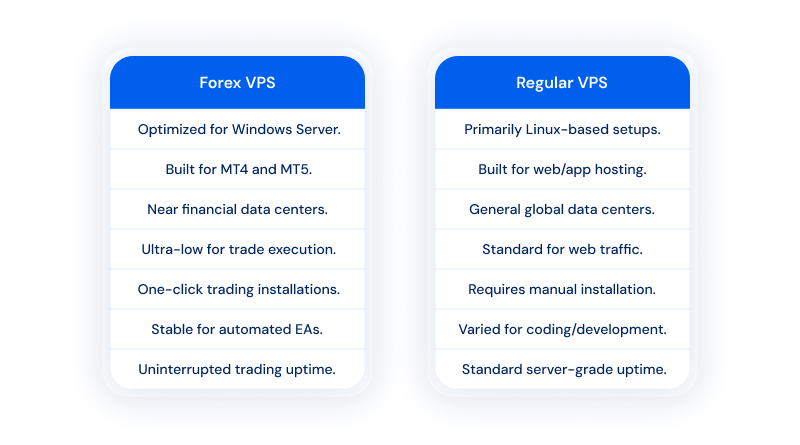
When looking at Forex VPS compared to a regular VPS, it may look similar on the outside; however, there are several differences that make a Forex VPS better suited for a trading environment.
1. Operating System Optimizations
Most Forex VPS hosting solutions are designed to work with Windows Server operating systems for optimal performance with trading platforms such as MT4 and MT5.Regular VPS hosts focus on using Linux-based systems to support web servers or other types of applications rather than running trading platforms. This results in suboptimal performance with Forex trading software/platforms.
2. Location of Servers
Good Forex VPS providers have their servers located near major international financial data centers, such as the following:
- New York (NY4)
- London (LD4)
- Tokyo (TY3)
These are typical locations where Forex brokers host their trading servers. Standard VPS servers aren’t usually located near major financial data centers, which can slow down your connection. This lack of proximity often leads to higher latency, causing delays in your trade executions.
3. Pre-Configured Trading Software
Many leading Forex VPS hosting companies, like MilesWeb, provide their clients with immediate access to trading tools that have the following:
- Trading platforms are installed on the server.
- One-click MT4 and MT5 setup.
- Configuration optimized specifically for using Expert Advisors.
This makes setting up your trading environment much easier (especially if you’re a beginner). The pre-configured software eliminates manual configurations of the server.
4. Trading-Focused Performance
Forex VPSs are designed specifically for trading; they have better performance characteristics for executing automated trading. For example:
- Stable performance from the CPU.
- Enough RAM to accommodate the workloads of multiple Forex trading accounts.
- Consistent speed on the internet so trades are executed without interruption.
Typical VPS hosting is generally for hosting websites, applications, and developing code. Therefore, regular VPS servers are not ideal for high-frequency trading tasks required to trade the Forex market.
Best Forex VPS Hosting Companies in 2026
Useful Read: Best Forex Trading Apps
| Provider | Best For | Performance Edge | Scalability | Ideal User Type |
|---|---|---|---|---|

|
Global Forex traders | Low-latency routing to broker servers | Limited deep customization | Traders using MT4/MT5 VPS |

|
Beginners & budget users | Modern AMD architecture for consistent speed | Paid upgrades required | New traders/small-scale setups |

|
Enterprise & pro traders | High bandwidth + enterprise-grade hardware | Enterprise scalability | Advanced traders/multiple platforms |
 |
High-frequency trading | Optimized for minimal latency in trades | Custom configs available | Traders needing precision execution |

|
Cost-stable long-term users | Reliable performance in multi-terminal setups | Easy vertical scaling | For multiple MT4/MT5 instances |

|
Growing trading businesses | Fast network + dynamic resource allocation | On-demand scaling | For long-term expansion |
The company that you choose as your Forex VPS hosting provider considerably impacts your trading performance. A reliable Forex VPS hosting provider should provide low latency, high uptime, and stable infrastructure to operate automated trading strategies without interruption.
The following is a summary of some of the leading Forex VPS hosting providers, including their main features, benefits, and more, which will help you as a trader to make your decision.
1. MilesWeb
MilesWeb has established itself as a popular Forex VPS provider among global traders by providing Forex VPS hosting designed for automated trading platforms (MT4 and MT5). MilesWeb has focused directly on providing low latency and high uptime, which are vital for the continuous operation of your Forex VPS hosting powered by Expert Advisors.
Additionally, MilesWeb utilizes enterprise-level hardware and NVMe storage on its Forex VPS servers, which are designed to run trading applications quickly. Additionally, the company has multiple data center locations around the world with a 99.9% uptime SLA, allowing traders to SSH into the Forex VPS server located closest to their brokers’ servers. This increases the chances of fast execution and reduces any delays.
Key Features
- Global server locations
- MT4/MT5 optimized servers
- NVMe SSD storage
- Dedicated resources
- Remote desktop access
| ✅ Pros | ❌ Cons |
|---|---|
| Strong presence in India | Managed support may vary |
| Reliable 99.9% uptime | Custom configurations limited |
| MT4/MT5 optimized servers | |
| Competitive pricing | |
2. Hostinger
Hostinger is a well-known provider of inexpensive Forex VPS servers. They offer high-performance infrastructure consisting of AMD EPYC processors, NVMe storage, and industry-leading DDoS protection that ensures you have consistent performance when using trading applications.
With the control panel designed by Hostinger, you can manage everything about your VPS server easily (even if you are not technically experienced)! Hostinger has thousands of data centers around the world and provides traders with the ability to choose a location that is close to the broker they are using.
Key Features
- NVMe storage infrastructure
- AMD EPYC processors
- Global data center locations
- MT4/MT5 compatibility
- DDoS security protection
| ✅ Pros | ❌ Cons |
|---|---|
| Beginner-friendly interface | Limited advanced configurations |
| Affordable pricing plans | Forex-specific support limited |
| Global data centers | Some plans are unmanaged |
| Resource upgrades cost extra | |
3. OVHCloud
OVHcloud offers enterprise-level VPS hosting solutions that can be used for professional trading environments. It has global data center locations to allow traders to deploy their VPS servers in strategic locations close to financial hubs.
OVHcloud comes equipped with NVMe SSD storage (high-performance flash), high-bandwidth connections, and anti-DDoS built into the platform. Therefore, if you are looking for a VPS provider that values performance and security, you can check out their plans. Their extensive database of VPS servers, coupled with their superior hardware (such as Intel Xeon E5-2600 v4 series processors), provides all the resources necessary to operate numerous platforms without risking your VPS reliability.
Key Features
- Global data center network
- Anti-DDoS protection
- NVMe SSD storage
- High-bandwidth connectivity
- Full administrative access
| ✅ Pros | ❌ Cons |
|---|---|
| Enterprise-grade infrastructure | Complex for beginners |
| Strong network bandwidth | Slower support response |
| Advanced security protection | Setup requires expertise |
| Higher pricing tiers | |
4. Webyne
Webyne specializes in Forex VPS hosting for traders who need customized configurations and reliable execution speeds. This allows it to reduce latency and execute trades more quickly by providing a highly reliable and effective infrastructure for high-frequency trading strategies.
Webyne has a 99.9% uptime guarantee and customizable configurations, meaning that traders can adjust their resources based on their individual trading strategy or the number of trading terminals they are using. In addition, Webyne has localized hosting options, which are advantageous to traders who want to reach a target broker location.
Key Features
- Lightning-fast trade execution
- Customizable server setup
- 99.9% uptime guarantee
- Low latency infrastructure
- Optimized trading environment
| ✅ Pros | ❌ Cons |
|---|---|
| Trading-focused VPS setup | Smaller hosting provider |
| Reliable uptime guarantee | Limited global locations |
| Optimized for low latency | Smaller support ecosystem |
| Fewer beginner guides | |
5. Interserver
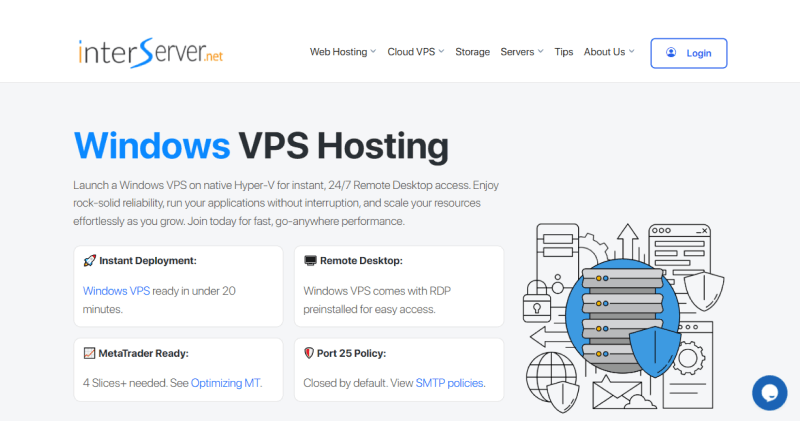
InterServer has fixed pricing and a reliable VPS infrastructure, which allows traders to plan for hosting costs. In addition, they offer Windows VPS hosting for installing trading platforms such as MetaTrader.
InterServer also provides options to grow VPS resources, which are beneficial in installing multiple trading terminals simultaneously. This allows maximum performance when making trades. It also provides full root access and flexible VPS configurations that let users customize their server for optimized automated trading strategies.
Key Features
- Fixed pricing structure
- Windows VPS environments
- Full root access
- Scalable server resources
- Flexible configurations
| ✅ Pros | ❌ Cons |
|---|---|
| Transparent pricing model | Fewer global data centers |
| Flexible server configurations | Setup may require expertise |
| Suitable for multiple terminals | Support varies by plan |
6. IONOS
IONOS has established itself as a reputable VPS provider offering scalable, high-performance VPS solutions with cutting-edge technology. The solution features NVMe-based storage and the potential for fast connectivity through its high-speed network.
Therefore, it’s perfect for trading platforms to run smoothly and with low latency. Traders can increase their CPU, RAM, and disk space as needed to handle the increased volume. This flexibility makes it ideal for those who anticipate growing their automated trading system over time without sacrificing the speed at which the trades are executed.
Key Features
- High-speed NVMe storage
- Scalable infrastructure
- Flexible resource allocation
- Global cloud infrastructure
- Reliable network performance
| ✅ Pros | ❌ Cons |
|---|---|
| Highly scalable VPS plans | Pricing can increase quickly |
| Fast NVMe storage | Forex-specific optimization is limited |
| Reliable infrastructure | Advanced plans are costly |
| Strong cloud ecosystem | Steep learning curve for beginners |
How to Choose a Forex VPS Provider
While price and popularity matter, the quality of a provider’s server environment is the most critical factor for automated or time-sensitive trading. A high-performance setup directly impacts your results by ensuring your strategies execute without technical delays.
When it comes to evaluating which of the best Forex VPS hosting solutions is the most suitable for you, there are multiple technical aspects that should be considered while making your decision. Outlined below are key elements that all FX traders use to evaluate their choices when selecting a Forex VPS provider.
Similar Read: Forex Trading vs. Stock Trading
– Latency and Server Location
Time latency refers to the time spent on your trade order from your platform to the broker’s server and back. Even delays of seconds in transmitting your trade order cause price slippage or slow executions of trades. This is why many VPS forex hosting providers host their servers close to major financial centers such as London, New York, or Tokyo. Therefore, if you choose a VPS server location close to your broker’s network, your trades will be executed faster with less chance of slippage, and your systems will operate more reliably.
– VPS Uptime Guarantee
The Forex market is open for businesses 24 hours a day during the trading week. For your trading platform to function properly, it must always be online. Reputable Forex VPS hosting providers typically provide a minimum of 99.9% uptime (guarantee) through the use of backup generators, redundant ISP networks, and 24-hour server monitoring. When you have high uptime, your MT4 or MT5 platform stays connected to the Forex market, and automated trading systems operate without interruption during the trading day.
– Operating System Compatibility
Most of the common trading platforms, such as MT4 and MT5, are created primarily to operate within a Microsoft operating system environment. Therefore, an important aspect of selecting a Forex VPS provider is whether or not the VPS supports Windows Server. A Windows-compatible VPS allows both new and experienced Forex traders to easily set up their trading terminals, Expert Advisors, and custom indicators. The good news is that some providers offer pre-configured Forex VPS benefits with all required trading platforms already installed.
– Resource Allocation (RAM and CPU)
Another main factor that affects a Forex VPS’s performance is its memory (RAM) and CPU configurations. While a single trading terminal doesn’t need much power, running multiple platforms at once increases the demand on your system. Using complex indicators or automated strategies further drains your RAM and CPU, requiring a more robust setup. Most Forex trading for beginners typically require an allocation of 2 – 4 GB RAM and possibly 1 – 2 CPUs. Whereas highly complex configurations may require 4 – 8 GB RAM and dedicated CPUs to provide a stable and smooth execution of trades.
Bottom Line
In conclusion, there are many ways that your infrastructure affects how well your trading strategies perform. Hence, you should carefully consider which Forex VPS provider will best suit your specific requirements. This includes your broker locations, the type of trading style, and the money you have to invest in technology.
Traders who depend on using an automated trading system or Expert Advisors or simply want their trades executed consistently should carefully select a reputable Forex VPS provider. When you have everything set up correctly, you will minimize slippage, maintain constant access to the market, and keep your trading platforms running round the clock.
If you’re seeking a dependable option, platforms like MilesWeb provide low-latency infrastructure, strong uptime assurances, and expert support for traders. Together, these features make it easier for both novice and experienced traders to enjoy a stable and efficient trading environment. A reputable forex vps server provider helps maintain uninterrupted trading operations, keeping your strategies responsive and competitive in today’s volatile Forex markets.
FAQs
1. How much CPU and RAM should I use for trading using automated systems?
For most traders, 2GB-4GB of RAM along with a stable processor (single core) will support 1-2 MetaTrader 4 or MetaTrader 5 terminals on a Forex VPS. If you use multiple Expert Advisors or indicators or run several other trading platforms concurrently, then it is advisable to select 4GB-8GB of RAM with more powerful CPU resources.
2. Is a Forex VPS secure?
Yes, Forex VPSs are secured through data centers with encrypted internet connections, firewall protection, and dedicated virtual servers. Most Forex VPS suppliers like MilesWeb set up different layers of monitoring and network protection to keep your trading platforms from becoming infected with malicious software, crashing due to hardware failures, or damaging your local computer systems.
3. What makes a Forex VPS valuable to traders?
Traders utilize Forex VPS hosting to ensure their trading platforms operate on a 24/7 basis. Automated trading systems (such as Expert Advisors) require 24/7 connectivity to execute trades. With a Forex VPS, traders can execute trades even if their own computer is powered off.
4. Where should I locate my Forex VPS server?
When making a decision on the location of your Forex VPS server, you should take into account the physical location of your broker (typically near a major trading hub). Example cities that serve as the physical location for many brokers include London (LD4), New York City (NY4), and Tokyo (TY3).
5. What should I look for when selecting a Forex VPS provider?
When determining which Forex VPS hosting provider to use, consider specific features like a minimum of NVMe SSD-based storage, low-latency connectivity (99.0%+ uptime guarantee), and 24/7 technical support. These characteristics will assist you in making sure your Forex VPS server successfully allows the uninterrupted operation of your trading platforms.