
 Jyoti Prasad
Your infrastructure doesn’t just need to stay ‘on’; it needs to stay ahead. Once considered simply uptime-driven, application infrastructure is now focused on intelligent scalability, automation, and resilience. Infrastructure used to be just about keeping things running. Now, it must be smart, fast, and able to recover from failures automatically.
Modern technology, such as AI and globally connected apps, has created a massive challenge for older hosting companies. Most traditional providers simply can’t handle the complex “container” systems (such as Kubernetes) that these new apps need to run reliably.
Kubernetes is now the foundation of modern cloud-native applications. However, deploying and operating clusters requires strong technical skills. Businesses are turning to managed VPS Kubernetes hosting to reduce operational overhead while maintaining performance, security, and scalability. From startups pursuing affordability to enterprises seeking the best provider, there are many opportunities in this rapidly growing market.
Businesses compare providers to find the most economical K8s hosting, based on CPU, RAM, and NVMe performance. Several companies compete with different pricing structures.
This guide will assist you in determining today’s best-performing Kubernetes hosting solution that meets your performance, price, scalability, and security needs.
Table Of Content
What is Kubernetes Hosting?
Kubernetes hosting is a specialized VPS hosting solution for deploying, managing, and scaling containerized applications with Kubernetes, which is an open-source platform for orchestrating containers. Rather than run the application on a single server, Kubernetes distributes the load across multiple computer nodes. It is designed to manage all aspects of deployment, scaling, network configuration, and proper recovery from failure.
In other words, Kubernetes hosting providers give you the infrastructure and tools to run your apps efficiently without managing the servers or dealing with failed servers yourself. Using the hosted Kubernetes environment, the provider sets up the cluster, manages the control plane, deploys applications, monitors IT systems, and secures the environment, allowing businesses to solely concentrate on their businesses.
Similar Blog: What is Kubernetes Monitoring?
- Example
Think of a food delivery company. When the company has a huge sale, traffic on the website could increase by 5 or 10 times within minutes. If the food delivery service were using traditional hosting, the website would either experience delays in loading or even crash altogether. The benefit of Kubernetes hosting is that additional containers are immediately created to handle the traffic surge. Once the traffic is back to normal, the resources from the previous surge are reduced automatically without any manual intervention.
TL;DR:
Kubernetes hosting allows you to build containerized applications with automatic scaling, self-healing, and high availability. It makes the handling of infrastructure complexity easy, thus ensuring minimal downtime with no added cost.
Why You Should Use Kubernetes Hosting?
Digital growth is moving so fast that it’s hard to predict where or when the next big boom will happen. For example, AI might cause a sudden surge in one city today and a completely different country tomorrow. This makes it impossible for old-school hosting to keep up.
Moreover, most current web applications are no longer bound by the limitations of static hosting. Adding AI and real-time data tools into the office makes server workloads jump around unpredictably. Plus, modern mobile apps now use ‘predictive’ technology to guess what a user wants before they even open the app. All of this puts a massive, uneven strain on the systems keeping everything running.
In addition, current traffic patterns are not as predictable as they have been in the past. Marketing campaigns, product launches, and viral events can cause a significant increase in user activity volume quickly. When using a managed Kubernetes hosting service, your infrastructure automatically scales itself so that performance remains stable, regardless of the increase in daily users.
Secondly, the architecture of applications has been changing too; nowadays, the majority of application development is based on microservices as opposed to traditional, monolithic applications. One way to manage microservices is through Kubernetes cloud hosting, which provides efficient resource allocation, reliable communication, and load balancing for multiple distributed services and servers.
The third reason is that operational efficiency has become a top priority for many companies. Hiring internal DevOps resources to support Kubernetes clusters can be expensive. It is necessary to identify and select the best Kubernetes hosting solution to minimize ongoing management costs of the environment while also increasing the speed of deployments and enhancing system reliability.
Cost is a major factor for all companies; however, start-ups and growing businesses are increasingly evaluating their costs. Companies now compare multiple vendors to find the least expensive solution for hosting their Kubernetes cluster while still providing adequate CPU, RAM, and NVMe performance. The emergence of low-priced VPS (affordable K8s hosting) packages allows all-sized organizations to leverage enterprise-class orchestration tools.
In a nutshell, Kubernetes is no longer an optional infrastructure; it is the foundation for developing scalable, reliable, and future-focused applications.
What Are the Benefits of Kubernetes?
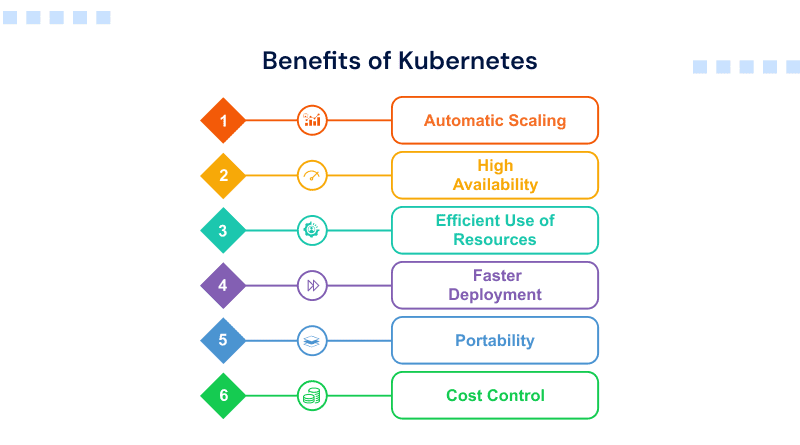
1. Automatic Scaling
Applications will automatically adjust their capacity upwards or downwards depending upon current levels of activity, thereby improving both performance and cost-effectiveness. cost-effectiveness.
2. High Availability
If any container fails at any time, Kubernetes automatically replaces it, thereby ensuring that downtime is minimized.
3. Efficient Use of Resources
Workloads are distributed among servers with maximum CPU and RAM utilization.
4. Faster Deployment
Rolling updates and rollbacks allow you to deploy new releases without any downtime.
5. Portability
Applications can be deployed in multiple places using different types of Kubernetes hosting providers without needing major modifications.
6. Cost Control
Businesses can select the least expensive Kubernetes hosting plans that meet their workload requirements while still providing good performance.
Top Kubernetes Hosting Providers in 2026
| Provider | Pricing | CPU | RAM | Storage | Bandwidth |
| MilesWeb | ₹499.00/mo | 2 vCPU | 8 GB RAM | 100 GB NVMe | 8 TB |
| Hostinger | ₹549.00/mo | 2 vCPU | 8 GB RAM | 100 GB NVMe | 8 TB |
| GoDaddy | ₹1,299.00 /mo | 2 vCPU | 4 GB RAM | 100 GB NVMe SSD | Unmetered |
| DigitalOcean | ₹905.00/mo ($9.99/month) | 4 CPU | 8GB virtual memory | 160GB storage | Metered |
| IONOS | ₹725.00/mo ($8/month) | 2 vCPU | 8 GB RAM | 240 GB NVMe | Not Included |
1. MilesWeb
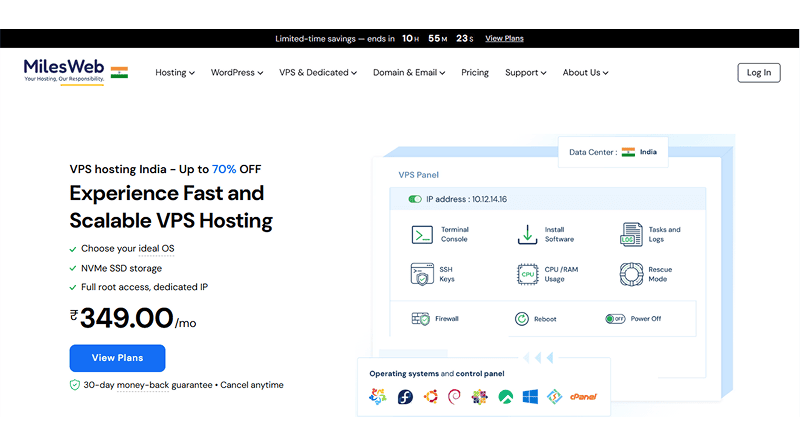
MilesWeb offers an excellent entry-level Kubernetes hosting service, providing developers and small businesses with a low-cost K8s hosting option without compromising on key resources.
Why You Should Use MilesWeb:
- A balanced configuration consisting of 2 vCPUs and 8 GB of RAM suitable to run small- to mid-range containerized workloads.
- Dependable 100 GB NVMe storage, which delivers fast read/write performance for modern applications.
- Commissioned generous amounts of bandwidth that let applications scale and support growing traffic.
Key Benefits:
- Great option for startups looking for the most affordable Kubernetes hosting with easy and essential functionality.
- Kubernetes clusters can be set up quickly and easily using the MilesWeb control panel.
- There is an abundance of expert help and support for those who are new to managing container orchestration.
2. Hostinger

Hostinger’s plans are robust and user-friendly Kubernetes hosting solutions that provide increased performance, minimal complexity, and flexibility to users.
Why You Should Use Hostinger:
- Hostinger provides a similar resource stack to MilesWeb but uses performance-tuned infrastructure and network optimization to deliver superior performance.
- 2 vCPUs and 8 GB of RAM are enough to support microservice-based application stacks or applications with moderate volumes of users with ease.
- 8 TB of bandwidth is provided to allow an application to scale to as many users as possible without issue.
Key Benefits:
- Excellent option for developers and businesses that are scaling their containerized applications.
- The intuitive dashboard, along with the automated tools, allows for low-cost, hassle-free maintenance.
- A strong welfare system, along with low entry costs, is available to you from Hostinger for managed Kubernetes hosting.
3. Godaddy
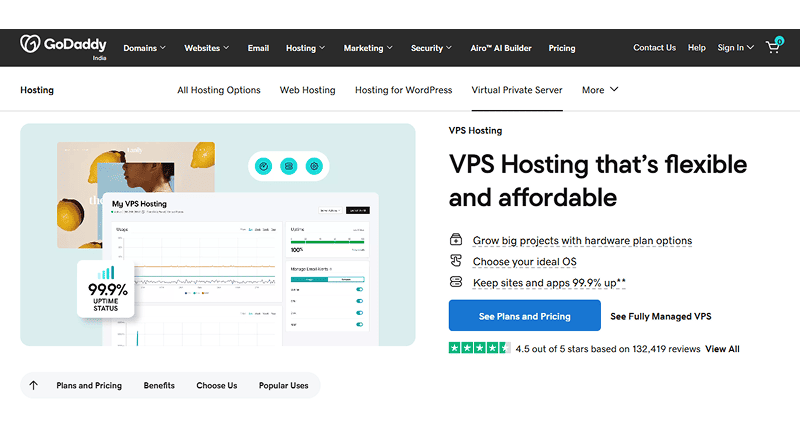
GoDaddy now provides a specialized K8s hosting setup for anyone wanting to run apps in containers. It’s a great choice if you need to handle huge amounts of traffic or want your website to reach users faster across the globe.
Why You Should Use GoDaddy:
- The 2 CPUs and 4 GB of RAM that GoDaddy provides are sufficient for smaller microservices.
- Users will not have monthly bandwidth limitations but will get the flexibility to support sudden increases in traffic.
- Provisioning SSD storage significantly increases application performance and response times.
Key Benefits:
- An ideal choice for teams expecting varying volumes of traffic with the need for unlimited data transfer.
- GoDaddy provides a platform that works well with their domain services and other hosting options.
- A good fit for companies already utilizing GoDaddy for all of their other business needs.
4. DigitalOcean
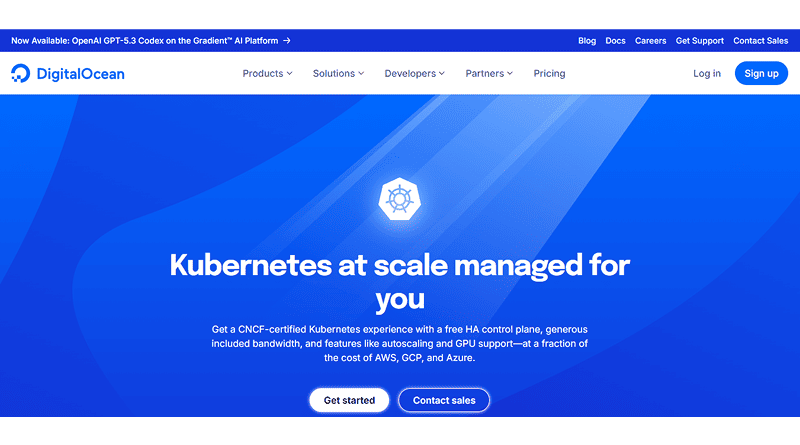
DigitalOcean offers a balanced choice for those wanting more server computing power, coupled with increased memory for larger applications or development projects on Kubernetes.
Why You Should Use DigitalOcean:
- 4 CPU cores to provide better support for higher parallel processing capabilities relative to doing both containerized workloads and application processes.
- 8 GB of virtual memory provides the resources to run more complex application processes.
- 160 GB of storage will comfortably accommodate larger images, logs, and databases from applications.
Key Benefits:
- A great option for developers to build apps that can consume more resources.
- Provides developers with ample opportunity to test and experiment with their applications with larger resource allowances.
- One of the top mid-level choices for organizations needing to host their applications on Kubernetes.
5. IONOS
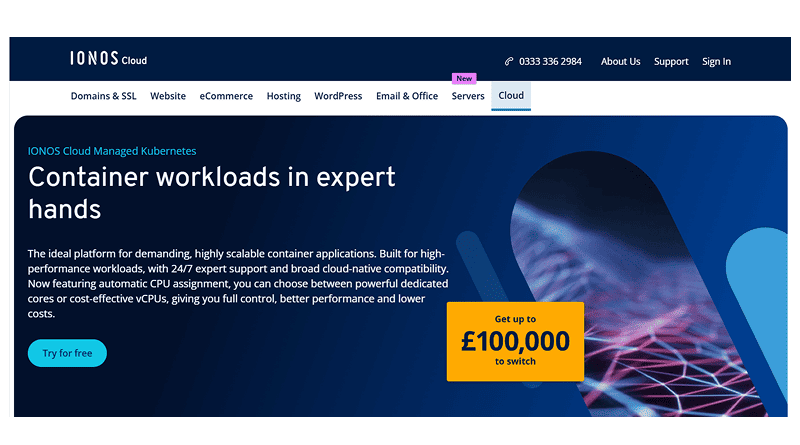
IONOS offers a solid Kubernetes hosting solution with a good performance vs. storage balance appropriate to small- to medium-sized applications.
Why You Should Use IONOS:
- The 2 vCPU and 8 GB of RAM provision provides excellent stability when running typical workloads.
- 240GB NVMe storage capacity ranks among the largest on this list.
- Strong infrastructure support along with enterprise-class reliability.
Key Benefits:
- Ideal for applications that have heavy storage requirements, like data-intensive service solutions.
- Great choice for teams prioritizing disk space while not sacrificing Kubernetes features.
- One of the best all-around choices for managed Kubernetes hosting solutions.
Managed vs. Unmanaged Kubernetes Hosting (Comparison)
Below are helpful insights to compare managed vs. unmanaged Kubernetes hosting. This helps to determine the best option for your needs based on your desired outcome, skills, and budget.
| Feature | Managed Kubernetes Hosting | Self-Managed Kubernetes Hosting |
| Control | Provider manages the most infrastructure tasks | Full control over cluster setup and configuration |
| Setup Complexity | Simple, fast onboarding | Requires deep expertise and manual setup |
| Maintenance & Updates | Automatic updates and patches | You handle all upgrades and security patches |
| Scaling | Built-in automated scaling support | Manual scaling setup and tuning |
| Support | 24/7 provider support available | Limited support — depends on in-house team |
| Security Hardening | Managed by provider with best practices | Responsibility of your DevOps team |
| Cost | Predictable pricing | Potentially lower base cost, but higher operational effort |
| Best For | Teams with limited DevOps resources | Experienced teams requiring full control |
Security & Compliance in Kubernetes Hosting
As the popularity of containers in Kubernetes increases, so does the importance of security when selecting Kubernetes hosting providers.
– Security
The dynamic nature of Kubernetes creates loopholes in security features. Because containers can spin up and down quickly, microservices are continuously communicating with one another, and clusters can span multiple nodes or regions. This complexity can increase an organization’s attack surface if appropriate controls are not put in place.
Kubernetes is constantly changing, so standard firewalls aren’t enough. You should implement security at every level—from your infrastructure to your individual workloads—whether you use a managed service or run it yourself.
-Core Security Features for Kubernetes Hosting Providers
- Role-Based Access Control (RBAC): Prevents unauthorized access to the cluster by defining different user roles with limited privileges for accessing a cluster.
- Network Policies: Enforce network isolation between pods via restricting pod-to-pod communications between pods and isolating sensitive service pods from other services within the cluster.
- Automatic Patch Management: Ensures the control plane and nodes of the Kubernetes cluster will always be up-to-date and patched to avoid vulnerabilities.
- Container Image Scanning: Scans and quarantines potentially malicious images or dependencies before being deployed.
- Secrets Management: A method of protecting sensitive data (e.g., API keys, credentials, and certificates).
- Firewalls/DDoS Protection: Protects the hosted Kubernetes servers from incoming external threats.
– Compliance
If you’re handling sensitive data, staying compliant with regulations is just as important as keeping it secure. Major enterprise Kubernetes hosting providers, like MilesWeb, are compliant with industry standards such as:
- Regulatory requirements for data privacy and protection
- Data encryption both at rest and in transit
- Traceability through audit logging
- Infrastructure isolation for complying industries
Kubernetes hosting providers offer out-of-the-box compliance solutions through security best practices that are preconfigured along with monitoring dashboards. They do this to alleviate the compliance requirements placed upon in-house DevOps teams while providing the governance requirements necessary to ensure compliance.
Bottom Line
Kubernetes is a permanent shift, not a passing trend. It is part of the base foundation for a modern application infrastructure. The choice of your Kubernetes hosting provider can be influential in the performance, scalability, cost to operate, and operational overhead of your applications. Whether you’re a startup looking for the cheapest Kubernetes hosting or a large enterprise that needs the most sophisticated orchestration with top-notch security and support, there’s a Kubernetes hosting provider to meet your requirements.
Managed Kubernetes hosting is perfect for teams looking for automated scaling, built-in maintenance support, and expert assistance without a high level of experience in DevOps. It simplifies cluster management, speeds up the deployment, and allows you to spend more time building application features.
If you are an experienced team with a robust DevOps foundation, self-managed (unmanaged Kubernetes) hosting gives you complete control of your configuration, customization, and optimization. This can often be a cost-effective solution for a specialized use case.
Ultimately, the solution that meets your needs will provide your application with the ability to grow in a secure and efficient manner to meet your future needs.
FAQs
1. Can I run Kubernetes on my own servers?
Yes! You can run Kubernetes on your own servers with a self-managed hosting option. This gives you complete control over your clusters, networks, and security policies. However, a strong DevOps background will be required for managing installation, monitoring, scaling, and patching.
Many companies decide to use a managed Kubernetes hosting provider to reduce operational complexity while maintaining performance and reliability.
2. What are the benefits of using Kubernetes for hosting applications?
Kubernetes enables automatic scaling, self-healing, load balancing, and zero-downtime deployments. It improves resource utilization across CPU and RAM while ensuring high availability. Businesses choosing the best Kubernetes hosting benefit from faster releases, improved resilience, and infrastructure flexibility. It also helps companies find the cheapest Kubernetes hosting options without sacrificing scalability or performance.
3. How do I choose a Kubernetes hosting provider?
When evaluating Kubernetes hosting providers, consider performance specifications (CPU, RAM, storage), bandwidth, scalability options, security features, and support availability. Decide whether you need managed Kubernetes hosting or a self-managed environment based on your technical expertise. Comparing reliability, uptime guarantees, and pricing structures will help you select the best Kubernetes hosting providers that align with your business goals.
4. Is Kubernetes suitable for all types of applications?
Kubernetes is ideal for microservices-based, cloud-native, and scalable web applications. It works particularly well for SaaS platforms, eCommerce stores, APIs, and AI-driven workloads. However, small static websites or simple applications may not require Kubernetes server hosting. For growing or traffic-intensive platforms, Kubernetes provides long-term scalability and operational efficiency.