
Modern applications run on data. Whether you are building an e-commerce platform, a SaaS product, a real-time dashboard, or a mobile backend, the database you choose quietly determines how well everything else performs. For a growing number of development teams, that database is MongoDB. The document-based model fits how developers actually think about data, and scaling it does not require the kind of painful schema migrations that come with traditional relational databases.
According to data from 6sense, MongoDB holds approximately 45.5% market share in the NoSQL database category, with over 56,000 companies actively using it. Research from 2025 attributes 8.14% of the overall DBMS market share to it, with 22.3% specifically within the NoSQL segment. MongoDB reported $2.01 billion in revenue for fiscal year 2025, with 71% of that coming from Atlas, its managed cloud offering. This figure tells you a lot about where the industry has moved.
Picking the right MongoDB hosting service matters more than most teams realize until something goes wrong. A slow server during peak traffic, a missed backup before a bad deployment, and support that takes 48 hours to respond. These are real problems that the right provider prevents. This guide provides a comprehensive analysis of the leading MongoDB hosting providers in 2026, offering unbiased insights into their core strengths and potential limitations.
Table Of Content
What is MongoDB Hosting?
At its core, MongoDB hosting just means running a MongoDB database on a server, either one you manage yourself or one that a provider manages for you. MongoDB stores data as JSON-like documents rather than rows and columns, making it a natural fit for applications with flexible or frequently changing data structures.
There are broadly two ways to host MongoDB. The first is a self-managed setup, typically on a VPS, where you install MongoDB, configure it, and handle maintenance yourself. The second is a managed service where the web hosting provider takes care of all of that. Which one makes sense depends entirely on how much infrastructure experience your team has and how much of your time you want to spend on the database layer versus the product itself.
What to Look for in a MongoDB Hosting Provider?
A few things separate a genuinely good MongoDB hosting provider from one that looks fine on paper but creates headaches in practice.
Storage type is the first thing to check. NVMe SSD storage is meaningfully faster than standard SATA SSDs, not marginally but significantly, because it communicates directly with the CPU rather than going through older interfaces. For MongoDB workloads with heavy read/write operations, all these factors matter.
Uptime guarantees should be backed by a real SLA, not just a marketing claim. Look for 99.9% or better, and check whether the provider has redundant infrastructure to support that number.
Scalability comes up sooner than most teams expect. RAM fills up, storage runs out, traffic grows. A MongoDB hosting provider that forces you to migrate entire servers to upgrade resources is a problem waiting to happen.
Support quality is genuinely hard to evaluate before you need it. Review scores and response time commitments give some signal, but the best indicator is whether a provider has MongoDB-specific expertise rather than generic hosting support.
On MongoDB hosting pricing: cheap MongoDB hosting is not always a bad deal, but low-cost plans that skimp on RAM or storage end up costing more through performance problems. Price per resource matters more than headline price.
Best MongoDB Hosting Comparison
| Hosting Provider | Service Type | Best For | Root Access | Storage Type |
|---|---|---|---|---|
 |
VPS (Managed / Unmanaged) | Developers & startups needing full control and NVMe performance | Yes — Full root | NVMe SSD |
 |
Managed Cloud | Enterprise teams wanting zero infrastructure overhead | No | Cloud (provider-managed) |
 |
Managed Cloud DBaaS | EU-based businesses with GDPR or data residency requirements | No | Cloud (provider-managed) |
 |
Managed Cloud DBaaS | Teams already on IONOS needing a simple, low-maintenance database | No | Cloud (provider-managed) |
 |
Managed Cloud | Developers wanting a managed MongoDB setup running in minutes | No | SSD, independently scalable |
Best MongoDB Hosting Providers in 2026
1. MilesWeb
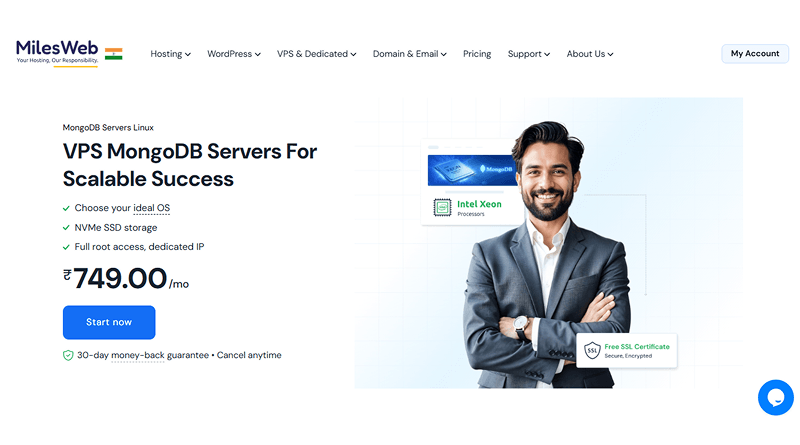
MilesWeb hosts more than a million websites and applications across its infrastructure. For MongoDB specifically, the MongoDB VPS hosting it runs on has a 100% NVMe SSD storage with KVM virtualization, which means every account gets dedicated resources. No shared CPU, no overselling, no inconsistent performance as another customer on the same server is running a heavy job.
What makes MilesWeb stand out as the best MongoDB hosting for developers is the combination of hardware quality and access level. Full root SSH access comes with every plan. You can install any MongoDB version, configure replication, tune memory settings, open custom ports, and run multiple instances. The server behaves like your own machine because, effectively, it is. The network connection runs at 1 Gbps, and data centers are spread across the globe with a 99.9% uptime SLA.
For teams switching from another provider, MilesWeb maintains an in-house MongoDB migration team. That is not something most hosts offer. Instead of figuring out mongodump, mongorestore, and connection string updates on their own, their specialists handle the migration, which significantly reduces the risk of data loss or extended downtime during the cutover.
For anyone comparing MongoDB hosting pricing across providers, MilesWeb sits in a strong position: NVMe hardware, dedicated resources, full root access, and round-the-clock support at rates that make it realistic for startups and individual developers, not just enterprises.
Key Features:
- 100% NVMe SSD storage
- KVM virtualization with fully dedicated resources
- Full root SSH access on all plans
- 99.9% uptime SLA
- 1 Gbps network speed
- Free SSL and DDoS protection included
- In-house MongoDB migration team
- Six global data center locations
- 24/7 live chat and ticket support
- Managed and unmanaged plan options
- 30-day money-back guarantee
2. MongoDB Atlas
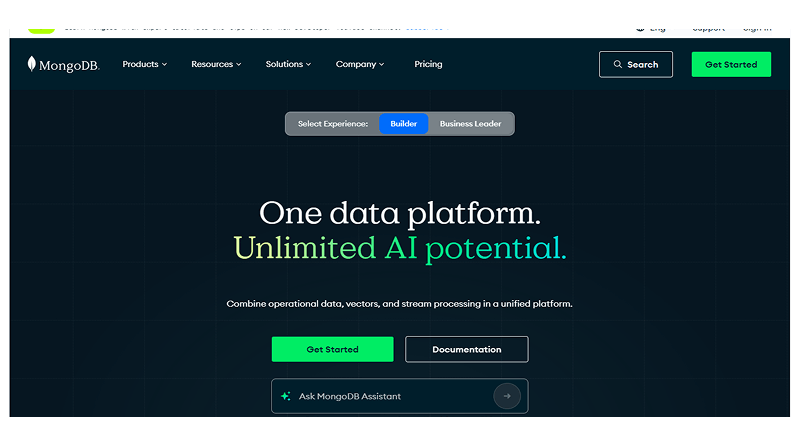
Atlas is MongoDB’s own managed cloud database platform, and it is the product that most large engineering teams reach for when they want zero infrastructure overhead. It runs across AWS, Google Cloud, and Azure handles everything, provisioning, patching, backups, monitoring, scaling, and failover, without any manual involvement. In FY2025, Atlas accounted for 71% of MongoDB’s $2.01 billion in total revenue, which reflects how broadly it has been adopted at the enterprise level.
The feature list is genuinely impressive. Atlas is built to cover far more ground than a standard hosted database. Multi-cloud cluster support, vector search, full-text search, time-series collections, real-time triggers, and tight integration with MongoDB charts and app services all come as part of the package. It is a full data platform sitting behind a single account. New users can start on the free M0 tier, which provides 512 MB of storage. It is plenty for development work and early-stage projects.
The honest downside is cost. Atlas pricing is consumption-based, and bills can become difficult to predict as workloads grow. Moving from a development cluster to a production-ready, high-availability setup involves a significant jump in monthly spend. Teams that need flat, predictable MongoDB hosting pricing tend to find Atlas frustrating to budget for over time.
Key Features:
- Multi-cloud and multi-region cluster configurations
- Automated backups, version management, and scaling
- Vector search, full-text search, and time-series support
- Free M0 tier for development use
- Deep integration with MongoDB’s broader product suite
3. OVHcloud
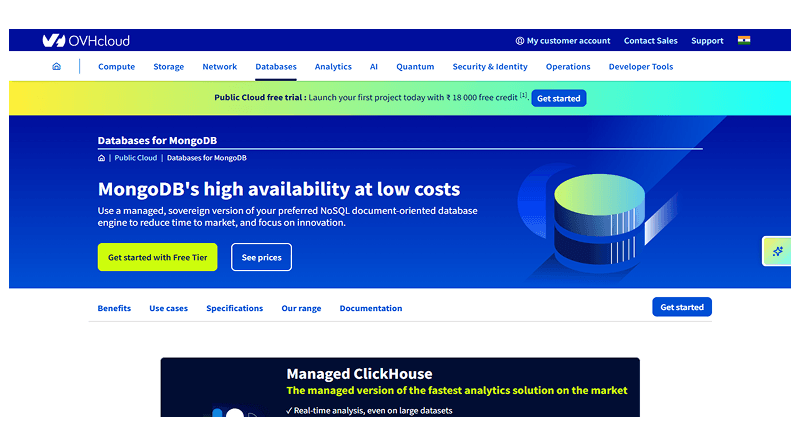
OVHcloud’s managed MongoDB functions within its public cloud DBaaS portfolio and is primarily built for businesses operating within the European Union. Data centers are spread across France, Germany, and the UK, which makes it a practical option for teams with GDPR obligations or data residency requirements that prevent hosting outside Europe. Production clusters support high-availability multi-node configurations, and development-tier clusters are available for non-critical workloads.
Automated backups, version upgrades, and replication are all handled by OVHcloud, so day-to-day database maintenance is minimal. Businesses already using OVHcloud for compute or object storage will find the integration reasonably smooth.
Outside of Europe, the case for OVHcloud gets weaker quickly. It is a workable MongoDB hosting service for a specific type of European customer, but not a strong general-purpose recommendation.
Key Features:
- EU-based data centers for GDPR and data sovereignty compliance
- High-availability multi-node cluster support
- Automated backups and version upgrades
- Pay-as-you-go pricing
4. IONOS
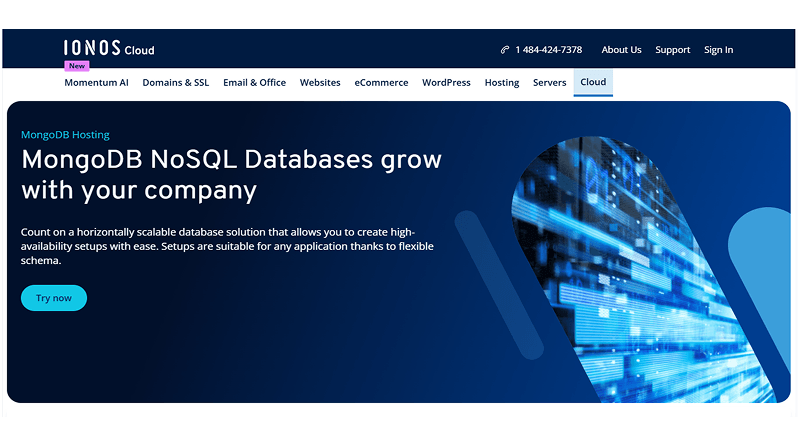
IONOS offers managed MongoDB through its cloud DBaaS platform, and the setup is fairly standard. Automated failover, backup management, scaling, and a console-based interface that does not require deep database knowledge to operate. It is most convenient for businesses already running other services through IONOS, since keeping domains and databases under one account simplifies billing and vendor management.
Pricing is pay-as-you-go, with both single-node and replicated cluster options available. The service covers Europe and the United States for data center locations.
The IONOS MongoDB offering is relatively new and shows it. Configuration options are limited compared to more mature platforms, and developers who need specific MongoDB version control or custom setups will find it restrictive. For internal tools, staging environments, or teams that simply want a database they do not have to think about, and who already use IONOS, it gets the job done.
Key Features:
- Automated failover, backups, and scaling
- Pay-as-you-go pricing
- Single-node and replicated cluster support
- EU and US data center coverage
5. DigitalOcean
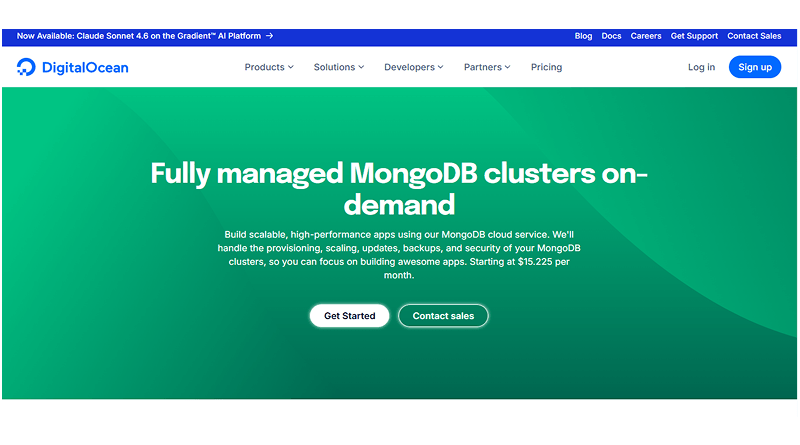
DigitalOcean has been offering managed MongoDB since 2020, and the product has matured well. Entry pricing starts at $15 per month for a single-node cluster. Supported versions include MongoDB 6.0, 7.0, and 8.0. Standard inclusions are automated daily backups, role-based access control, built-in monitoring, and seven days of point-in-time recovery.
A notable recent addition is independently scalable storage. You can add capacity at $0.20 per GiB per month without touching the rest of the cluster configuration, up to a maximum of 16 TiB per instance. Provisioning is fast, and the control panel is clean, with CLI and API access available alongside the UI. For developers who want a managed MongoDB setup running in minutes without a steep learning curve, DigitalOcean is genuinely easy to work with.
Two practical caveats: moving from a single-node cluster to a three-node high-availability replica set immediately triples the monthly cost, which catches smaller teams off guard. And like all managed MongoDB hosting services, there is no OS-level access. If your setup requires custom MongoDB configuration beyond what the managed platform exposes, you will need a VPS-based solution like MilesWeb instead.
Key Features:
- Managed MongoDB supporting versions 6.0, 7.0, and 8.0
- Automated daily backups and 7-day point-in-time recovery
- Role-based access control (RBAC)
- Independently scalable storage up to 16 TiB at $0.20/GiB/month
- 16 data centers across 9 global regions
- Provisioning via UI, CLI, or API
Can You Migrate Your Existing MongoDB Database to a New Provider?
Yes. The process is more manageable with MongoDB than most people expect. MilesWeb and Atlas also offer their own live migration service for transfers into its platform.
The variables that affect how straightforward a migration actually is come down to a few things. Database size is the obvious one, a 50 GB database transfers faster than a 2 TB one. Downtime tolerance matters too, since a live migration approach can keep your application running throughout the cutover.
Post-migration, connection strings will need updating, IP whitelisting will need reconfiguring, and it is worth verifying version compatibility between your existing setup and the target environment before starting.
MilesWeb’s in-house MongoDB migration team removes most of this friction for teams moving to their platform. Rather than running the process manually and hoping nothing breaks, their specialists handle the transfer end to end, which is a meaningful advantage for teams without dedicated database engineers.
For teams that need NVMe performance, dedicated resources, full server access, and predictable monthly costs, MilesWeb comes out ahead on overall value. The managed cloud options make more sense as workloads grow to a scale where operational simplicity justifies the added cost.
Self-Managed vs. Managed MongoDB Hosting
When you go self-managed, usually on a VPS, you’re taking the wheel entirely. That means you’re handling the MongoDB installation yourself, setting up replication, pushing updates, and keeping an eye on performance. It’s more work, but the upside is genuine.
You get full control over which MongoDB version you’re running, and you can tune configuration parameters to your exact needs. MilesWeb’s MongoDB VPS sits in this category.
Managed web hosting flips that around. Providers like Atlas, OVHcloud, IONOS, and DigitalOcean take care of the database layer on your behalf. You can get up and running quickly, day-to-day maintenance is largely off your plate, and you don’t need someone on the team who lives and breathes MongoDB internals. The catch is that you trade away flexibility, and you’ll generally pay more per unit of compute than you would with a self-managed setup.
For a startup or a solo developer, a self-managed MongoDB VPS through MilesWeb tends to be the smarter financial move. You get more control, NVMe storage, and a predictable monthly bill that managed services rarely come close to matching. But for a larger team with dedicated infrastructure engineers, real SLA requirements, and a need for advanced database features, something like Atlas is probably worth the premium.
The Closing Line
MongoDB’s growth over the past few years has been consistent and well-documented, with over 56,000 companies using it, a 45.5% NoSQL market share, and $2 billion in annual revenue. The ecosystem around it has matured to the point where there are now genuinely good hosting options at every price point and technical level.
A solo developer building a side project has different needs than an enterprise team running global clusters across multiple cloud providers. For most developers and growing businesses, MilesWeb hits the right combination of factors: NVMe storage, dedicated resources, full server access, reliable support, and MongoDB hosting pricing that does not require enterprise budgets.
The in-house migration team and the range of both managed and unmanaged plans make it practical for a wide range of use cases. And for teams with specific geographic or compliance constraints, OVHcloud and IONOS serve their niches reasonably well. Whatever direction you take, it is important to get the hosting infrastructure right before your database becomes a bottleneck. It is far easier to make a good decision at the start than to migrate a production MongoDB deployment under pressure.
FAQs
1. What should I look for when choosing a MongoDB hosting provider?
Storage type is the first practical filter. NVMe SSDs over standard SSDs make a real difference for MongoDB’s read/write patterns. After that, check guaranteed resource allocation (shared environments create unpredictable performance), uptime SLA terms, support availability, and what scalability looks like when your database grows. MongoDB hosting pricing is worth evaluating per resource rather than just by headline plan price.
2. What is the difference between self-managed and managed MongoDB hosting?
Self-managed gives you a server, usually a VPS, where you install and run MongoDB yourself. You have full control over version, configuration, and setup, and the cost is generally lower. Managed MongoDB hosting services handle all of that for you. You interact with it through a control panel rather than a command line.
3. Can I migrate my existing MongoDB database to a new hosting provider easily?
In most cases, yes. MongoDB’s native tools mongodump, mongorestore, and mongomirror cover the majority of migration scenarios. A live migration approach keeps things running throughout the transfer. If you are migrating to MilesWeb, their MongoDB migration team handles the process for you.

The Author
Popular on MilesWeb
We are living in the new normal times and there are changes in everything we do! Our way of working has changed, the times are changed, the attitude has changed…