Gaurav Bodhare
Here is a question worth asking before 2027 begins: when an AI assistant recommends one brand in a category, what earns that brand the spot? The answer shapes every ranking, citation, and click ahead, and it is more within reach than most teams expect.
Search now unfolds across assistants, video feeds, forums, and classic results pages, and each surface rewards clear, trusted content. Strong foundations help as well, from structured pages to dependable cloud hosting that keeps every page fast for crawlers and visitors. In this post, we will explore the trends, the benefits, and the practical steps that turn this shift into steady growth.
Table Of Content
What Is Driving the Latest SEO Trends?
Generative AI has changed how people ask questions and how engines respond. Assistants now summarize, cite, and recommend, so visibility depends on being the source those systems trust. Generative Engine Optimization (GEO) has grown into a core discipline because of this shift. Shoppers open YouTube for tutorials, Reddit for candid opinions, and social feeds for product ideas before they ever reach a results page. Discovery has spread across all of these places, and each one favors content that is credible and well organized.
Related Reaad : Generative AI Vs. Agentic AI Vs. AI Agents
What Benefits Do SEO Trends Offer?
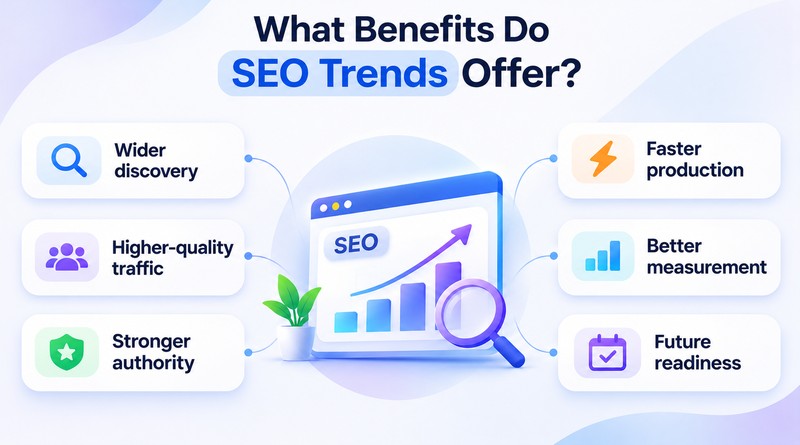
Early adopters gain advantages that compound over time. Every trend in this guide strengthens a different part of a brand’s presence. The six benefits below show where the returns appear first.
01
Wider discovery
Content now reaches people on search engines, assistants, social feeds, and forums. Each new surface adds a fresh path to the same brand. Reach grows without added pressure on a single channel.
02
Higher-quality traffic
Visitors arrive after an assistant or a snippet has already matched their need. Intent is sharper, so sessions run deeper. Conversion rates tend to follow that clarity.
03
Stronger authority
When an AI system names a brand as a source again and again, readers notice. Mentions that keep recurring earn more trust than one ranking position. Authority built this way grows with every new reference.
04
Faster production
Automation shortens research, briefing, and auditing cycles. Specialists spend more hours on strategy and original insight. Publishing cadence rises while quality holds steady.
05
Better measurement
Mentions, citations, and brand searches reveal influence that click counts never show. Together they provide marketers a fuller view of performance. Budget decisions then rest on stronger evidence.
06
Future readiness
Pages built with clean structure and markup adjust easily when a platform changes its rules. Updates take hours instead of full rebuilds. That flexibility protects results through every algorithm shift.
AI SEO Predictions for 2027
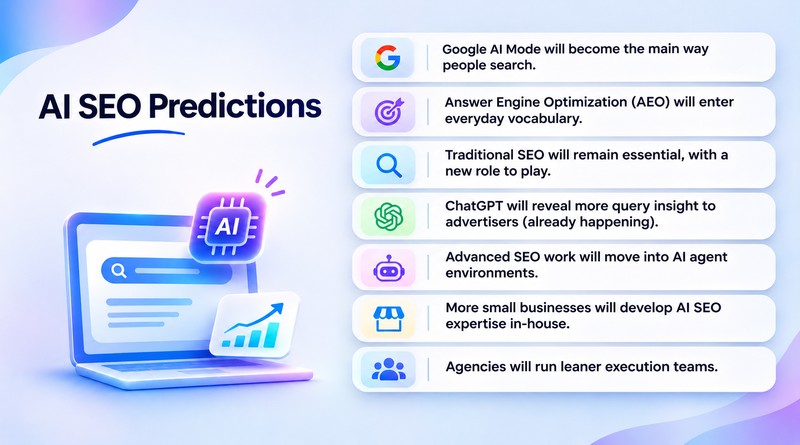
Search is entering a phase where answers, not links, shape what users see first. These seven predictions outline how that shift will change the tools, skills and teams behind SEO. Each one points to a practical area where brands can start preparing now.
01
Prediction
Google AI Mode will become the main way people search.
Google is expected to make its AI-led search experience the default for most queries. Brands will need content that earns a place inside summarised answers, not only a blue link.
02
Prediction
Answer Engine Optimization (AEO) will enter everyday vocabulary.
Answer Engine Optimization will move from a niche term to standard language across marketing teams and agencies. Briefs, reports and job titles will start to reflect it.
03
Prediction
Traditional SEO will remain essential, with a new role to play.
Technical health, content quality and authority still matter, and the work shifts toward supporting AI-generated answers. Strong fundamentals remain the base that AI systems draw from.
04
Prediction
ChatGPT will reveal more query insight to advertisers (already happening).
This is already underway, and advertisers are gaining a clearer view of what users ask. That visibility can sharpen targeting and shape content planning.
05
Prediction
Advanced SEO work will move into AI agent environments.
Audits, research and optimization tasks increasingly run inside agent-driven workflows. Specialists will spend more time directing these systems and reviewing their output.
06
Prediction
More small businesses will develop AI SEO expertise in-house.
Accessible tools let compact teams handle work that once needed outside specialists. This gives smaller brands faster control over their own visibility.
07
Prediction
Agencies will run leaner execution teams.
AI handles routine production, so fewer people deliver the same output. Agency value shifts toward strategy, quality control and client guidance.
Which SEO Trends Should Marketers Follow in 2027?
Search behavior now spans assistants, video, communities, and voice. Each shift below changes how content gets found, read, and chosen. Together they form a practical roadmap for the year ahead.
1. Agentic SEO—AI Agents and the Future of Search
AI agents now compare products, shortlist vendors, and complete bookings for the people they serve. Before recommending anything, an agent reads pricing pages, policy details, and structured data. Publishing machine-readable specifications, plain-language terms, and live availability gives agents what they need to choose a brand. Agentic SEO treats the agent as a second audience, and that audience values precision over persuasion.
Related Read : Vibe Coding vs Agentic Coding
2. Search Everywhere Optimization
Discovery now happens on search engines, video platforms, marketplaces, and social feeds. Search Everywhere Optimization builds a consistent presence across all of them. Every platform weighs its own signals, yet the core message does not change. Marketers map where the audience asks questions, then adapt the format to each surface. A single research insight can become an article, a short video, and a forum answer.
3. AI Crawler Optimization
Some AI crawlers gather pages to train models, while others fetch content to answer a live question. Both read a website more accurately when the architecture is clean, permissions are clear, and responses are quick. SEO leads check robots directives, the sitemap, and how each crawler renders a page. Slow servers shorten a crawl. A fast site gets read in full, and AI systems then describe the brand with fewer errors.
4. Zero-Click SEO
Many searches now end on the results page, with the answer shown in full. Zero-click SEO accepts this behavior and turns it into brand exposure. Concise definitions, clear lists, and direct answers earn featured placements. Branded phrasing inside those answers builds recall even without a visit. Analysts track impressions, brand searches, and assisted conversions alongside clicks.
5. Multimodal Search Optimization
People now search with photos, voice, screenshots, and text in a single query. Video SEO, Visual and Multimodal Search reward pages that describe every asset well. Descriptive file names, accurate alt text, captions, and transcripts give engines context for each format. Original images and diagrams improve selection in visual results. Well-labeled media lets one page answer many query types.
6. Conversational Search and Long-Tail Keywords
Searchers now type full questions and speak to assistants. These queries run longer and carry sharper intent. Content built around natural phrasing matches that behavior. Editors collect real questions from support tickets, sales calls, and community threads. Each question earns a heading and a direct answer in the first sentence. Long-tail coverage builds topical depth, and depth signals expertise.
Realated Read : MilesWeb Launches AI Builder: Powered by Vibe Coding
7. Entity-Based SEO
Search engines now understand people, brands, products, and places as connected entities. Entity-based SEO strengthens those connections. Consistent naming across the website and every public profile lets engines identify a brand with confidence. Schema markup, author pages, and links to trusted sources confirm who a brand is and what it knows. A clearly defined entity gives every article firmer context.
8. Video SEO and Visual Search
Video appears in results, assistant answers, and social discovery every day. Strong titles, chapters, transcripts, and thumbnails help engines index each moment. A short clip that answers a single question often wins a featured slot. Visual search lets shoppers point a camera at an item and find matching products. Planning video and images together reaches audiences at every stage.
9. Reddit and Community-Driven SEO
Reddit threads and niche forums now occupy prime space in results and AI-generated summaries. Reddit and community-driven SEO start with real participation. A specialist who answers in full, states an affiliation, and shares a working example earns upvotes and replies. Moderators remove thin promotions quickly. Consistent, useful contributions build a reputation, and assistants often draw on that reputation when they summarize a topic.
10. SEO Automation Using AI Tools
A website audit that took an analyst two days now finishes the same afternoon. SEO automation tools runs the crawl, clusters keywords by intent, and assembles the weekly report without a manual export. The saved hours go to strategy, interviews, and original research. Human editors then read every draft and check each claim against a source. Pairing every tool with one named owner keeps the output accurate.
11. Keyword Research Using Grok Automation
Grok reads X in real time, so a phrase starts showing up in its results days before it reaches a keyword tool. A prompt such as “What are founders asking about AI search this week?” returns rising questions, the wording people use, and the mood around each topic. Analysts then check those terms against search volume data to confirm real demand. Every confirmed term earns a place on the content calendar. Anything unverified stays out of the draft.
12. Citation Share
Citation share counts how often assistants name a brand when they answer questions in its category. AI search visibility and citation share now work beside rankings as a core measure. A study with original numbers, a quote from a named expert, or a crisp definition gives an assistant something specific to cite. Teams test a fixed set of prompts across ChatGPT, Gemini, and Perplexity each month and log every mention. The month-to-month trend shows which pages earn trust.
13. Business Listing in ChatGPT
Assistants increasingly recommend local and online businesses directly in conversation. OpenAI describes this direction on its Businesses in ChatGPT page. Correct business details give ChatGPT facts it can trust. Profiles that match across every platform confirm those facts, and detailed service pages show what the business offers. Customer reviews and structured data let the assistant connect a business to a specific request.
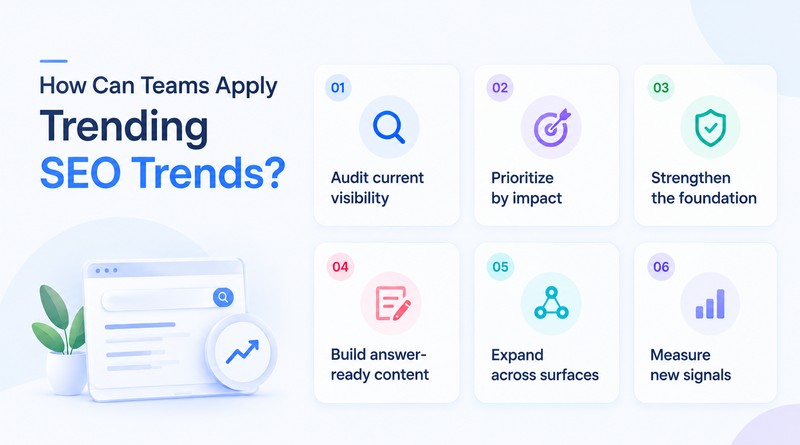
How Can Teams Apply Trending SEO Trends?
Execution works best in clear stages, because each stage supplies the evidence for the next. A phased plan keeps effort focused and results measurable. The six steps below move from assessment to long-term improvement.
Step1
Audit current visibility
Export your current rankings, then ask a few assistants questions in your category and note whether your brand appears. List the pages that currently earn citations and the topics that have no coverage at all. This baseline decides where the effort goes first.
Step2
Prioritize by impact
Score each trend on three things: fit with your audience, the work it demands, and the return it could bring. Pick the top two or three that match what your team already does well. A few focused wins prove the approach faster than a dozen scattered tests.
Step3
Strengthen the foundation
Test page speed, heading hierarchy, schema markup, and crawler access to every priority page. Fast, stable hosting matters here, since AI crawlers and visitors both abandon slow pages. Every later step performs better on a clean base.
Step4
Build answer-ready content
Open each section with the direct answer in one or two sentences, then follow with detail and evidence. Phrase headings the way people type or speak their questions. Assistants can then lift a single passage and cite it accurately.
Step5
Expand across surfaces
Pick one strong insight and carry it to every platform in a form that fits: a short video, a forum reply, or an annotated image. The message remains the same, and only the format adapts to each audience. One idea then reaches people in several places.
Step6
Measure new signals
Track citations, brand searches, and assisted conversions every month. Compare each result with the baseline from the audit. A review every quarter keeps the plan current as platforms are updated.
Key Takeaways
The year ahead rewards brands that answer clearly, structure content carefully, and appear wherever questions begin. Each trend above opens a new route to discovery, and each route compounds over time. Assistants, communities, and video work best as parts of one connected strategy, and together they deliver visibility that rankings alone cannot.
The best time to start is the present moment. A small first step, such as auditing citations or rewriting one page as a direct answer, creates momentum fast. As search continues to evolve, brands that prepare today will shape the conversations of tomorrow, and the opportunities ahead look brighter than ever.
Frequently Asked Questions
1. How will Agentic SEO change the future of search?
Software will soon handle part of the buying journey. Agents shortlist vendors, compare prices, and book services on a user’s behalf. Before they pick a brand, they check its pricing page, policies, and structured data. Sites that publish exact specifications and current availability give agents reliable data to act on.
2. What is search everywhere optimization?
Search Everywhere Optimization treats every platform as a place where a customer might start looking. A buyer may ask a question on Google, watch a review on YouTube, and check a Reddit thread before deciding. Each platform ranks content by its signals, so the format changes while the core message stays fixed.
3. How does Multimodal Search Optimization work?
It gives engines context for every asset on a page. Descriptive file names, alt text, captions, and transcripts explain each image and video. Well-labeled pages then appear for photo, voice, and text queries alike.
4. What is Citation Share in AI Search?
AI search visibility and citation share measures how often assistants name a brand compared with competitors in the same category. Teams track it by running the same prompts across ChatGPT, Gemini, and Perplexity each month and logging every mention.