
 Gaurav Bodhare
Most AI agents operate with a ten-minute memory span, forcing you to manually bridge the gap between sessions. You don’t need another chatbot that treats every request like a first-time meeting; you need a system that remembers your technical constraints and actually gets smarter the more you use it.
The industry currently relies on transient chat interfaces, yet real technical work demands a permanent operational layer. When you close your browser, your workflow should not vanish along with the active tab. Instead of constantly narrating your project requirements to a stateless tool, you should build a foundation on reliable web hosting that retains your logic and compounds your progress.
This is where the architecture shifts. Hermes Agent serves as a persistent, background-running engine on your infrastructure, treating your past work as its primary reference point. By moving your agent onto your infrastructure, you gain a persistent, background-running engine that treats your past work as its primary reference point. It stops acting like a temporary guest and starts functioning as a permanent member of your technical stack. When you open the terminal, your previous work is still there waiting; the system logs every command you run, so you pick up exactly where you left off.
Table Of Content
TL;DR: Quick Overview of Hermes’ Agent
Hermes Agent runs as a dedicated service, keeping your automation active even after you disconnect your terminal or shut down your workstation. The developers at Nous Research engineered this system for ensuring the long-running stability of a single terminal session. You can host the Hermes Agent directly on your hardware, using a VPS or a dedicated server to bypass the rigid constraints of commercial web dashboards and vendor-locked platforms.
What is Hermes Agent?
Hermes Agent acts as a long-term execution engine that stays awake even when your workstation is turned off. Nous Research built this system to run as a permanent background service, keeping your automation alive long after you disconnect your terminal. It avoids the typical “session-only” limits found in standard interfaces, acting instead as an engine that runs locally.
The framework stays provider-independent. You route tasks through any LLM available via OpenRouter or direct API connections. You choose the underlying model—perhaps GPT-4o, Claude, or a specialized local model—and swap it whenever your project requires different reasoning.
Serving as a unified gateway, it links your terminal to over 20 messaging platforms, so you can trigger scripts or receive automated updates from your phone while the agent works quietly in the background on your server.
How is Hermes Agent different from every other AI agent?
This framework transitions the priority from transient chat interactions toward long-term digital evolution. It stands out by treating your operational patterns as data for future improvements.
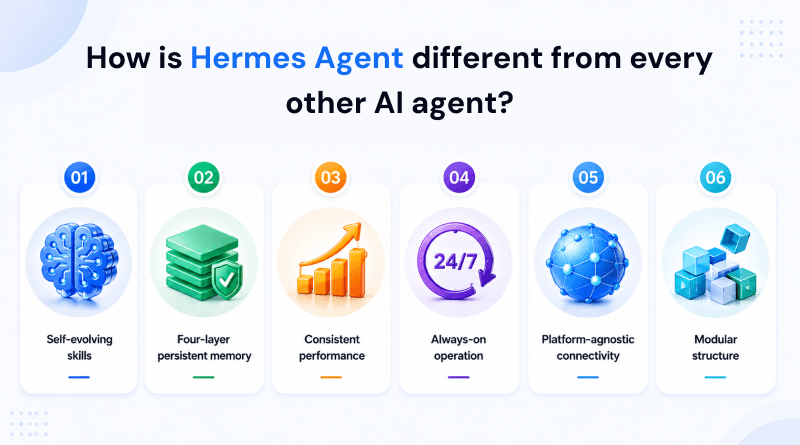
Self-evolving skills
The Hermes Agent tracks when a workflow achieves a high-quality result and encodes those steps into reusable SKILL.md files.
Four-layer persistent memory
It manages your history through a structured system that keeps critical context active across months of operation.
Consistent performance
By running in a self-contained environment, the agent maintains stability across the most complex, multi-step workflows.
Always-on operation
It runs as a system process, watching your workflows and finishing scheduled tasks without needing you to press enter.
Platform-agnostic connectivity
You manage your server terminal directly from your chat app, putting your command line and your daily messages into a single view.
Modular structure
Logic and chat code live in separate files, so you can change how the system learns without breaking your active scripts.
Related Read : Ollama Models List: Top AI Models You Can Run Locally
What Is Hermes Agent’s Four-Layer Memory Architecture?
The system saves you from repeating project specs by sorting your details into four separate, logical layers.
- Active context (MEMORY.md + USER.md): These files are the agent’s brain. They load up at the start, keeping your preferences and goals in sight so the replies actually stay on track from the very beginning.
- Episodic recall (SQLite + FTS5): For information not in those files, the agent queries an indexed SQLite database. It scans your history to find specific points in a blink, retrieving the exact answer whenever you need it.
- User modeling (Mem0/Honcho): Over time, the same tools and workflows start appearing more often in its responses. It picks up your patterns as you work, so you spend less time explaining your routine.
- Procedural memory (SKILL.md): This turns the system into an independent operator. It saves the exact steps for tasks that went well within SKILL.md files. When you ask it for something it has done before, it checks those files first to follow the path you already cleared.
Who is Hermes Agent built for?
This framework shifts the emphasis from transient chat interactions to long-term digital development. It is built for a specific class of user who values autonomy and deep, integrated workflows.
- Developers who want a 24/7 assistant on a VPS: If your needs involve cloud backups, monitoring server logs, or running automated reports while you are away, the Hermes Agent is your primary tool.
- Power users fed up with context windows: If you are tired of spending twenty minutes explaining your project setup every time you start a new conversation, the persistent memory system will transform your productivity.
- Open-source AI builders and researchers: Those interested in agent infrastructure will find the framework’s transparent memory and skill structure ideal for experimentation.
- Teams evaluating agent infrastructure: Tech leads often implement this practice to align how the whole group uses agents, sharing configuration files so everyone works from the same page.
Hermes Agent limitations: What to know before you commit?
Although the framework represents a major step in automation, it performs best when you stay involved and oversee the underlying systems yourself.
- The “self-improving” narrative requires scrutiny: Informational accuracy improves only through your periodic verification of the system’s retained documentation.
- It relies on your active supervision: Since the code lives on your hardware, you fill the role of the system administrator. You manage the patches and look after the setup, which provides you complete command but means you handle the maintenance yourself.
- Performance drops in complex workflows: Complex, multi-step workflows require clear documentation. You can only achieve consistent results by recording precise, detailed steps for your systems to follow.
- No native Windows support (yet): Most users currently deploy it via Linux or Docker. While the setup centralizes your data, you remain responsible for tuning container parameters and maintaining the underlying Linux environment yourself.
How do you debug when the agent gets stuck?
When your agent gets stuck or skips a task, you need a way to fix it. You can stop the process, empty the temp cache, or open the MEMORY.md and SKILL.md files to find where the logic went off track. You always maintain ultimate control whenever the automation stops doing what you expect.
What is the true cost of hosting your agent?
Beyond the subscription fees for LLMs, talk about the hidden “infrastructure tax.” Hermes agent hosting on a VPS means you’re responsible for monitoring CPU usage, applying security patches, and ensuring your storage doesn’t reach capacity. Provide a realistic picture of the maintenance overhead—such as how often you need to audit the agent’s skill files—so readers can weigh the independence of self-hosting against the reality of being their own system administrator.
How does this workflow integrate with your existing CI/CD pipelines?
You link the agent into your deployment setup as its container. It sits alongside your CI/CD runners, where you point it at build logs or test results. When a job hits an error, the agent reads the output, posts fixes for known issues, and comments on pull requests, so you spend less time digging through logs.
Related Read : CI/CD Pipeline for Beginners: The Ultimate Guide
How does Hermes Agent compare to OpenClaw vs Claude Code?
Choosing the right agent requires understanding where your automation happens. These tools offer distinct approaches to the development workflow, and each one demands a different level of technical oversight.
Most developers find that the value of these tools depends heavily on how much time they are willing to spend configuring the environment versus how much they prioritize immediate results.
|
Hermes Agent
|
OpenClaw
|
Claude Code
|
|
|---|---|---|---|
| Primary Focus | Persistent automation & self-correction | Personal productivity & message-based tasks | Terminal-native coding & refactoring |
| Interface | CLI Bot Gateway | Messaging Apps | Terminal |
| Memory System | Built-in learning loop via SKILL.md | Structured state store | Session-based |
| Routine | Natural language scheduling | Task-based retry logic | On-demand execution |
| Best For | Long-running tasks, persistent uptime | Casual chat-based interaction | Project-level coding & debugging |
| Setup | Requires server management | Self-hosted | Terminal-native |
Closing Perspectives
The evolution toward persistent, memory-backed architectures resolves the limitations of traditional session-based interactions. Deploying your assistant on local infrastructure converts it from a fragmented utility into a cohesive resource that retains the specific context of your professional operations.
Hermes Agent offers the necessary technical framework to sustain this workflow for extended operations. After spending more time with the same projects, it starts handling recurring tasks with less guidance than before. As you continue to refine your memory and skill files, you gain a persistent partner that manages, adapts, and learns, allowing you to focus on the high-level strategy while your infrastructure handles the execution.
FAQs
1. Is Hermes Agent free?
Yes, the software is entirely free and open-source. Just keep in mind that if you opt for premium AI models, those providers will still charge you for your usage.
2. What makes Hermes Agent different from OpenClaw?
OpenClaw is often used where tasks are shared across multiple team members, while Hermes is typically set up around the workflow of a single user over time. It prioritizes a self-improving runtime that learns your habits, rather than just handling task delegation.
3. What does “self-improving” actually mean in Hermes?
It means the agent actively learns from your history to overcome the usual “forgetfulness” of AI. It builds a personal profile of your workflow and can even write its functions to automate recurring tasks for you.
4. What models does Hermes Agent support?
It is highly flexible and works with almost anything. You can use major providers like Anthropic or OpenAI, or stick to private, local setups using tools like Ollama.
5. Can Hermes Agent run without the internet?
Yes, once you finish the initial setup, you can keep it completely private. By running local models on your local machine, you can keep the entire process completely off-grid and away from outside servers.