

 Gaurav Bodhare

Every developer, every systems administrator, and most importantly, every business owner has felt the pain of the unpredictable infrastructure. That’s the moment when you deploy an application to staging, and it works perfectly; however, when you move it to the production server, everything breaks. The problem is simple: Somewhere along the line, someone clicked a checkbox, updated a firewall rule, or used a slightly different version of a database—and forgot to document the change. This isn’t just frustrating; it’s a massive risk! It costs time, money, and sanity. That’s exactly why the industry has shifted its entire approach to Infrastructure as Code (IaC)—it turns your cloud hosting into a repeatable, automated blueprint that works every single time.
If a team decides to treat their backend resources—servers, databases, networks, and load balancers—as standard software code, they gain a huge advantage. Teams can manage their backend resources in the same way they manage the application itself: with discipline, version control, and automation. Honestly, this practice is no longer optional; it’s the foundational philosophy for modern, resilient cloud operations. When seeking a robust partner, confirming their support for IaC principles is just as important as checking their affordable web hosting plans.
Table Of Content
What is IaC? The Simple Definition
At its core, infrastructure as code (IaC) means managing and provisioning cloud computing business environment through simple configuration files, rather than manual clicks.
Think of it as writing the perfect blueprint for your servers. This blueprint is the code, and it functions as an authoritative guide for your entire server environment. If the code says you have three web servers and one database, that’s exactly what exists. Nothing more, nothing less.
Two Ways to Write Your Infrastructure Code
Infrastructure as Code examples differ widely based on their function and method. The approach you take depends on how you decide to instruct the automated IaC tools:
1. Declarative Approach (Focus: The “What”)
The Idea: You just describe the ultimate configuration you want.
How it Works: You write a file saying, “I need three t2.micro servers and one RDS database in this region.” The tool then determines all the complex steps—the sequencing, the dependency checks—to make that result happen. It does the heavy lifting for you.
Where It Excels: It’s easier, more predictable, and reliable. That means you can run the same script over and over again. It won’t build anything twice; it just checks that everything is set up exactly as you wanted.
Examples: Tools that use this approach include Terraform infrastructure as code and AWS CloudFormation.
2. Imperative Approach (Focus: The “How”)
The Idea: You have to specify every single instruction.
How it Works: The script dictates the process: ‘Create server A, wait for a minute, then install Apache.’ You must define every single action explicitly.
The Catch: While that approach gives you total, minute-by-minute control, it’s a pain to maintain and really easy to cause errors. If you miss one tiny step, the whole deployment either fails or you end up with an inconsistent system.
Examples: This imperative approach is often seen in older scripts using Bash, or in specific implementations within legacy configuration management tools.
The Unrivalled Advantages of Infrastructure as Code
Adopting IaC in DevOps isn’t just theory anymore; it delivers massive, measurable wins that increase productivity and speed up product deadlines. The benefits of infrastructure as code are just too huge to ignore.
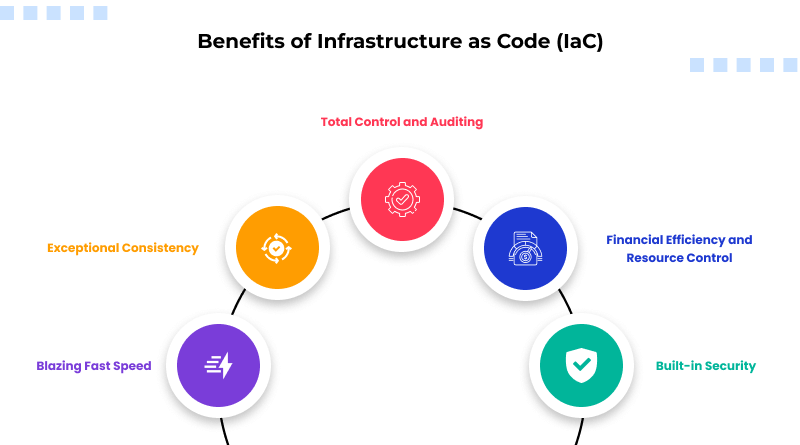
1. Blazing Fast Speed that Boost Productivity
Forget about those wasted days dealing with server setup manually—the ticket queues, the script running, and the endless error corrections. IaC reduces that process down to minutes. One simple command can launch hundreds of perfectly configured resources simultaneously. By eliminating repetitive tasks, teams are free to concentrate on high-value work, which is a direct path to boosting productivity. This change in focus permits the integration of complex tools rather than requiring time for routine server management.
2. Exceptional Consistency
Configuration drift occurs when your environments (dev, staging, prod) gradually diverge due to missed or manual changes. IaC resolves this issue completely. Since the code is the only way infrastructure is deployed, every single environment is a perfect clone: If it works in staging, it will work in production. This consistency is vital for UX designers trying to optimize performance, as issues surface in testing, not on the live website. The code repository is the definitive standard.
3. Total Control and Auditing
Just like application code, IaC files live in version control (Git). This brings software best practices to your servers.
Audit Trail: Every change is recorded: who made it, when it was made, and the associated reason. This is absolutely critical for tracking security and meeting compliance rules.
Easy Rollbacks: Thanks to IaC, if a deployment fails, reverting is easy, preventing a crisis. You just revert the infrastructure code to the last stable version, and the tool immediately rolls your environment.
Collaboration: Teams can just submit pull requests (PRs) for any infrastructure changes. This enables team members to review the code before it goes live, which serves as a crucial safety net.
4. Financial Efficiency and Resource Control
Infrastructure as Code plays a vital role in ensuring cost optimization, which is indispensable for navigating large-scale cloud environments. It prevents the common trap of over-provisioning—where you create extra resources just to cover yourself against risk. IaC scripts also automatically turn off temporary testing environments the moment their purpose is fulfilled. It makes sure you don’t forget to turn off resources that quietly cost you money once the workday is over.
5. Built-in Security
Since you define your infrastructure using code, you can embed security—such as SSL encryption, access rules, and compliance requirements—within the foundational templates from the beginning. Every server is automatically set up securely, which means no one can accidentally forget to close a crucial port. This way, the foundation of your AI website builder or core application is constantly protected and secure.
Key Infrastructure as Code Tools
The IaC ecosystem essentially handles two main tasks:
- Provisioning: Builds the external cloud components (VMs, networks)
- Configuration Management: Handles the internal setup (software, settings) on those components.
Provisioning Tools (The Builders)
These tools directly connect with the cloud provider (like AWS or Azure) to actually build the environment—the servers, networks, and databases.
Terraform: The leading standard for multi-cloud provisioning. It relies on HCL, which is its language, but its biggest advantage is being able to consistently deploy infrastructure, whether you’re using AWS, Azure, Google Cloud, or another platform. One script manages different pieces of a hybrid environment.
Pulumi: This is for coders who prefer writing in familiar languages like Python, TypeScript, or Go to define their infrastructure. It’s a huge add-on if you want to use advanced programming logic.
Configuration Management Tools (The Installers)
These tools manage the software and settings within the server after deployment.
Ansible: It operates without an agent (meaning no software installation is needed on the server) and relies on straightforward YAML playbooks. It’s perfect for configuration tasks and sequencing simple commands. It often runs directly after a Terraform infrastructure as code script deploys the machine.
Chef & Puppet: These tools use a client-server model and are designed for maintaining extremely complex, consistent configurations across massive groups of existing servers. They’re excellent for long-term maintenance in environments like a managed WordPress hosting infrastructure.
IaC in DevOps: The Automation Anchor
IaC isn’t an option for DevOps; it’s the reliable foundation that finally makes the whole Continuous Integration and Delivery (CI/CD) system trustworthy.
Testing Infrastructure: Before IaC, truly testing infrastructure was a massive headache. Now, you can create a fresh, production-standard environment, run your application verification steps, and terminate the setup—all via code. This prevents critical errors from ever reaching production.
The Branding Angle: For anyone focused on personal branding, this translates directly to reliability. An automated, IaC-driven infrastructure delivers a consistent, high-speed experience, which is essential to a professional image.
Concluding Insights
Ultimately, Infrastructure as Code is about equipping human engineers with better tools to enable them to focus on more valuable, complex challenges. It completely eliminates the need for that tedious, repetitive, and error-prone manual setup.
IaC’s biggest success is simple: it eliminates our reliance on individual knowledge and paper lists, replacing them with a software process you can easily audit and check. It ensures that your digital foundation is built on integrity and speed, making the growth of your platform predictable and sustainable.
FAQs
1. What is Infrastructure as Code (IaC)?
It involves consolidating all your infrastructure setup—servers, networks, databases, everything—and defining it as code instead of doing it manually. You write a definition file, execute the script, and a specialized tool builds the environment perfectly every time. It’s all about automating what used to be a tedious, hands-on process.
2. What are the main benefits of IaC?
You get incredible speed and consistency; deploying identical dev or production environments takes minutes, not hours. It also saves you money by stopping people from over-provisioning servers. Additionally, with code, security, and fixing mistakes (rollbacks) become simple and auditable.
3. Why is IaC important in DevOps?
IaC is the essential bridge that makes DevOps function smoothly. It automates the environment setup process, which was a huge bottleneck between development and operations teams. By treating infrastructure like software, everyone uses the same tools (such as Git) for transparent, consistent collaboration.
4. Which tools are used for Infrastructure as Code?
The tools are split into two primary categories: Provisioning and Configuration Management. Terraform is the top tool for multi-cloud provisioning (creating the resources). Ansible is popular for configuration management (installing software on those resources).
5. What are the types of IaC?
There are two philosophies: Declarative (the best approach), which requires you to describe the final environment you want, with the tool handling the steps; the second is Imperative, where you must manually document every single command in sequence.
6. What programming languages are used in IaC?
Most provisioning is done using HCL (Terraform’s language) or config files such as YAML and JSON. However, newer tools like Pulumi support the use of standard, familiar programming languages such as Python or JavaScript to define your infrastructure.