
 Gaurav Bodhare
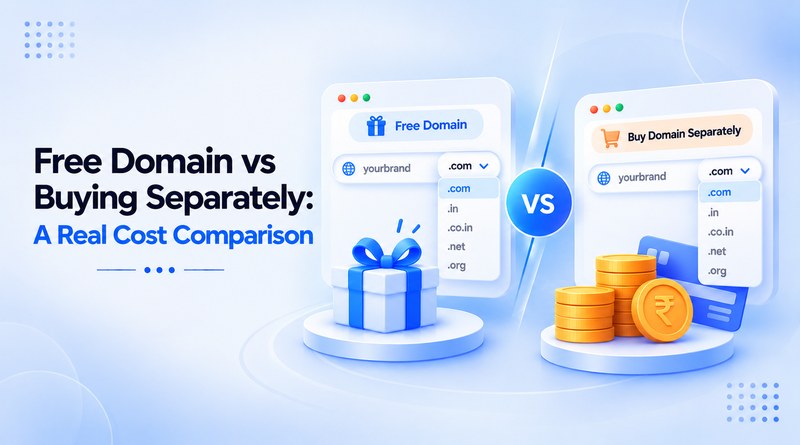
A web address starts working for a brand the day it goes live. Backlinks, email threads, and customer bookmarks attach to it and add value with each passing year. The route a business takes to register that address, through a hosting bundle or a dedicated registrar, shapes renewal costs, technical control, and portability for years. A clear view of both routes turns a routine checkout into a confident, long-term decision.
A domain and a hosting account work as a pair. Modern web hosting plans often bundle a free domain for the first year, while registrars sell the same name at a published annual rate. Each approach has real strengths. The terms, renewal rates, and technical controls behind them show which option serves a particular business. In this post, we will explore how a free domain compares with separate registration once renewal rates enter the budget.
Table Of Content
What Does a “Free Domain” Actually Mean in Hosting Plans?
A free domain is a promotional registration that a hosting provider attaches to certain plans. The offer typically covers the first year and may include extensions such as a free .in domain or a free .com domain, depending on the provider’s terms. It often requires an annual or multi-year billing term, while monthly billing may exclude it. The domain still carries a separate renewal date, so “free” applies to the initial registration period, not the lifetime of the domain name.
Most providers display a prompt in the billing area of the client dashboard for eligible accounts to claim the free domain. The claim flow leads to the standard domain search, which means the name follows the same registration rules as any paid domain. Buyers who understand the structure of the free domain with hosting from the beginning can accurately plan their second-year budget.
How Much Does a Domain Cost When Bought Separately?
A registrar prices each extension across three actions: registration, renewal, and transfer. Those three numbers matter more than any single advertised rate, because each one applies at a different stage of the domain’s life. Current domain prices vary widely by extension, and a niche extension can cost many times more than a common one.
MilesWeb lists register, renew, and transfer rates side by side for every extension on its domain page. A buyer can model the full domain registration cost before adding a name to the cart. Optional services such as DNS management, email forwarding, and ID protection appear as clear checkboxes on the configuration step, so every charge stays visible ahead of payment.
Related Read : What is the Cost of a Domain Name?
Why Does the Renewal Price Matter?
Many extensions carry a lower first-year rate and a higher domain renewal price. The widely used .com domain follows this pattern with many providers. A free first year extends the same pattern, since the renewal invoice arrives at the standard rate. The points below show where the shift appears most often.
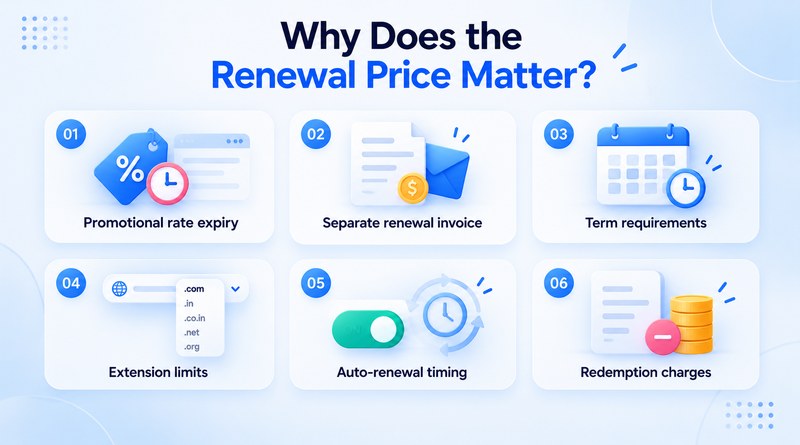
Promotional rate expiry
The discounted or free first year ends on a set date, and the standard rate applies from the next invoice.
Separate renewal invoice
Hosting and domain renewals rarely fall on the same day, so teams track two reminders and two payments.
Term requirements
Most free domain offers begin at an annual or three-year hosting plan, so the saving depends on a longer commitment.
Extension limits
The free registration applies to a short list of extensions. Premium and country-level names bill at regular rates.
Auto-renewal timing
Auto-renewal bills the saved payment method, so a reminder set 30 days ahead leaves room to review the rate.
Redemption charges
A domain that passes its grace period can carry a recovery fee, which raises the cost of a late renewal.
How Do Costs Compare Over 1, 3, and 5 Years?
Year one favors the bundle, because the registration fee drops to zero. From year two to year five, the domain renewal price, add-on choices, and portfolio size shape the total spend each year. The table below maps these variables across each period.
| Duration | Free domain with hosting | Domain bought separately | Deciding factor |
|---|---|---|---|
| Year 1 | Registration fee waived on qualifying plans and billing terms | Full registration rate at the registrar, with optional add-ons | Eligible extensions and hosting term |
| Year 3 | One waived registration and two renewals at the standard rate | One registration and two renewals at the registrar’s rate | Gap between first-year and renewal rates |
| Year 5 | One waived registration and four renewals, often on a separate billing date | One registration and four renewals, tracked in a single registrar dashboard | Add-on costs and renewal reminders |
Which Hidden Fees Deserve Attention?
Three categories account for most unplanned charges at checkout and renewal. Each charge looks modest on its own, yet the combined total can shift how a separate registration compares with a bundled offer. Reviewing the categories before payment lets a buyer compare the true annual cost instead of the headline registration rate.
Privacy protection
WHOIS privacy masks the registrant’s personal details in public records. Some providers include it, and others sell it as an add-on.
Transfer charges
A domain transfer typically adds one year to the registration and carries a fee, so the total depends on the incoming registrar’s rate.
Add-on services
DNS management, email forwarding, and premium DNS bills are separate at checkout, so the cart total can exceed the base registration price.
A quick review of the cart before payment keeps the final total predictable.
Who Really Controls Your Domain?
The registrant named in the registration record controls the domain. Some providers register a domain under the hosting company’s details instead of the customer’s, so the record deserves a check at purchase. That detail decides who can approve transfers and edits. Buyers should confirm the registrant name, the contact email, and the account that holds the login.
MilesWeb handles the domain hosting management, and nameserver settings from a single client area, and the order form collects registrant contact details at checkout. Registering with a separate registrar adds a second login, which suits teams that prefer to keep the domain apart from the hosting vendor.
What Are the Transfer Restrictions and Lock-In Risks?
Two rules shape every transfer. A new registration or a completed transfer carries a 60-day lock under ICANN policy. Each domain is then safeguarded during any transfer by an authorization code and a registrar lock. Bundled domains add a third layer, because some providers attach conditions to the promotional name, such as deducting its cost from a refund after an early cancellation.
Buyers can read the domain terms before checkout and confirm the unlock steps. MilesWeb supports incoming transfers through an “I want to transfer my domain to MilesWeb” option at order time, which lets an existing name join a hosting account without a new registration. Registering separately simplifies a later move to another host, since the domain carries no hosting conditions.
How Do DNS Management and Technical Control Differ?
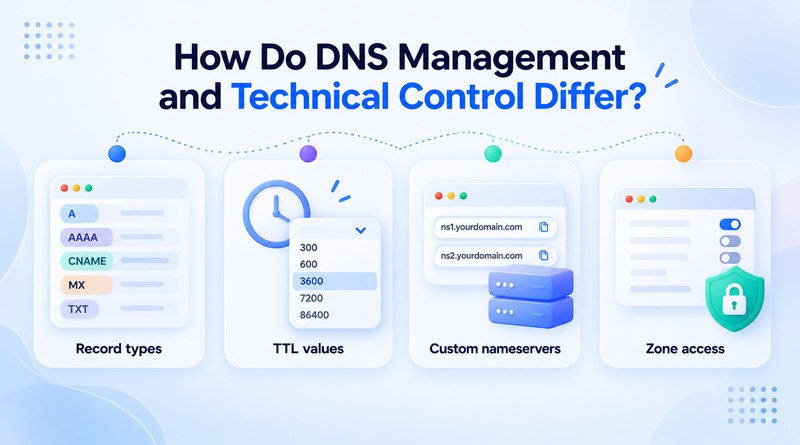
DNS settings decide where a website, an email service, and a verification record point, so the depth of DNS management matters to every technical team. A provider that combines domain with hosting and DNS in one place shortens each change. The controls below deserve a side-by-side check.
Record types
A, AAAA, CNAME, MX, and TXT records cover web, email, SPF, DKIM, and DMARC needs.
TTL values
A lower TTL speeds propagation before a migration, and a higher TTL reduces lookup traffic afterward.
Custom nameservers
Custom nameservers let agencies and resellers present branded nameservers to clients.
Zone access
cPanel includes a zone editor for adding and editing DNS records. Changes happen from the same dashboard that manages email accounts and databases.
MilesWeb also provides free website migration, which pairs well with this DNS control when a site moves between servers.
Related Read : DNS Record Types Explained: A, AAAA, CNAME, MX, TXT, and More
Which Option Fits Which Type of Business?
Each business profile weighs cost, control, and technical depth differently. Teams launching a first website want a low starting cost and a quick setup. Teams running many domains need a single renewal dashboard and consistent DNS controls across every name. Matching the registration approach to that priority keeps later migrations simple.
Startups and solo founders
A bundled free domain trims first-year spend and simplifies setup. Marking the renewal date on day one keeps the second year predictable.
Agencies managing several clients
Separate registration or a consolidated dashboard suits large portfolios, since one login can track every renewal and nameserver.
E-commerce and brand-critical stores
Priority goes to registrant clarity, transfer terms, and DNS depth. These factors protect checkout, email, and SEO stability.
Local and regional businesses
Country-focused extensions build regional trust, and low first-year rates make the bundled route attractive for a first launch.
How Should a Business Decide?
A short checklist turns the comparison into a decision. Each point below takes only minutes to verify and protects the domain for years.
01
Registrant record
Confirm the registrant name and contact email at purchase. The registrant holds the legal rights to the domain and approves every transfer request. A record that lists the business itself keeps future changes under the business’s direct authority.
02
Renewal rate
Verify the year-two price and the renewal date before placing the order. Please add that date to a shared calendar to ensure that both the finance and technical teams receive the same reminder on the same day. Reviewing the rate a month ahead leaves time to compare other registrars.
03
Transfer terms
Read the lock period conditions, the unlock steps, and any refund conditions attached to the promotional domain. Please confirm the process for obtaining the authorization code when a transfer becomes necessary. Clear terms keep a future switch to another host or registrar straightforward.
04
DNS access
Open the DNS panel and look for A, AAAA, CNAME, MX, and TXT records with editable TTL values. Agencies and resellers should also confirm custom nameserver support.
05
Add-on costs
Add privacy protection, email forwarding, and DNS services to the cart total before payment. MilesWeb shows these options on the configuration step, so the full price appears before checkout. A complete total makes the comparison between the free domain and the separate registration accurate.
Final Verdict
The free domain delivers clear value in year one, and separate registration delivers clarity in every year after. Startups with a focused launch budget gain the most from the bundle. Agencies and brand-critical stores gain the most from registrar-level control and consolidated renewals. Both routes work well when the buyer confirms the renewal rate, the registrant record, and the transfer terms before the first payment.
MilesWeb supports both paths from a single client area. Eligible plans include a free domain claim, incoming transfers keep existing names active, and published register, renew, and transfer rates keep budgets accurate. Custom nameservers, DNS management, ID protection, and cPanel controls give technical teams command of the domain from day one. With those tools in place, a brand can add new extensions, launch new regions, and scale campaigns on an address that stays steady, portable, and ready for whatever the next launch brings.
Frequently Asked Questions
1. Does the free domain include privacy protection?
Privacy protection depends on the provider and the plan. At MilesWeb, ID Protection is an optional paid service that appears on the configuration step, so buyers can add it during the domain order. Checking that step before payment shows the full cost.
2. Is the free domain mine to keep if I cancel hosting later?
The registrant named in the registration record holds the domain, and the name generally stays with that registrant after a hosting cancellation. Some providers attach conditions to the promotional domain, such as deducting its cost from a refund, so the terms deserve a read before purchase. The domain can move to another registrar once the 60-day lock ends.
3. Can I get a free domain without buying hosting?
The free domain is a promotion tied to a qualifying hosting plan and billing term, so it requires a hosting purchase. Buyers who need only a domain can register it separately and connect it to any host. MilesWeb supports both separate registration and incoming transfers.
4. Does a free domain come with the same features as a paid one?
Yes. Record editing and nameserver changes work the same on a free domain as on a paid one. Extras such as ID protection and email forwarding stay optional add-ons in both cases. The only difference between the two is the first-year price.