

 Gaurav Bodhare
Your database is either the launchpad for your application’s growth or its absolute bottleneck. A misaligned storage engine forces engineering teams into continuous infrastructure patching, inflated cloud bills, and eventual database migrations. Selecting the right engine directly impacts your long-term infrastructure stability. To settle the PostgreSQL vs. MongoDB debate, look past generic feature lists and test how their underlying storage models handle high-volume workloads.
Deploying on dedicated cloud hosting or high-performance MongoDB VPS servers provide a realistic benchmarking ground to isolate I/O bottlenecks before your application reaches production. Local testing environments fail to replicate real-world concurrent connections or complex indexing limits. Analyzing the operational differences between these two storage engines helps your team make the ultimate infrastructure decision.
Table Of Content
PostgreSQL vs MongoDB: At a Glance
Your data requirements dictate the exact database architecture your team needs. PostgreSQL relies on fixed tables to keep records consistent, which works best for complex relational models and financial ledgers. MongoDB uses flexible BSON documents instead, letting developers modify the code and spread the workload across multiple servers.
What is PostgreSQL?
PostgreSQL enforces strict tabular schemas with precise data types and constraints. This strict architecture ensures reliable query execution because the engine immediately blocks any data modification that violates your rules. Beyond core relational capabilities, its JSONB implementation stores parsed, semi-structured documents in a binary format, allowing you to run indexed searches directly on nested keys. This setup is essential for platforms that need exact cross-table calculations, complete data consistency, and total isolation between parallel operations.
Related Read: What is PostgreSQL Hosting? Benefits, Types, and Uses Explained
What is MongoDB?

MongoDB holds data as BSON documents, giving you massive structural flexibility without strict schemas. This means individual records in a single collection can have entirely different fields, arrays, or sub-documents. This design lets your team deploy code updates continuously without executing complex database migrations or locking tables. The engine ingests high-volume writes immediately without waiting for background validation, making it the perfect fit for high-throughput tracking systems and unstructured content catalogs.
Related Read: Best MongoDB Hosting Providers
How Does PostgreSQL vs MongoDB Performance Compare?
A distinctive benchmark testing approach reveals that query complexity directly shapes PostgreSQL vs MongoDB performance. PostgreSQL uses a highly advanced query planner that evaluates table statistics to map out the most efficient execution plan for multi-table operations. This simplifies the complex reporting and makes it fast even through millions of rows. MongoDB processes basic CRUD operations on single documents with lower latency. It extracts pre-aggregated data from a single memory location rather than compiling disjointed table fragments from different areas of the disk.
Related Read: PostgreSQL vs MariaDB: Finding the Perfect Match for Your Cloud Strategy
PostgreSQL vs MongoDB: Which Database is Faster?
The performance winner in PostgreSQL vs MongoDB speed tests depends entirely on the specific queries and workloads your application runs. MongoDB maintains a performance lead during point reads and rapid single-document writes. Its storage engine utilizes memory-mapped files to read directly from memory when possible, avoiding the overhead of strict schema validation and detailed transaction logging. PostgreSQL handles complex analytical queries significantly faster. MongoDB slows down considerably when executing the $lookup operator because resolving relationships across distributed collections introduces substantial network and compute latency.
How PostgreSQL and MongoDB Handle Growth?
Infrastructure requirements expose the fundamental differences in PostgreSQL vs MongoDB scalability. PostgreSQL relies on vertical scaling rather than horizontal expansion, requiring upgrades to CPU, memory, and storage capacity on a single server host. While setting up read replicas distributes query traffic, your write traffic remains tied to the primary node, which can eventually saturate your storage hardware. MongoDB scales out horizontally by distributing large datasets across separate compute nodes, which balances the processing load across your infrastructure cluster.
When to Choose PostgreSQL?
Deploy PostgreSQL when your data structures are clean and your transactions demand complete accuracy. Payment gateways, accounting systems, and enterprise logistics platforms rely on its exact ACID implementation to ensure every transaction processes completely or rolls back during an unexpected failure. This strict consistency blocks data errors from entering persistent storage over long-term operations. This process enables growing companies to verify user identities accurately and maintain continuous trust by keeping core customer databases protected.
When to Choose MongoDB?
Select MongoDB when your application demands the flexibility to manage fluid or evolving data structures that change over time. Media platforms, product catalogs, and telemetry ingestion engines require this level of schema flexibility. For instance, in an e-commerce catalog with electronics and apparel, MongoDB stores both distinct item types in the exact same collection without schema updates. The document model also allows you to iterate and launch new features instantly if you build your front end with an AI website builder.
What Are the Advantages of PostgreSQL?
PostgreSQL is widely used for applications that require strong data consistency, structured relationships, and advanced querying capabilities. Its feature-rich architecture makes it suitable for handling complex business and analytical workloads.
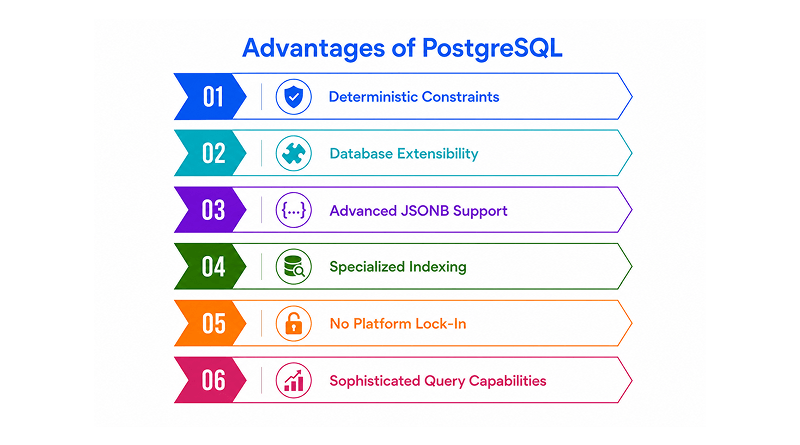
- Deterministic Constraints: Blocks invalid, malformed, or incomplete data at the storage layer.
- Database Extensibility: Supports specialized extensions like PostGIS for complex geospatial operations.
- Advanced JSONB Support: Provides fast search and retrieval across semi-structured datasets without sacrificing reliability.
- Specialized Indexing: Uses GIN and BRIN indexes to speed up searches across complicated, high-density data.
- No Platform Lock-In: An entirely open-source codebase backed by a global developer community ensures long-term operational independence.
- Sophisticated Query Capabilities: Executes complex window functions and recursive queries directly on the database engine.
Related Read: Find out which DBMS is best suited for your project
What Are the Advantages of MongoDB?
MongoDB is designed for flexible and rapidly changing applications where schema adaptability and horizontal scaling are important. It works especially well for modern web apps, real-time platforms, and large distributed systems.
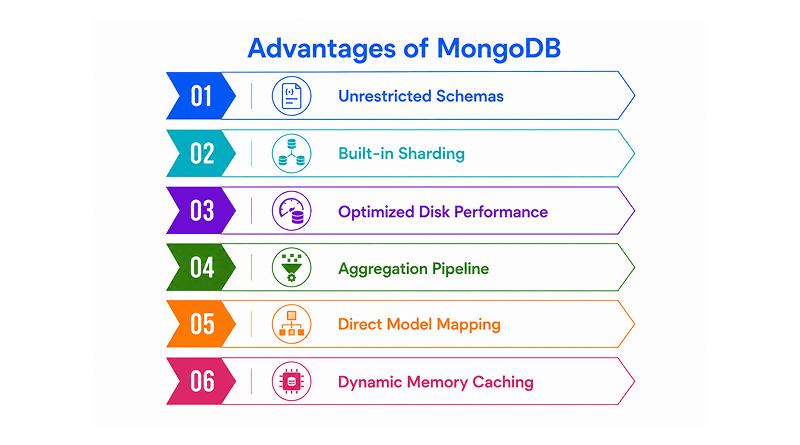
- Unrestricted Schemas: Allows developers to update data models immediately without causing system downtime.
- Built-in Sharding: Partitions huge datasets across distinct hardware nodes without requiring code modifications.
- Optimized Disk Performance: Clusters related data points together to reduce the total read operations needed per query.
- Aggregation Pipeline: Filters, groups, and manipulates data directly on the database host.
- Direct Model Mapping: Matches BSON documents directly to backend objects, completely removing the need for complex ORMs.
- Dynamic Memory Caching: Caches the most frequently queried working datasets in RAM for real-time retrieval.
Related Read: Running MongoDB in Docker
What Are the Pros and Cons of PostgreSQL vs MongoDB?
PostgreSQL: PostgreSQL excels at handling structured data that requires absolute precision and complex relational logic. It is the standard choice for applications where transactional reliability is non-negotiable.
| Pros | Cons |
|---|---|
| ACID compliance | Scaling friction |
| Complex queries | Rigid schemas |
| Extensible architecture | Resource intensive |
| Data integrity | Write bottlenecks |
MongoDB: MongoDB shifts the focus toward rapid deployment and fluid data structures that evolve alongside application code. It removes the constraints of traditional tables to handle unstructured payloads at scale.
| Pros | Cons |
|---|---|
| Flexible schemas | Heavy memory reliance |
| Native sharding | Slow aggregations |
| Rapid ingestion | Code-level validation |
| Hierarchical storage | Higher storage overhead |
Which Is Better for Modern Applications?
Your software architecture dictates how well your database survives long-term growth. When building microservices, you can implement a polyglot persistence model by deploying both engines to handle separate operational goals. Utilizing MongoDB for high-throughput session caches or user activity feeds while routing complex financial records to PostgreSQL ensures each engine processes the exact workload it was engineered to handle. Tuning MongoDB vs PostgreSQL performance requires reviewing your specific traffic patterns to eliminate processing latency.
Which Database Offers Better Security and Data Integrity?
Enterprise systems demand deterministic data validation. PostgreSQL forces rigorous data checks directly within its storage core, ensuring every single write strictly matches your table constraints. This halts malformed data before it harms your storage drives, giving you the operational reliability needed to protect your online store. MongoDB offers enterprise-grade security features like role-based access control (RBAC) and TLS and SSL security for in-transit connections. However, its default acceptance of diverse document structures means your engineering team must build validation logic into your code to prevent incomplete records from reaching storage.
What Are the Cost and Hosting Differences?
Your choice of database sets your long-term hardware costs and cloud overhead. Because PostgreSQL scales vertically, managing large databases requires a high-end host with plenty of CPU cores, substantial RAM, and fast drives. Many developers move their workloads to specialized PostgreSQL hosting to guarantee their relational databases get the dedicated resources they need. MongoDB requires ample RAM to keep its active working indexes fully cached for maximum throughput. Scaling horizontally means managing multiple nodes, which adds administrative overhead. Managed web hosting platforms eliminate this complexity by handling data distribution maintenance, automated recovery, and node synchronization on your behalf.
What Are the Key Differences Between PostgreSQL and MongoDB?
The direct architectural difference between MongoDB and PostgreSQL lies in how each engine optimizes for data retrieval. PostgreSQL enforces normalization, breaking data points apart into dedicated tables to eliminate duplicate records and using relational joins to reconstruct data at runtime. MongoDB packs related data together inside nested BSON documents. By putting your data in one place, you avoid pulling from separate collections, which speeds up lookups.
| Feature | PostgreSQL | MongoDB |
|---|---|---|
| Data Model | Relational (Tables, Rows, Columns) | Document-oriented (BSON collections) |
| Schema Flexibility | Strict, predefined schema required | Schema-less (Dynamic or flexible fields) |
| Scalability | Primarily vertical (Scale up hardware) | Horizontal (Built-in sharding across servers) |
| Transactions | Strong ACID compliance by default | ACID support available, but optimized for single documents |
| Best For | Complex joins, data consistency, analytics | High-velocity writes, fast prototyping, unstructured data |
Concluding Insights
Evaluating which is better MongoDB or PostgreSQL comes down to the underlying structure of your data. PostgreSQL remains the optimal tool when your software relies on structured data, exact transactional rules, and complex calculations. Its relational design prevents data corruption while providing highly optimized data extraction across linked records.
MongoDB works best for projects with unpredictable data, fast release cycles, and a need for simple horizontal scaling. Its document architecture lets your team build without schema bottlenecks, while built-in sharding distributes intense write traffic evenly. Matching your storage setup to your data structure from the start serves as the ultimate catalyst for operational efficiency, ensuring every server deployment performs at its absolute peak.
FAQs
1. Which database offers better data integrity: PostgreSQL or MongoDB?
PostgreSQL prevents errors by checking every update against strict tables, precise data types, and primary or foreign key constraints. MongoDB works differently by letting you save almost any data structure without initial validation, leaving your application code to handle the heavy lifting of verification.
2. What indexing options are available in PostgreSQL vs MongoDB?
To keep performance high in both PostgreSQL and MongoDB, each database relies on its own specialized indexing options. PostgreSQL relies on standard B-Trees for primary searches, but it also includes advanced GIN indexes to quickly scan nested JSON and GiST indexes to handle geographic data. MongoDB supports multikey indexes to scan array fields directly, automatically indexing every individual element to locate nested data efficiently without full-collection scans.
3. Which is more cost-effective: PostgreSQL or MongoDB?
PostgreSQL is completely open-source, and its compact table structure keeps RAM and disk usage low. MongoDB duplicates field names inside every single document, meaning you need more storage and memory, which makes managed cloud setups expensive as you grow.
4. Which database is easier for beginners: PostgreSQL or MongoDB?
MongoDB is usually much easier to pick up because its data format feels just like writing standard JavaScript objects or Python dictionaries. You can store data immediately without learning a new language. PostgreSQL requires you to learn SQL and plan your tables before writing code, requiring more effort initially but saving you from fixing structural complications later.
5. PostgreSQL vs MongoDB: which is better for cloud-based applications?
Deciding which is better MongoDB or PostgreSQL for the cloud depends entirely on how you plan to scale. MongoDB uses built-in data distribution to spread massive, unstructured datasets across multiple servers effortlessly. PostgreSQL delivers highly predictable execution speeds because its system handles parallel tasks directly, keeping query performance steady even under heavy workloads.