

 Gaurav Bodhare
Efficiency in a web application isn’t found in the lines of code users see but in the silent execution of data turning into a visual interface. Many developers overlook rendering, but this layer directly impacts whether an application feels responsive or sluggish. In 2026, where every millisecond influences user retention, your choice of a Python hosting environment must pair with a rendering strategy that eliminates latency before it reaches the browser.
High-performance environments require moving beyond default settings. You need a system that minimizes CPU cycles while maintaining a clean separation between your core Python logic and the visual layer. Your choice determines whether your application remains agile or slows down due to unoptimized string processing.
Understanding Python Templating
A template engine serves as the primary translator for your application. It converts raw Python objects into structured formats like HTML, XML, or JSON without requiring manual string manipulation. These engines help keep your website secure by automatically cleaning data to block cross-site scripting vulnerabilities.
Your choice here directly affects your server’s Time to First Byte (TTFB). An engine that compiles to machine code will always outperform one that interprets logic on every request. By selecting a library that mirrors your framework’s architecture—whether you use Flask, Django, or FastAPI—you optimize the way your Python template library consumes system memory.
Table Of Content
Summary (TL;DR)
Your template engine is what finally turns backend data into the actual page a visitor sees on their screen. While Jinja2 is the standard for security and balance, engines like Chameleon, Mako, Genshi, Tenjin, and Cheetah3 provide the specific power needed for raw speed, XML integrity, or complex automation. Optimizing this rendering layer keeps your website fast, your server efficient, and your code clean enough to scale without hitting a bottleneck.
Core Advantages of Python Template Engines
Choosing the right engine simplifies how you manage dynamic content while maintaining a professional and secure codebase. The following key benefits highlight why these tools are essential for any modern web development project.
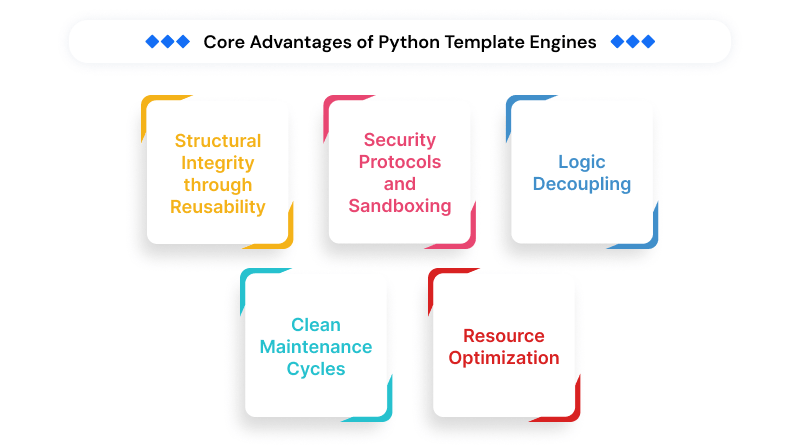
- Structural Integrity through Reusability
A single base file provides the structure for every page, so you never have to rewrite the same code twice. This keeps your Python HTML templates uniform across the website and makes global updates instant.
- Security Protocols and Sandboxing
Modern engines implement a strict security layer by default. They isolate the rendering environment, ensuring that user-provided data cannot execute unauthorized commands on your high-security data center hardware.
- Logic Decoupling
Placing UI logic in separate files keeps your Python backend safe from front-end errors. You can tweak the JavaScript code editor or other visual parts without any risk of breaking your core calculations.
- Clean Maintenance Cycles
Centralizing your templates allows you to edit one global element, such as a navigation bar or footer, and see that change appear across your entire collection of Python web templates immediately.
- Resource Optimization
Advanced engines utilize bytecode caching to reduce redundant processing. This allows your server to process thousands of concurrent visitors while keeping CPU usage within a sustainable range.
Related Read: Best Python Hosting Providers
Top 6 Python Template Engines to Use
1. Jinja2
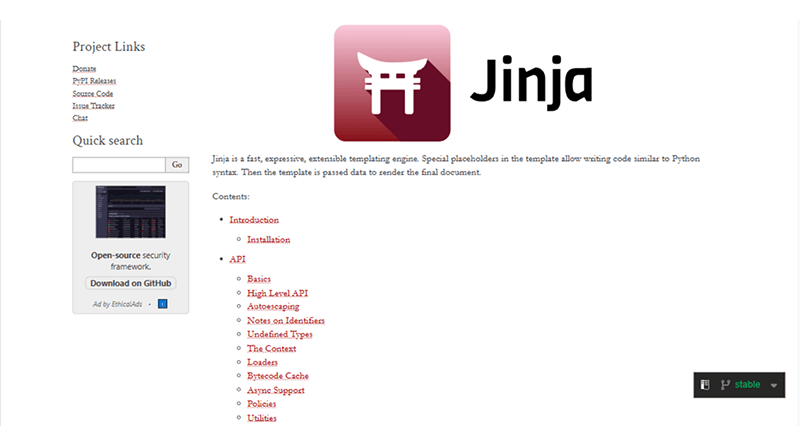
Jinja2 relies on a sandboxed environment to keep template execution safe and restricted. Its custom parser translates code into Python bytecode, which allows the server to process requests quickly without the performance lag typical of standard template engines. This engine is particularly effective when you need to generate dynamic content for a WooCommerce hosting provider or similar e-commerce platforms where security and speed must coexist. The Jinja2 Python template separates logic from presentation, helping you avoid complicated code structures while making quick layout updates.
High-Performance Capabilities
- Mandatory automatic HTML escaping
- Support for asynchronous template execution
- Extensive template inheritance
- Highly customizable filter system
- Configurable syntax to avoid language conflicts
2. Mako
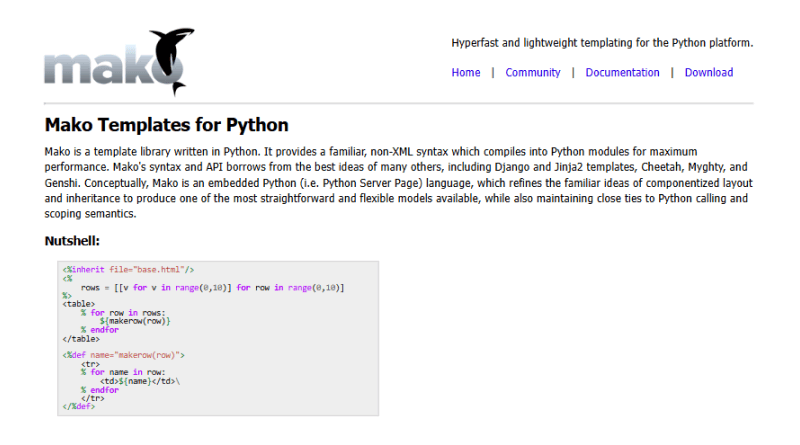
Mako turns templates into Python modules, which lets your code run as fast as the server itself. It does not try to create a new language; instead, it allows you to use standard Python syntax within your HTML files. Mako avoids reinterpreting code for every request; it converts templates into Python modules to keep the server from stalling under load. Mako works well on Windows VPS server because it handles the intensive calculations needed for page generation without overloading the server. It manages the deep logic in the background so visitors never face a laggy interface.
High-Performance Capabilities
- Direct compilation into Python source code
- Native Python support and control structures
- Component-level caching for pre-rendered fragments
- Flexible layout inheritance through “def” tags
- Uses less memory to handle more traffic
Related Read : What Are the Benefits of Windows VPS Hosting?
3. Chameleon
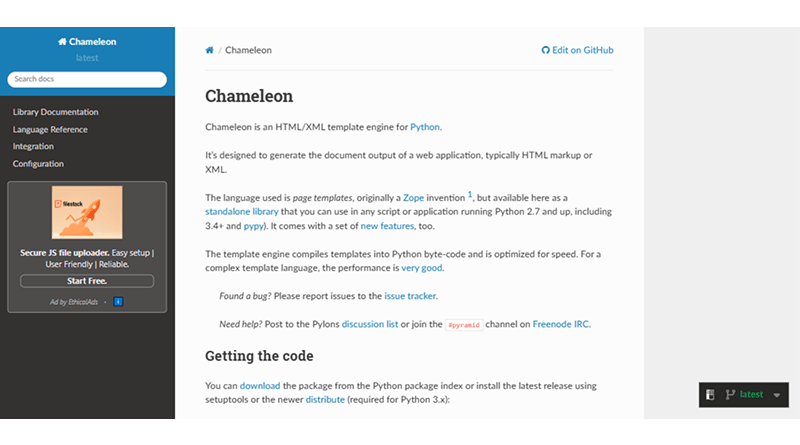
Chameleon is built for developers who need extreme speed. It translates templates into optimized machine code using an AST (Abstract Syntax Tree) compiler. Chameleon provides the fastest way to render structured XML or XHTML documents on specialized Linux distributions. It often outperforms other engines when the server is under heavy load. This speed comes from its ability to compile templates directly into Python code, which reduces the typical processing lag. This efficiency makes it the preferred option for developers who need to follow strict formatting rules while keeping the site fast.
High-Performance Capabilities
- Translation into optimized Python bytecode
- Strict implementation of the Zope Page Templates (ZPT) spec
- Dynamic attribute language for cleaner XML structures
- Native support for internationalization (i18n)
- High compatibility with Debian Linux VPS server environments
4. Genshi
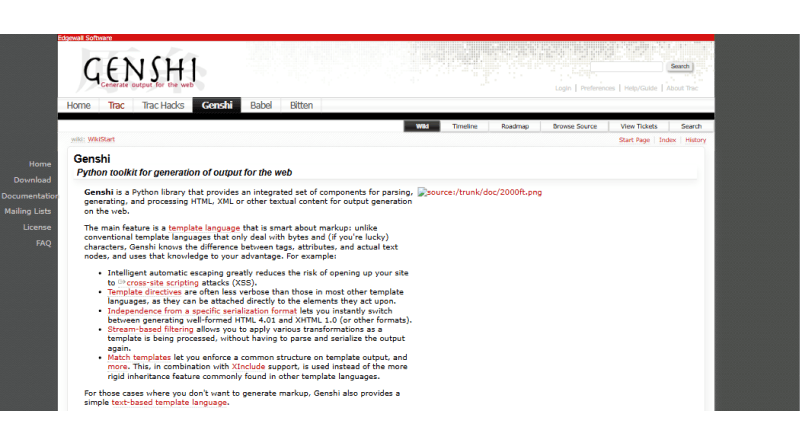
Genshi excels by processing data as a continuous stream, avoiding memory spikes during the handling of extensive datasets. Instead of loading an entire page at once, it processes the output piece by piece. This is a critical feature for generating large-scale reports or complex Python template example files that would otherwise exhaust server resources. Using reliable web hosting alongside Genshi ensures high-volume output without slowing down the experience for other people on your website. This allows you to run massive data summaries and complex background tasks that would typically drain your server resources.
High-Performance Capabilities
- Strict XML compliance for flawless data parsing
- Stream-based processing for low memory consumption
- Path-based directive system for data injection
- XInclude support for modular content
- Strong integration with XML-heavy enterprise systems
5. Tenjin
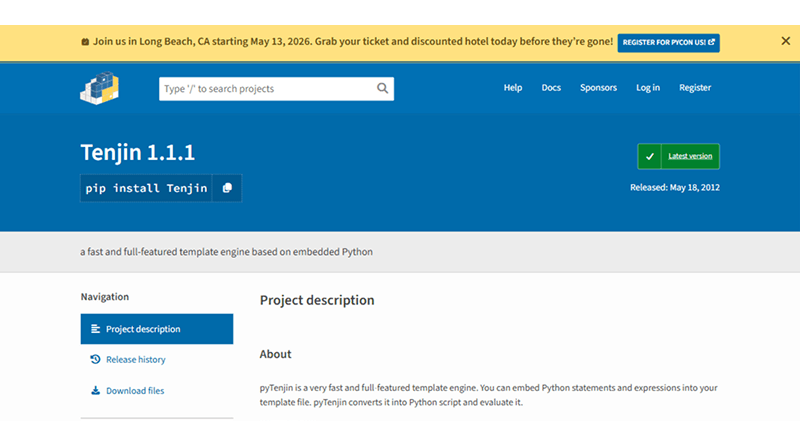
Tenjin serves as a specialized Python template engine tailored for high-performance microservices. It skips the complexity of high-level abstractions to provide a tool that is as close to the hardware as possible. Tenjin serves as a primary choice for environments where RAM is a premium, particularly in edge computing or lightweight cloud hosting. While Genshi excels at XML safety, Tenjin provides a leaner path for developers who prioritize raw speed and low resource consumption. It functions without the heavy overhead found in standard tools, ensuring your application stays responsive even on minimal hardware.
High-Performance Capabilities
- Zero dependencies for simple deployment
- Embedded Python for direct data control
- Pre-processing for static template segments
- Lean codebase for rapid execution
- High stability for API-driven apps
6. Cheetah3
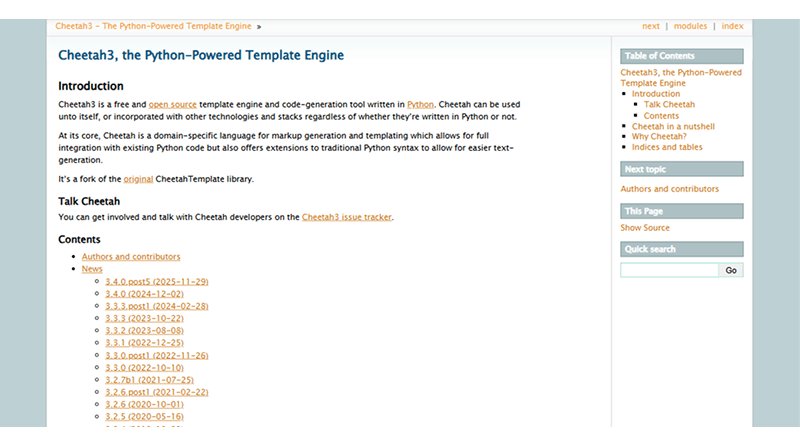
Cheetah3 is a modernized tool that functions as both a template engine and a powerful code generator. Treating templates as classes allows inheritance to swap server-specific variables without altering your core logic. This object-oriented setup offers a significant advantage for massive automation, letting you push unique source code to a whole fleet of servers from a single, clean base. Cheetah3 turns templates into actual Python modules so your scripts execute instantly without wasting time on repeated parsing. By integrating directly with the modern Python ecosystem, it keeps your automated server deployments stable and lightning-fast.
High-Performance Capabilities
- Dedicated support for Python 3 and modern syntax
- Object-oriented template structure for deep nesting
- Namespace conflict prevention
- Built-in file-based caching
- Generating non-HTML files for versatile source code output
Performance Benchmark: Raw Execution Speed
Speed tests often miss how a tool behaves when your app pulls massive datasets or runs complex loops. Map out your specific hardware bottlenecks to find the engine that stays responsive under your real-world load.
- Chameleon: The premier choice for XML/XHTML rendering. If your application sends large amounts of structured data to the client, this engine minimizes the CPU time per request.
- Mako: Provides the highest efficiency for templates that perform logical operations—like sorting or filtering—within the template layer.
- Jinja2: Maintains a steady performance level to manage standard web traffic without sudden spikes in resource consumption.
- Tenjin: Skips heavy middleware by turning templates into lean Python code to hit the highest possible execution speeds.
- Cheetah3: Prevents repeated parsing delays by converting templates into persistent Python modules.
- Genshi: Uses an XML-based stream to process output in small bites, preventing memory exhaustion during massive data exports.
Finding the fastest Python template engine requires matching the engine’s compilation style to your data type. If you are integrating an n8n workflow to automate data updates, ensuring your template engine doesn’t lag behind the incoming data stream is essential.
Framework Compatibility
Integration defines how quickly you can move from a concept to a live deployment. Most modern frameworks include a native Python template engine to remove configuration hurdles and accelerate your initial deployment.
- Flask: Built around Jinja2. This setup allows developers to push from local environments to live URLs with minimal configuration.
- Django: Although it includes a native system, many high-traffic websites replace it with Jinja2 for better performance and more flexible filtering.
- FastAPI: Since it is built for speed, pairing it with a high-performance engine like Jinja2 or Chameleon ensures the rendering layer doesn’t slow down the asynchronous backend.
Common Integration Pitfalls
Forcing business logic into templates often leads to website failure. Instead of pushing the template to process data, handle those calculations in the Python controller. Too much logic makes debugging difficult and ruins your rendering speeds. Keep your templates focused on displaying the final output rather than deciding what that data is or where it comes from.
Neglecting to cache static elements is another major oversight. Even the fastest engine will encounter delays if it has to regenerate the same header and footer for every visitor. Implementing server-side caching via your business email hosting or web server interface ensures that static parts of your page stay in memory, reducing the CPU load for every request and preventing a 404 error due to timed-out processes.
How to Choose the Right Python Templates
Selecting the ideal template engine depends on your specific performance requirements and the complexity of the data you handle.
- For Rapid Development: Use Jinja2. Its massive community and extensive documentation guarantee you never have to solve a problem from scratch.
- For Maximum Performance: Go with Chameleon or Tenjin. These engines remove unnecessary processing between your code and the final page.
- For Strict Security: Choose Jinja2 for sandboxing to keep your server safe.
- For XML/XHTML Standards: Genshi gives you the most reliable tools to make sure your output passes every strict validation check.
- For Large-Scale Automation: Cheetah3 provides the depth you need to handle complex code and massive sets of data.
Top Python Template Engines: Head-to-Head Comparison
| Engine | Best For | Speed | Learning Curve | Security | Use Case |
|---|---|---|---|---|---|
 |
All-around flexibility | Very quick; compiles to optimized Python code | Easy to pick up if you know basic Python | Strong; keeps everything in a sandbox | Modern Flask or Django apps that need to stay secure and fast |
 |
Pure performance | Blazing fast; turns templates into Python modules | Demanding learning curve; allows raw Python directly in HTML | Needs extra care; no automatic sandboxing | High-traffic sites where you can’t afford any lag in page loads |
 |
HTML/XML integrity | High-end; uses an efficient attribute-based compiler | Harder for beginners; uses specific TAL syntax | Very reliable; strictly separates data from design | Projects requiring 100% valid XML or strict document rules |

|
Legacy systems | Respectable, but not the fastest on this list | Moderate; feels like shell scripting mixed with Python | Basic; requires manual safety checks | Generating large configuration files or keeping older server setups running |
 |
XML-based web applications | Moderate; relies on stream-based processing which is slower than bytecode compilation | Steep; uses a template attribute language (TAL) similar to Chameleon | Excellent; automatically escapes all content to prevent injection | Projects where valid XHTML or strict structural integrity is the top priority |
 |
Lean environments and raw speed | Exceptionally fast; often outperforms Jinja2 and Mako in benchmarks | Simple; uses standard Python tags but requires manual effort for complex tasks | Basic; offers manual escaping, so developers must handle security themselves | High-performance microservices or lightweight apps where every millisecond matters |
Concluding Insights
The rendering engine you pick is a statement about your application’s architecture. Moving beyond basic setups demonstrates a commitment to building a fast, reliable platform. In today’s demanding market, precision is vital; leveraging these Python tools transforms your infrastructure into a competitive asset that meets modern performance standards.
Optimizing backend rendering produces seamless updates and instantaneous page loads. Thinking ahead like this protects your brand’s reputation and gives you the framework you need to grow without any technical friction. Staying ahead on performance is the best way to keep your online presence leading the pack as things change.
When you focus on these small technical wins, you create a better experience that users actually enjoy coming back to. Improving your website speed keeps your brand ahead of the competition.
FAQs
1. What are the best Python template engines for web development?
Developers opt for Jinja2 because it remains stable and reduces the risk of errors during deployment. When handling high-traffic platforms, Mako serves as a reliable Python template engine that processes intensive data requests without compromising server response times.
2. Are Python HTML templates good for web design?
Python HTML templates work well because they separate your data logic from your visual design. These engines separate the application logic from the presentation layer, allowing you to generate dynamic web pages by injecting data into static HTML files.
3. How do dynamic templates in Python improve performance?
Dynamic templates save time by reusing specific code sections instead of rebuilding every page from scratch. A Jinja2 Python template handles the processing load by focusing on specific data requests. This approach prevents the server from performing unnecessary tasks and results in faster page loads.
4. What is template rendering in Python?
Template rendering combines your database information with a static layout. A Python template library fetches specific data and drops it into placeholders, building a complete web page the moment a visitor lands on your website.