
 Jyoti Prasad
The multi-agent artificial intelligence (AI) sector is developing rapidly. Basic AI agents have given way to teams that work together, share workloads, coordinate, manage workflows, and even simulate entire organizations. With new AI frameworks emerging every few months, choosing among them has become a challenge.
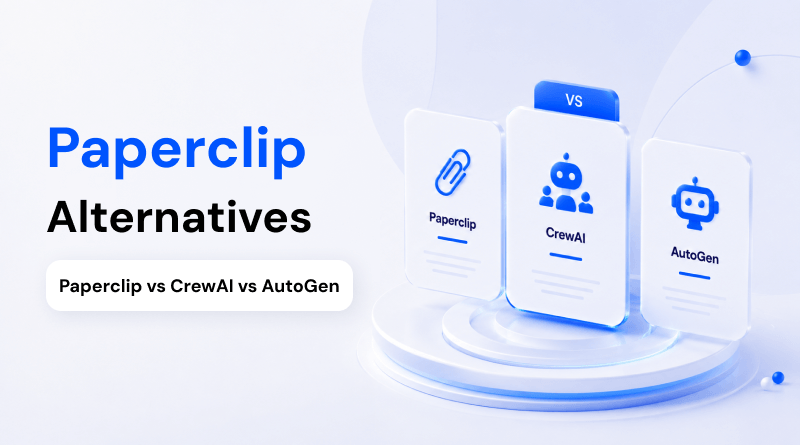
Paperclip AI, CrewAI, and AutoGen frequently appear in conversations about multi-agent applications. Each of the three frameworks provides distinct solutions for creating multi-agent systems. Paperclip focuses on running AI agents like a structured company with specified roles, budgets, and governance. CrewAI is designed to perform specific roles with ease, using minimal setup. Microsoft developed AutoGen to facilitate rich conversations among multi-agent teams.
In this guide, we will compare CrewAI and AutoGen as Paperclip alternatives and identify which framework will be the best fit for your use case. The detailed MilesWeb blog includes a thorough evaluation of architecture, setup complexity, production readiness, cost control, model support, and long-term ecosystem health.
After you’ve finished reading this guide, you will have a clear idea of which framework will work best for your project as a Paperclip alternative.
Similar Read: OpenClaw Alternatives
Table Of Content
TL;DR
1
For builders who want to manage AI agents like they would a business, Paperclip AI provides a way to have departments, budgets, and governance controls around multiple AI agents.
2
If you prefer minimal code, then CrewAI gives you the fastest method for adding multiple AI agents to production-ready workflows.
3
If you need complex agent-to-agent conversations and work primarily in Microsoft’s or Azure’s ecosystem, then AutoGen is the option to consider.
4
Although all three of the frameworks are open source, they approach architecture, setup experience, cost management, and maturity differently in production.
5
For many developers starting today, CrewAI brings the best overall balance of simplicity and capability. Paperclip provides a unique organization around the multiple AI agents, and AutoGen is strong for conversational agents.
Why Do Users Prefer Paperclip Alternatives?
✓
Need for a more mature framework for deploying to production
✓
Utilization of Python first for development
✓
The main use case of task automation as opposed to governance example structures
✓
Need advanced agent-to-agent conversational capabilities, including collaborative reasoning.
✓
Access to a larger support community and ecosystem
✓
Utilizing Microsoft Azure or other related tools
What’s Paperclip AI?
The Paperclip AI platform organizes AI agents like a company rather than a workflow. Instead of just creating a list of tasks to be accomplished, you can also create departments, job titles, a reporting hierarchy, and budgets for how agents will work with one another.
Here are some of the main highlights of Paperclip AI:
- Organize agents based on an organizational chart.
- Built-in budget and governance controls.
- Dashboard-driven, easy to use, low-code.
- Supports multiple models and providers of AI.
- Works great for building ‘AI companies’ and autonomous organizations.
- Excellent for experimenting, prototyping, and creating well-defined teams of agents.
- Completely free and 100% open source.
Useful Read: Top Ollama Alternatives
Why Does Choosing The Right Multi-Agent Framework Matter?
The multi-agent artificial intelligence ecosystem has evolved immensely in the last year due to an increased focus on creating groups of specialized agents. These groups work together by utilizing their unique skills and capabilities, rather than developing standalone AIs that are only capable of performing single-task actions consecutively.
Therefore, selecting the right framework to utilize for your organization’s multi-agent system has a profound effect on both the development speed and operating expenses associated with the system. Migrating from one type of multi-agent architecture to another is challenging, and the core reason behind it is the tightly interwoven nature of each agent’s workflow, memory, orchestration logic, and monitoring tools.
This recognition is one reason why Paperclip AI is an intriguing alternative to other established multi-agent frameworks such as CrewAI and AutoGen. CrewAI emphasizes task-oriented collaborative agents, whereas AutoGen concentrates on multi-agent conversations. In contrast, Paperclip provides an innovative approach to multi-agent organization by treating each agent as a member of a virtual company with established organizational structures, budget constraints, and governance protocols.
📊
Evaluation Criteria
As we compare the two popular alternatives to Paperclip AI frameworks, we’ll use the following criteria to evaluate them:
🏗️ The Architecture Model
The way agents are organized and coordinated.
⚙️ Setup Complexity
Availability of an easy way to set up a working model.
🚀 Production Readiness
Is the framework mature enough to run business-critical solutions?
💰 Cost Controls
How well you can manage token usage and related operational expenses.
🌐 Ecosystem Health
Will the community supporting it provide ongoing support? Will they have been active in maintaining the resource over time?
Now, let’s move ahead and check out the top Paperclip AI alternatives.
Top Paperclip AI Alternatives: CrewAI vs. AutoGen
1. What is CrewAI?

CrewAI is one of the leading multi-agent systems for developers interested in creating collaborative workflows with agents. This product has a heavy focus on assigning a different role to each agent and coordinating their collaborative efforts through defined tasks.
Main highlights of CrewAI:
- Role-based architecture
- Straightforward to set up with just a few lines of Python code
- Quick learning curve for developer resources
- Large community of support for production purposes
- Supports a variety of different Large Language Model (LLM hosting providers)
- Creation of automated pipelines and enterprise business workflows
- Completely free and 100% open source
2. What is AutoGen?
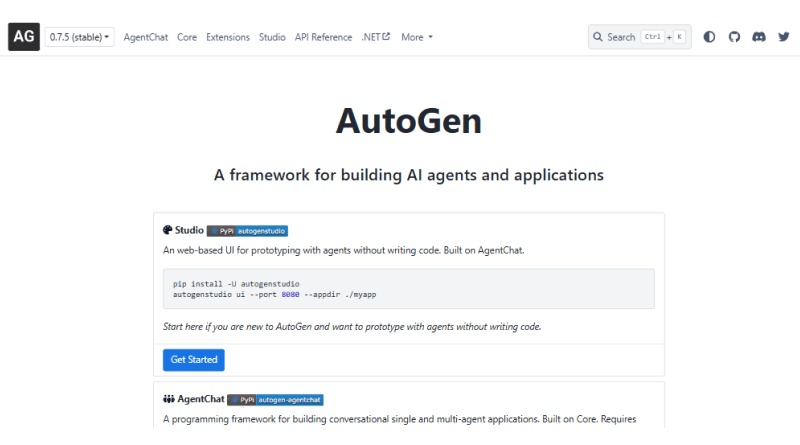
AutoGen is a multi-agent conversational framework from Microsoft. In this framework, agents engage in conversations with each other, and through a structured exchange of messages, they collaborate on solving issues.
Main highlights of AutoGen:
- A multi-agent system with internal agent interactions
- Close integration with Microsoft tools and Azure
- Manages intricate interactions among many agents
- Highly customizable AI agents
- Ideal for both research and elaborate orchestration scenarios
- Complex setup compared to CrewAI
- Limited addition of new features
- 100% free and open source, just like Paperclip and CrewAI
Paperclip vs. CrewAI vs. AutoGen: Full Detailed Comparison
| Comparison Feature | Paperclip AI | CrewAI | AutoGen |
|---|---|---|---|
| Paradigm | Organization-Based | Role-Based | Conversation-Based |
| Setup Time | Very Fast Dashboard-first setup |
Fast Few lines of Python |
Moderate to High Intense-setup |
| Code Required | Low | Low to Moderate | Moderate to High |
| Budget Control | Native per-agent budgets and governance | No built-in budget controls | No built-in budget controls |
| Persistent Memory | Basic organizational memory | Available through memory integrations | Supported through conversation history and memory modules |
| Production Ready | For prototypes and internal tools | Highly production-ready | Less actively evolving |
| Model Support | Multiple LLM providers | Multiple LLM providers | OpenAI, Azure OpenAI, and other supported models |
| Best For |
Governance AI companies, governance-heavy workflows, non-developers |
Automation Business automation, task pipelines, production workflows |
Reasoning Complex agent discussions and collaborative reasoning |
1. Underlying Working Framework
Even though all frameworks are multi-agent systems (an ideal alternative to the Paperclip framework), each of them is coordinated in entirely different ways. It’s important to know these architectural differences because they impact scalability, price, maintenance, and performance.
- Paperclip’s WorkFlow: Organization-Layer Architecture
From an organizational standpoint, Paperclip AI includes multi-agent systems that don’t treat the agents as separate and individual workers performing tasks. Instead, it treats them as employees in a virtual company.
In Paperclip, agents are assigned roles, departments, responsibilities, and reporting relationships within the company. Sophisticated agents delegate work to less sophisticated agents, while governance rules and budget limit the resources used in the company.
The result is that Paperclip feels less like a workflow engine and more like an OS for autonomous AI teams. Through a built-in dashboard, users can see the organizational hierarchy, monitor activity, and manage budgets of agents without writing extensive code.
🏢 Paperclip AI Architecture
How it works
- ✓ Agents are organized into departments and teams.
- ✓ Work is delegated down the reporting structure.
- ✓ Budget limits can be placed on individual agents.
- ✓ Governance rules guide decision-making.
- ✓ The organizational hierarchy serves as the orchestration layer.
Best suited for
🤖 Autonomous AI Organizations
🏬 Multi-Department AI Workflows
🛡️ Governance-Sensitive Environments
🧪 Experimental & AI Company Use Cases
- CrewAI’s WorkFlow: Role-Based Pipeline Model
CrewAI uses a practical and workflow-oriented model for working with agents and their tasks. The developer assigns roles to agents who perform specific tasks within a defined workflow. For example, one person could be performing research, another could be generating content, and the last person would be approving what was generated. The task sequence provides a clear path for improving the efficiency and predictability of work as it moves between the agents.
Because there are fewer moving parts, developers can develop and deploy multi-agent applications faster than they could with a more complex orchestration framework.
⚙️ CrewAI Workflow Architecture
How it works
- 1 Tasks are explicitly defined.
- 2 Workflows have defined paths of execution.
- 3 Agents pass off tasks between one another for collaboration.
- 4 Developers control the orchestration of agents directly.
Best suited for
✍️ Content Generation Pipelines
🔄 Business Process Automation
📊 Research & Analysis Workflows
🚀 Production-Grade Multi-Agent Applications
- AutoGen’s WorkFlow: Conversation Architecture
AutoGen operates by having an architecture that focuses on communication between agents first. Rather than agents following a pre-defined workflow for completing individual tasks, agents use a structured approach to communicate with one another to accomplish their goals.
For example, the AutoGen system contains multiple independent agents, each with a specific area of expertise. These collaborate through exchanging messages, debating possible solutions, reviewing previous work, requesting clarification, and ultimately working together. There is a manager (or coordinator) agent that monitors all conversations and ultimately decides when they should stop.
Thus, this structure creates highly flexible workflows where agents quickly adapt to changes as conversations continue to develop. However, the additional rounds of conversation between agents add complexity and increase the number of tokens consumed relative to task-based frameworks.
💬 AutoGen Conversation Architecture
How it works
- Agents communicate with one another through exchanging messages.
- Multi-agent discussions drive decisions.
- Manager agents oversee conversations.
- Work is created via collaborative reasoning.
- Conversation history provides a common point of reference.
Best suited for
🧠 Complex Reasoning-Based Tasks
🤝 Collaborative Problem Resolution
🔬 Research & Experimentation
🎯 Advanced Multi-Agent Simulations
2. Cost and Complexity Overview
Remember that all of the open-source libraries or Paperclip AI alternatives being compared (CrewAI & AutoGen) are free & open-source frameworks. The true costs of using them are dependent on usage of the underlying APIs (API tokens).
The difference is based on how agents are executed in the frameworks. It impacts the number of tokens consumed, the operational overhead, and the overall complexity of the framework.
- Paperclip AI: Cost Structuring
Paperclip AI’s cost structure is more controlled than either CrewAI or AutoGen. For instance, with the per-agent token budgeting, you can prevent runaway API costs when multiple agents are executing at once.
Another unique aspect of this framework is the availability of a no-code dashboard. This allows beginners (users unfamiliar with Python or back-end orchestration) to access the framework’s capabilities without extreme coding.
However, this flexibility comes with a few drawbacks. It makes the Paperclip ecosystem relatively immature.
🎯
Hence, it’s better suited for:
Prototyping multi-agent systems
Internal tools and controlled environments
Well-defined templates for “AI companies” rather than for large-scale production workloads.
- CrewAI: Cost Structuring
CrewAI has a predictable cost model, but a lower level of built-in control. As it’s based on a role and the task pipeline model, the number of tokens used scales naturally:
There aren’t any intrinsic cost control features available. Therefore, development teams had to rely on external tracking tools (e.g., LangFuse or Helicone) to track consumed tokens.
📊 Key Factors That Influence Tokens
1
The number of agents involved
2
The complexity of the task
3
The level of task performed in parallel
CrewAI makes it easier to start a fully functional multi-agent pipeline using only 3 to 5 lines of Python. Thus, it is even easier for a developer with little or no prior experience to create their first multi-agent system compared to the other two products included in this analysis.
- AutoGen: Cost Structure
The AutoGen framework is highly flexible but is also the most expensive option unless it is carefully configured and managed. Due to the conversation-based nature of AutoGen, agents can enter into multi-turn group chat loops, each of which generates additional LLM calls. Since there are no limitations in the interactions, it results in high token consumption.
💰 Key Cost Drivers Include the Following
The centralized manager agent calls the LLM repeatedly to perform coordination.
The increase in total turn count created by agent interaction within multi-agent conversation loops.
The need to carefully set maximum turns and stopping conditions.
Any additional infrastructure costs associated with using Azure-hosted deployments.
Although the AutoGen framework is the most expensive of the three frameworks, it is the most powerful for complex reasoning systems. Therefore, when being compared to the other frameworks, the AutoGen framework is among the top Paperclip alternatives with the best capabilities.
Quick Takeaway
- If you prioritize the need to govern, budget, or organize your time more effectively than delivering a production-ready service, select Paperclip AI.
- If you want to build scalable, production-ready, stable multi-agent applications as simply as possible, select CrewAI.
- If you require rich agent-to-agent conversations and collaborative reasoning patterns, select AutoGen.
Verdict: Which Multi-Agent Framework Should You Use?
The decision of whether to use CrewAI or AutoGen as an alternative to Paperclip AI depends on how you want your agents to behave in the real world (i.e., as structured organizations, as task pipelines, or as conversational systems). Below is a simple breakdown of important factors to choose the best Paperclip alternative.
Use CrewAI if:
- You want to develop a working multi-agent system from idea to implementation in the quickest time possible.
- You prefer an easy Python setup.
- You’re developing systems (content pipelines, research, and automation) in your production environment.
- You need a predictable execution of tasks without any overhead (orchestration) for the task.
- You don’t require an in-built tracking tool to count your expenses.
- You need help and development efforts for growth and sophistication.
✅ Best fit: Practical multi-agent apps, production workflows, developer-first simplicity
Use AutoGen if:
- You require comprehensive multi-agent collaboration through discussions.
- Your system relies on agents debating, reasoning, and generating design outputs collectively.
- You’re already utilizing Microsoft or Azure technology.
- You’re comfortable managing higher levels of complexity and overhead configurations.
- You would like to maximize flexibility for research-heavy or experimental implementations.
- You can track your token usage.
🧠 Best fit: Advanced reasoning systems, conversational agent research, and enterprise Azure builds.
Bottom Line
No framework is considered “best,” as each has its own features and supports your varied needs.
Most teams think that choosing the wrong model for their project is a failure. However, the projects’ real failures happen when their workflow needs (complexity and price point) are not clear.
Go with:
Paperclip AI → If you want to create a company based around AI
CrewAI → If you want to release production-ready workflows as quickly as possible
AutoGen → If you want the ability to conduct multi-agent conversations and create complex reasoning algorithms
For a team to understand these types of differences prior to selecting a Paperclip alternative brings additional features and ease.
FAQs
1. Is CrewAI superior to AutoGen?
CrewAI is superior to AutoGen for task-based multi-agent pipelines as it has a quicker setup time and is consistently updated. The advantage of AutoGen is that it excels at conversational multi-agent systems and integrates well with Azure.
2. Is Paperclip AI ready for production use?
Paperclip AI is currently not an ideal solution for high-volume production systems. However, it works great for prototypes, internal tools, or structured agent configurations within a company (with fewer than 10 agents).
3. Is AutoGen being maintained?
Currently, AutoGen has bug and security fixes continually released, but Microsoft has chosen to focus on developing more generic agent frameworks. The development of new, major features has been reduced compared to previous sessions.
4. Can I use Paperclip, CrewAI, and AutoGen together?
Many teams use these three frameworks in tandem by leveraging CrewAI for tasks while Paperclip manages organizational structure and budgets. AutoGen handles advanced levels of conversational reasoning.
5. Which one has the lowest cost to set up and maintain: Paperclip vs. CrewAI vs. AutoGen?
According to surveys of developers, Paperclip has the lowest cost of setup because it provides a dashboard and only requires a single command to set up. CrewAI has the second lowest cost to set up, simply requiring minimal Python code to configure, while AutoGen has the highest level of configuration and requires the most setup effort.
6. What is the best multi-agent framework for beginners?
CrewAI is best for Python beginners due to its simplicity. Paperclip is better for non-developers who prefer no-code dashboard-based workflows instead of writing Python.