
 Gaurav Bodhare

Imagine waking up to a dashboard where three major projects moved from “in-progress” to “complete” while you slept. You do not encounter a collection of disjointed logs or a dozen browser tabs competing for your attention. Instead, you see a clean org chart, a clear audit trail of decisions, and a team of workers who never need a coffee break. This isn’t just another automation script. This is how you stop acting as a manual operator for your software and start acting as a company architect.
Most people treat AI as a persistent chat interface—a single window where they type prompts, wait for outputs, and struggle to maintain focus across long sessions. If your current setup involves manually tasking agents or copy-pasting scripts between tabs, you aren’t scaling a business; you are performing administrative work for your tools. The industry is shifting toward “zero-human company” models because the bottlenecks of manual prompting are becoming impossible to ignore. Real growth requires a system that manages its own delegation and records, hosted on high-performance infrastructure like managed web hosting to ensure the speed and reliability needed for autonomous operations.
Paperclip AI provides the infrastructure to build this reality. It is an open-source orchestration layer that treats AI agents as employees rather than simple chatbots. By defining clear roles, reporting lines, and budgetary boundaries, you turn a disorganized collection of scripts into a professional entity that executes on your behalf.
Table Of Content
Summary: The Core of Paperclip AI
Paperclip AI is a Node.js server and React dashboard that wraps your AI agents in a formal organizational structure. It doesn’t replace the agents you already use — it manages them. You define a mission, create an org chart, and set hard budget caps, and the platform handles the task routing, state management, and reporting. It is the control plane for anyone ready to move beyond “chatting” with AI and toward running an autonomous, goal-driven organization.
What is Paperclip AI?
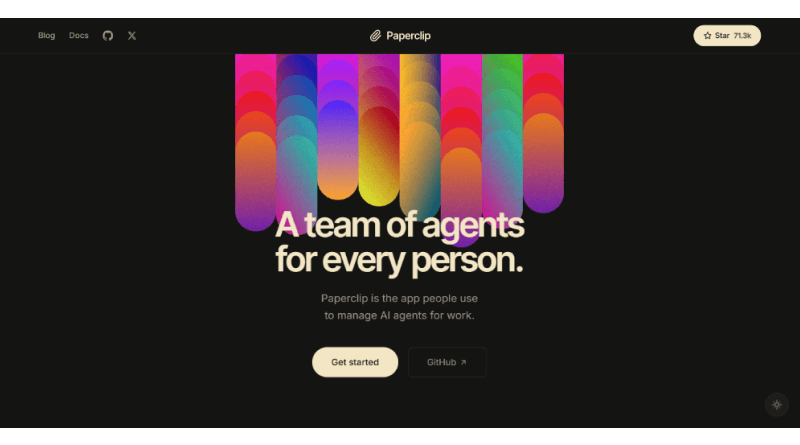
At its core, the platform acts as the operational backbone for a business entity that runs without constant human presence. Paperclip AI exists because multi-agent systems often fail—not because the agents are weak, but because they lack a management layer. It bundles a Node.js backend with a React dashboard to give you a single source of truth for all your agent activities. When you boot this system, you stop launching mere software and start formalizing a business entity—complete with defined goals, strategic initiatives, and a transparent chain of command.
This open-source platform grants you full control over your infrastructure. You avoid the restrictions of closed-source vendor solutions and keep your data within your environment, which is essential for any serious operation. When choosing your cloud hosting, you ensure that these persistent processes remain online and responsive around the clock. This architecture reflects a fundamental shift: you move away from manual micromanagement and toward high-level governance of your company’s strategy.
How does Paperclip AI work?
Paperclip AI runs on a recurring execution loop. Each agent holds a specific post—researcher, developer, or content strategist—and reports through a clear management path. When you initiate a business objective, the system dissects that goal into specific tasks. Agents carry out these tasks in parallel or sequence, depending on the dependencies you have set.
Agents here act like professional staff; they share context across the team. One agent’s findings naturally inform the next stage of execution without requiring you to act as a human middleman. This coordination is what differentiates a true autonomous company from a simple, one-off automation script. The agents do not simply “chat” with each other; they interact through a shared state that tracks the progress of the entire institutional mission.
What are the key features of Paperclip AI?
Paperclip AI structures operations and accountability just as a physical office does. It enforces technical constraints that transform scattered scripts into a professional, verifiable organization.
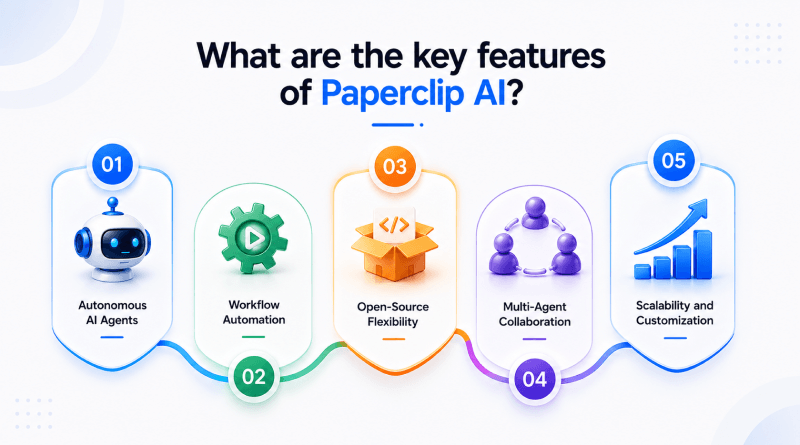
Autonomous AI Agents
Agents function as independent employees. You assign each one a title, a manager, and a scope of work. They operate based on your goals, not just your latest prompt.
Workflow Automation
Work flows through a formal ticket system. This creates an immutable audit log that explains every decision made during the business process, ensuring you can track progress or identify bottlenecks instantly.
Open-Source Flexibility
The entire platform is open-source. Running it on your own hardware keeps your data within your private network and allows you to adjust the code to match your requirements.
Multi-Agent Collaboration
Agents coordinate through the system rather than through unorganized scripts. When an agent creates a task, the system routes it to the correct team member. If an agent hits a blocker, it escalates the ticket up the org chart.
Scalability and Customization
You scale by adding new roles to your org chart. Because the system is adaptable, you can integrate different runtimes — such as Claude Code, OpenClaw Plugins, or custom HTTP-based agents — as your business needs evolve.
Related Read
What is Hermes Agent?
What are zero-human companies?
A zero-human company model automates business operations end-to-end using autonomous agents. When you open the dashboard, you see individual agents listed by function. You click into a profile to grant specific file access and set a budget limit for the task. Instead of managing personnel, you spend your time reviewing the logs of completed work and approving the next technical steps.
This model is becoming the standard for founders who need 24/7 productivity without the overhead of a large workforce. Whether you operate a WooCommerce store or manage server infrastructure, your daily task is to delegate the execution to agents so you remain free to drive the vision.
Related Read: Top WooCommerce Hosting Providers
What are the benefits of using Paperclip AI?
When you add agents to your workflow, you stop tracking every task manually; rather, you monitor the system’s output. Your volume of work increases without a corresponding increase in the hours you spend at the desk.
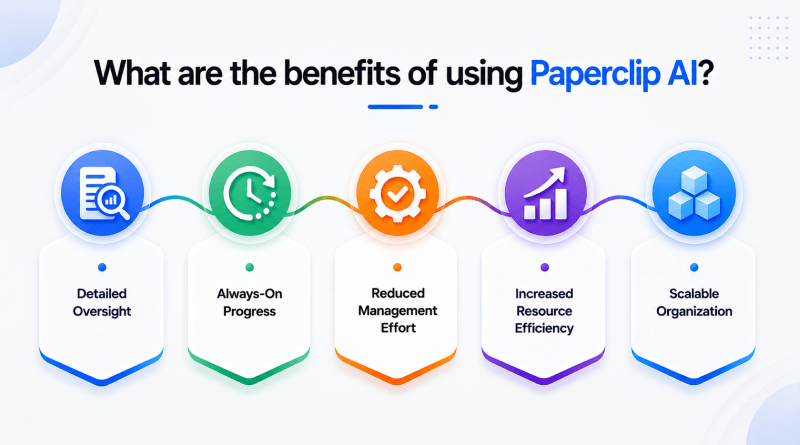
Detailed Oversight
You open the activity feed to track every internal movement. Because each entry pairs with a specific objective, you scan the logs to identify the exact point where a task went off track.
Always-On Progress
Projects don’t stop when you log off. You walk back to your desk to view the updates sitting in your inbox.
Reduced Management Effort
Once a workflow is deployed, fewer routine decisions revolve around task assignment and coordination.
Increased Resource Efficiency
Every dedicated support interaction is optimized because your agents handle the routine work.
Scalable Organization
You grow from a single agent to a complex team by simply adding new roles and reporting lines to your existing structure.
What are the use cases of Paperclip AI?
Paperclip AI is built to handle complex, multi-step workflows. Your operations flourish when workflows require separating complex goals, tracking individual progress, and authenticating every output within a distributed team.
SaaS Startups
Founders hand off recurring chores — repository health checks, updating documentation, and running deployments — to automated agents. Most prefer running these on a Plesk server to keep management in one place.
Customer Support Automation
Agents prioritize incoming tickets for immediate review. They group inquiries by technical depth and provide the initial response. This filters the queue so your team spends time only on complex challenges that require direct human intervention.
Content Operations
You assemble a team of specialized research and writing agents to create, polish, and push content across your platforms. It keeps your messaging on track without requiring you to handle the manual execution every single day.
Research and Data Analysis
Autonomous agents aggregate market intelligence, track competitor movements, and produce concise daily reports for your board-level review. For instance, if you use Immich to organize your visual data, you can have agents index and report on trends.
How to get started with Paperclip AI?
To begin, you will need to clone the platform repository and configure your Node.js environment. The platform offers a guided onboarding process to define your company’s initial goals and hire your first agents. You will need a professional account to register for the necessary API keys, but the core setup remains entirely self-hosted.
Community resources provide templates for common company structures, which you can import to save time on initial setup. It is smarter to start with one division to get a feel for the delegation flow before you try to scale up. Just ensure that your infrastructure—like a Node.js setup—can actually handle the concurrent API calls without failing.
What are the challenges and limitations of Paperclip AI?
Even the most sophisticated autonomous systems need clear boundaries. Vague instructions frequently cause automated systems to produce inaccurate results, which prevents tasks from meeting established standards. You need to act like a project lead; being explicit about your goals is the only way to obtain the results you want.
Security is a critical consideration. These agents touch your internal files, so keep your dashboard locked down and limit their access to exactly what they need. Given the rapid pace of technical evolution, you must proactively review platform documentation to ensure your agents operate with the most current capabilities.
Related Read
Paperclip Alternatives: Paperclip vs. CrewAI vs. AutoGen
Is Paperclip AI the right fit for your operations?
Running an orchestration layer stops you from acting as a manual prompt operator. Instead of typing instructions all day, you govern a system where agents hold strict roles, operate under hard budgets, and use a check-in loop to stay aligned with your core objective.
The industry push toward “zero-human” workflows proves that organizing AI is now more critical than the individual agents themselves. Paperclip gives you the exact command board needed to manage this digital staff, keeping every task auditable and strictly on track. Just configure an SSL install directly on your server to lock down the traffic, and you instantly have a secure, self-governing operation ready to work.
Is Paperclip AI the future of business automation?
Modern businesses often struggle with fragmented tools that require constant oversight to remain functional. While traditional platforms rely on rigid, rule-based sequences, newer orchestration models allow for autonomous reasoning and hierarchical control. The following comparison outlines how this shift changes operational strategy.
| Feature | Traditional Business Automation | Paperclip AI (Orchestration) |
|---|---|---|
| Core Logic | Rule-based If-this-then-that triggers with no adaptive reasoning. |
Goal-oriented Autonomous reasoning that adapts to changing goals. |
| Structure | Fragmented Disconnected scripts and terminal tabs with no unified layer. |
Hierarchical Organized into departments and roles like a real company. |
| Human Role | Hands-on Constant manual intervention required at every step. |
Strategic Governance and high-level strategy only — agents handle execution. |
| Budgeting | Reactive Reporting happens after the fact with no proactive control. |
Proactive Per-agent spending limits set before work begins. |
| Context | Narrow Limited to specific task scope with no memory carry-over. |
Persistent Context maintained via goal ancestry across the entire workflow. |
| Workflow | Linear Rigid, sequential steps that break on any deviation. |
Collaborative Multi-agent delegation and parallel task handling. |
| Accountability | Opaque Difficult to define or trace responsibility at scale. |
Transparent Append-only audit trails capture every action taken. |
Final Verdict: Is Paperclip Worth It?
If you aim to shift from manual labor toward strategic oversight, this platform provides the necessary framework. You stop focusing on individual tasks and start building the way your whole operation runs. By giving your agents specific responsibilities and clear financial limits, you develop a predictable structure that grows far better than basic automation ever could.
You determine the objectives and establish the operating constraints, freeing yourself from the cycle of daily execution. For anyone pursuing a fully autonomous business, Paperclip AI delivers the tools to develop and maintain an enterprise that operates around the clock.
MilesWeb complements the autonomous workflow by providing the high-uptime server infrastructure necessary to keep those automated processes running consistently. It stands as a significant step forward for any founder looking to integrate autonomous power into their professional workflow.
FAQs
1. Is Paperclip AI free?
The source code is available at no cost because it is an open-source project. However, the cost-free nature of the project applies only to the software license; you remain responsible for your API token usage and the operational expenses for the server infrastructure hosting your deployment.
2. What models does Paperclip support?
The platform functions as a framework that remains agnostic regarding the specific engine utilized within it. It uses an adapter design, so you can plug in Claude, OpenAI, or your local agents without complexity. You just pick the specific model that handles the job best for that agent’s role.
3. Do I need to know how to code using Paperclip?
You aren’t required to be a developer, but you should be comfortable navigating a terminal. The setup is just a list of commands you run in order, so if you can follow a technical manual without losing your place, you can get it live and run yourself.
4. Can Paperclip run 24/7 without my input?
The monitoring system serves as the primary mechanism for verifying the constant availability of your automated operations. Set the frequency for agents to scan the task list, and they complete the work while you focus on other priorities.